
The Inversion: African Americans and Education (Part One)
African Americans, particularly in North Carolina, sacrificed more to build schools than any other group. Despite this, many educators accept the myth that African American families are less interested in education than others. Historically, nothing could be further from the truth. I call this damaging stereotype “the inversion.”
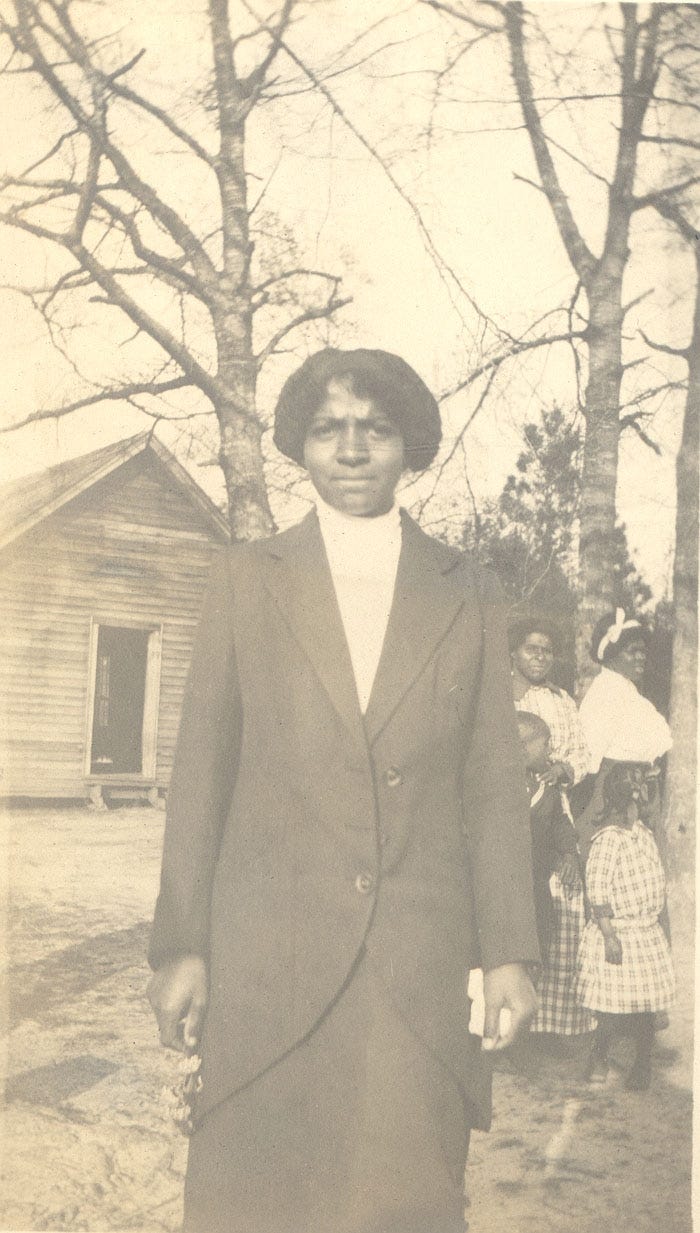
If you teach in Title One (high poverty) schools as I do, then it is likely that you have endured many workshops focused on student deficits. Title One schools are likely to have a higher proportion of students of color than their wealthier counterparts. At one point, I taught in a school where the student body was over 95% African American. Cue the professional development on the achievement gap, complex PBIS (Positive Behavioral Interventions and Supports) schemes, and using pictures of Beyonce’ to teach Shakespeare because “they” (meaning African American students) “like pretty pictures.”
No one suggested that our well-intentioned but largely European American staff might benefit from knowing the students better. The school where I attended those workshops, like others in North Carolina, had a large and growing divide between the racial makeup of the student body and the racial makeup of teachers and administrators.
In North Carolina the student body is approximately 25% African American, while teachers are over 80% European American. As someone who falls in the latter group, I wondered: Where is my workshop on the strengths of our students?
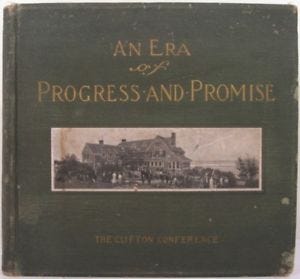
By the time that question crystallized in my mind, I had already been documenting historic African American schools for ten years. This gave me a wider perspective. I knew that from Reconstruction forward, North Carolina’s African American families had been striving for education and building schools. The 1910 book An Era of Progress and Promise by George W. Penniman highlighted dozens of schools in North Carolina built by African Americans. The book is online (see link and picture below).
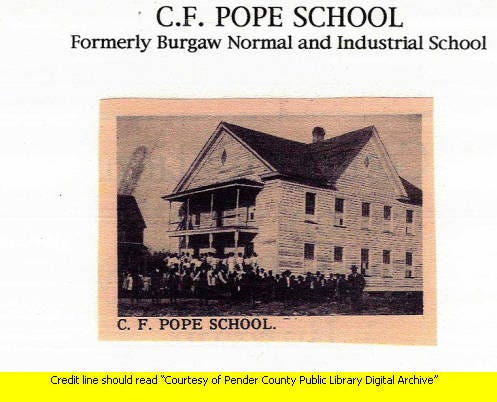
African Americans in North Carolina built and supported many types of schools. One example is the C.F. Pope school in Burgaw. The C.F. Pope School was founded in 1896 as Burgaw Institute, created for the education of Baptist Ministers. It was later renamed for long-time principal Cicero F. Pope. Upon its opening, the school was quickly inundated by students whose parents sent them to get a general education. (Stories about one of the school’s founders can be heard in my second feature film, Carrie Mae: An American Life -click title to view).
In my research, I learned that from the late 1910s to the early 1930s North Carolina’s African American families paid their taxes, then raised additional funds to build 813 Rosenwald school buildings. These were schools for which communities had to raise funds to match a contribution from the Rosenwald Fund. The Rosenwald Fund in turn used its donation to leverage commitments from southern school boards to complete and operate the schools. At the behest of Booker T. Washington, philanthropist Julius Rosenwald started the school building program in 1912. The National Trust for Historic Preservation (NTHP) notes that by 1928, one third of rural African American students attended Rosenwald schools.
Most residents of Wilmington, NC know there is a statue of Confederate Attorney General George Davis on Market Street, but few are aware of another man by the same name whose impact on North Carolina ripples into the present. Dr. George Edward Davis was born in Wilmington in 1862 to Hester and Edward Davis. He attended Wilmington’s Gregory Normal Institute, then Biddle and Howard Universities. In 1885 Davis became the first African American professor and dean at Biddle University in Charlotte (now Johnson C. Smith University).
After retiring from Biddle in 1920, Davis was appointed “Supervisor of Rosenwald Buildings” in 1921 by Nathan Carter Newbold, the first Director of North Carolina’s Division of Negro Education. This appointment made Davis the highest placed African American government official in North Carolina.
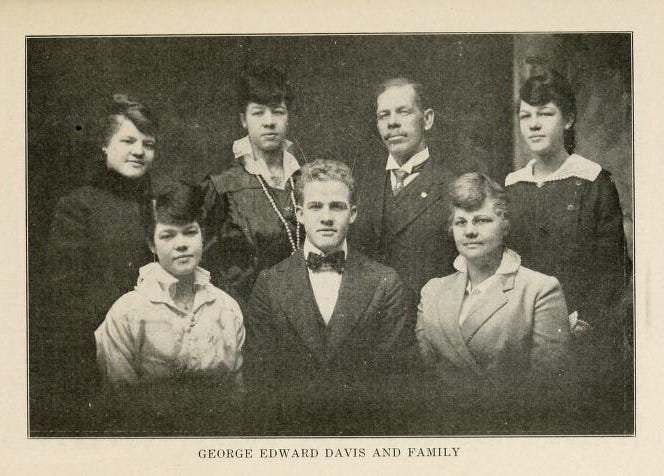
Davis took on the demanding role of promoting and overseeing Rosenwald school building in North Carolina. From 1921 to 1935 he traveled the state, rallying African American communities to raise money to apply for a Rosenwald school. According to the North Carolina Department of Natural and Cultural Resources, “Davis crisscrossed the state to raise funds in mostly impoverished communities. In 1932, he reported having raised more than $660,000 in matching funds since 1917.” This is the equivalent of $9.3 million today.
Between 1917 and 1932 over 5,300 Rosenwald schools, shops and teachers’ homes were constructed in fifteen southern states. Historian Dr. Thomas W. Hanchett notes that North Carolina “constructed 813 Rosenwald buildings, far more than any other state… 787 were schoolhouses, 18 were teachers’ residences, and 8 were industrial education shops.”
The fact that North Carolina topped the list was due in no small part to the dedication of George E. Davis. A 1928 handbill called him “one of the greatest speakers of our race.” My first film, Under the Kudzu, traces the history of two Rosenwald schools in southeastern North Carolina. It screened at Tuskegee University in 2012 during the first NTHP Rosenwald Schools conference, and has since been shown at many conferences, schools, and libraries. While Under the Kudzu traces the specific history of two Rosenwald schools in Pender County, NC, the experiences related by alumni in the film are echoed by Rosenwald school alumni at every location where it has screened. (Link to Under the Kudzu on Amazon Prime Video)
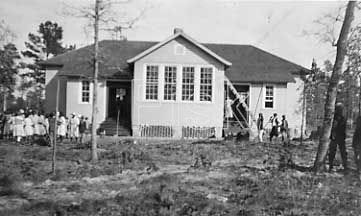
What does this have to do with teaching today? To my mind, everything. In the interest of understanding our students’ backgrounds, I think it’s important to know that just a few generations ago the families of our African American students sacrificed to build and maintain schools. Particularly in North Carolina, this culture of striving for education runs very deep.
Parts of this post were adapted from “The Other George Davis” by Claudia Stack and Richard T. Newkirk, first published by Port City Daily on 2/27/19


