The Intriguing Aspects of Japanese Onomatopoeia
They are not just about sounds and voices
Japanese onomatopoeia words often catch Japanese language learners’ attention.
The sheer number of onomatopoeia words in Japanese, along with the variety of unique situations in which they are used, is an interesting feature of the language with their massive number and uniqueness.
The Japanese language, along with the Korean language, is said to have far more onomatopoeia words than other languages. There are as many as 4,500 onomatopoeia listed in a Japanese dictionary.
Speakers of other languages may wonder “OK, but is that number really so huge?”
I know what you mean. Other languages also have a lot of words that express sounds such as “meow” and “smack!” But what you need to take into account when talking about Japanese onomatopoeia is the difference in its definition.
The Merriam-Webster dictionary defines onomatopoeia as: “The naming of a thing or action by a vocal imitation of the sound associated with it (such as buzz, hiss).”
On the other hand, Japanese dictionaries give a broader definition of onomatopoeia (in Japanese, オノマトペ) , which includes 擬声語 (giseigo), 擬音語 (giongo), and 擬態語 (gitaigo).
Here are the descriptions of the above three words:
- 擬声語 (giseigo): Words which express animal and human voices.
- 擬音語 (giongo): Words which express sounds (not voices).
- 擬態語 (gitaigo): Words which express the state or condition of things in a sensory phonetic way.
#1 and #2 would be considered onomatopoeia by native English speakers. However, importantly, Japanese onomatopoeia also includes #3, which makes the number much more extensive than English onomatopoeia. In English, the words in #3 are more like “mimetic words”, rather than onomatopoeia.
For instance, we have a sound to show silence, “シーン” (shiin). You may argue that it is a contradiction that silence has a sound. However, when we are mindfully walking in a quiet forest all by ourselves, or when we ask a question to an audience and receive no answer, we can picture the word “シーン” (shiin) in our mind. The word is not an exact sound, but it is the state or condition of things, so it is classified as #3 擬態語 (gitaigo).
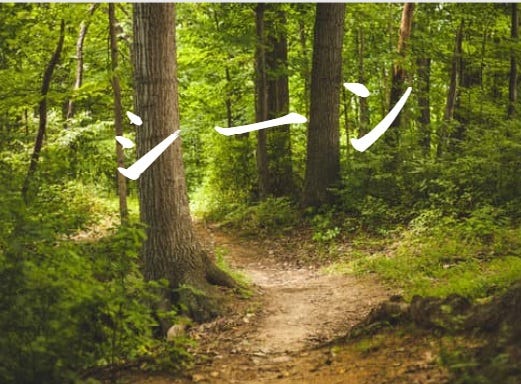
The word’s origin is fairly mysterious, but it is said Soseki Natsume, a Japanese novelist famous for “Kokoro”, “Botchan”, and “ I Am a Cat”, first used the word “しんとした” (shin-to-shita) around 100 years ago as a description of silence. It seemed he created the word from a kanji (Chinese character) word “森閑” (shin-kan) which had the same meaning. Later Osamu Tezuka, the Japanese legendary manga artist famous for creating Astro Boy, is said to have used the expression “シーン” (shiin) in his manga works, leading to widespread use of the word.
擬態語 (gitaigo) is also convenient when you go to see a doctor and describe your pain. Of course, pain has no sound, but using sound-like expressions helps to convey our sense of pain accurately.
Here are some examples of onomatopoeia words which describe pain:
ずきずき (zuki-zuki): throbbing pain (for headaches)
がんがん (gan-gan): pounding pain (for headaches)
きりきり (kiri-kiri): sharp pain (for stomachaches)
しくしく (shiku-shiku): continuous dull pain (for stomachaches)
ひりひり (hiri-hiri): stinging pain (for burns)
がんがん (gan-gan) is also used for a very loud sound of hitting iron plates. Can you imagine the pain as if someone is hammering an iron plate in your head? Then the doctor will have the same image.
On one hand, onomatopoeia words can be seen as childish, clumsy expressions. But on the other hand, these sound words help to articulate our feelings and situations more freely. For this reason, you can see a variety of onomatopoeia in manga works or on social media.
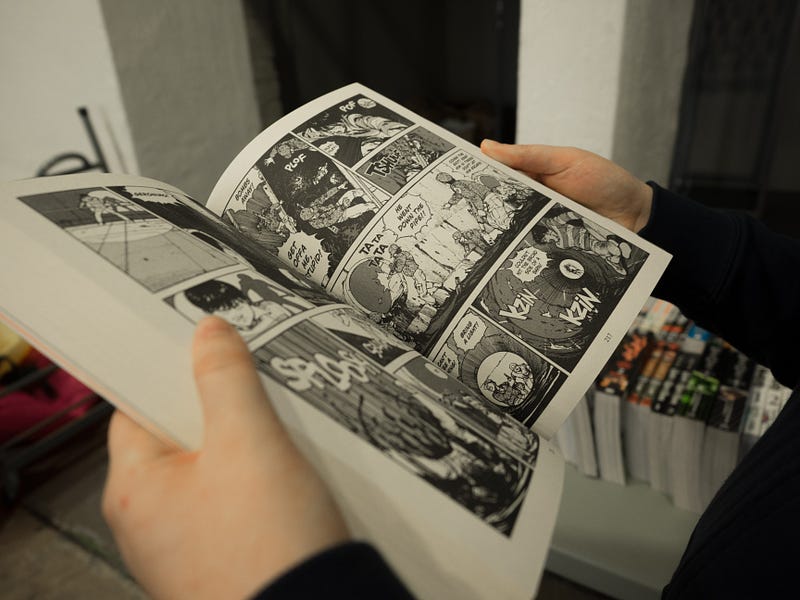
I always recommend to my Japanese language students that they read manga so that they can learn more Japanese onomatopoeia words and become more fluent in Japanese.
Japanese comic books serve as a storehouse of Japanese onomatopoeia, and you can easily understand the meaning because they present the words and their visual images at the same time. You may think of English comic books with sound words such as “BOOOM!” and “BANG!”, but Japanese manga works take onomatopoeia to another level. That’s because they have also a number of 擬態語 (gitaigo): words for characters’ actions or feelings without sounds.
Here are some examples of onomatopoeia words used in manga to enhance the feelings or activities of characters:
ジー (zii): staring
チラッ (chira): glancing
ポッ (po): (face) blushing
ニコッ (niko): smiling in a friendly way
ニヤッ (niya): smirking
クルッ (kuru): turning around quickly
ドキッ (doki): heart jumping
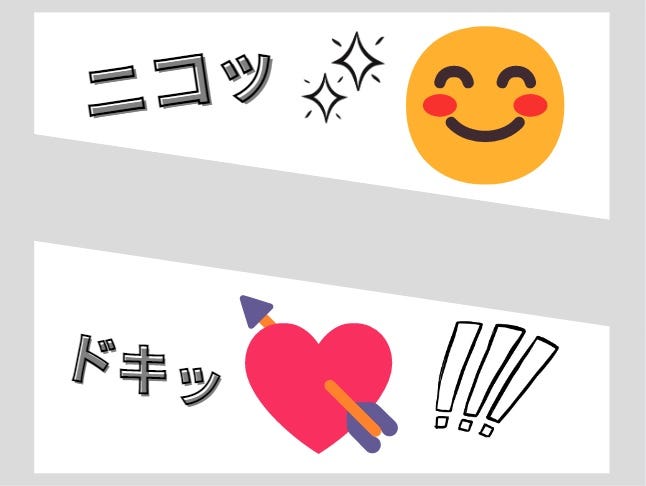
My students sometimes don’t notice there are onomatopoeia words in manga pages because most of the time these words are drawn by hand just like other pictures and are therefore not distinctive from their backgrounds. Try to take a careful look at the pictures. Can you see hiragana or katakana characters in the background? Yes, that’s the onomatopoeia.
One theory that explains the reason why the Japanese language has so many onomatopoeia words is, as I mentioned earlier, that it includes 擬態語 (gitaigo). Next, I will introduce some other theories.
First, the fact that the Japanese language has fewer verbs is also an explanation. When I started to read English novels as part of my English learning, I was overwhelmed by how many verbs English has. For instance, I found that characters in novels “walk” in a variety of ways, and each way of walking has an appropriate verb to describe the manner of that way.
However, the Japanese term 歩く (aruku), meaning to walk, is used regardless of the manner of walking. Onomatopoeia, specifically 擬態語 (gitaigo), can help to enhance the meanings.
Here are some English words meaning to walk and their Japanese counterparts, 歩く (aruku) with onomatopoeia:
stroll: ぶらぶら歩く (bura-bura-aruku)
stumble: よろよろ歩く (yoro-yoro-aruku)
traipse: とぼとぼ歩く (tobo-tobo-aruku)
stagger: よたよた歩く (yota-yota-aruku)
waddle/toddle: よちよち歩く (yochi-yochi-aruku)
tramp: どたどた歩く (dota-dota-aruku)
tiptoe: そろそろ歩く (soro-soro-aruku)
march (walk briskly): すたすた歩く (suta-suta-aruku)
Onomatopoeia in Japanese can give a clear image of how people walk. They are just some examples, and the same is true with other verbs such as to drink, laugh and see. Again, in manga works, these onomatopoeia words can work together with the pictures to give readers vivid images of stationary characters.
The second theory is something more lovely, and it’s related to the national character of Japanese people. Traditionally, Japanese people are said to have the sensibility of valuing nature and adoring the sound nature makes.
Transforming sounds into words seems to be our forte in a sense. In fact, we can see onomatopoeia used in “Kojiki”, which is considered to be the oldest extant record of Japanese history and “Man Yoshu”, the oldest extant collection of classical Japanese poems.
The history goes back to the early 8th century. It’s fascinating that we can hear the sound of Japan being created in the myths or grasses swaying in the wind in the old poems.
Looking around, we can see our lives here in Japan are surrounded by a lot of onomatopoeia words. If you have a chance to come to Japan, please let me know about the fun discoveries you make!