
The Interplay of Reality and Fiction: Pieter Aertsen’s Meta-Painting Revolution
Pieter Aertsen — a 16th century Belgium painter — was the 1st known painter to exemplify meta-painting, a pictorial device where painter’s blur the boundaries of reality and comment on the very act of painting.
First I want to compare what a successful conventional painting does vs. a successful meta-painting.
A Successful conventional painting
The artist paints a still life so convincingly we are beguiled into feeling what is painted is REAL. The success is that the painter can render a still life in such detail we lose track that it is painted on a 2-D surface.
Meta-Painting
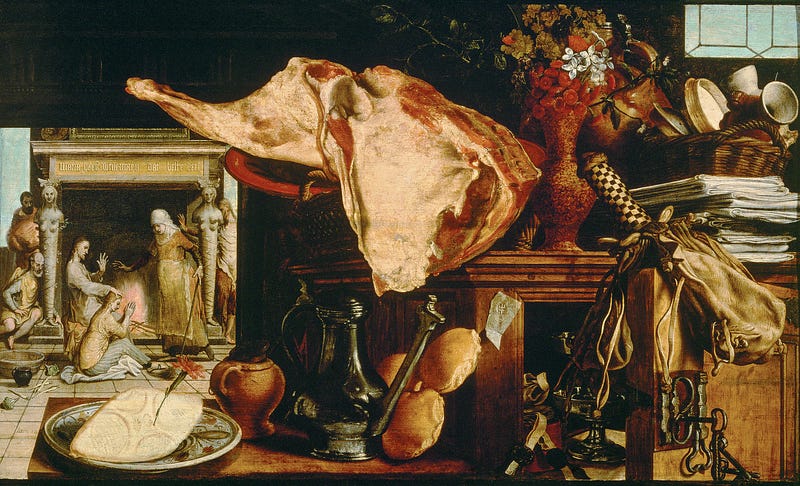
A painter plays with the nature of painting. Conventional painting rules may be used in the painting [like we see in Aertsen’s painting above] but they become self-referential.* Levels of reality are blurred as the painter plays with the act of painting itself.
In the case of Aertsen, he composed his painting “Christ in the House of Mary and Martha” in a totally original way.
At the time he painted this painting — 1552 — he was considered a heretic and this painting is the only one that remains of his paintings. All others were destroyed by Protestant iconoclasts.
Viewing this work today we see its complexity and modernization. The surface of Aertsen’s painting is almost completely inhabited by a gigantic still life composed of a rack of lamb, a vase of flowers, bread, kitchen utensils, and other household stuff.
In the upper right corner — a window goes out of the picture frame.
On the left-hand side — a doorway opens onto a biblical scene with Christ sitting blessing Martha and Mary standing.
Unique to this painting is the perspective. The still life table is in perfect perspective and draws the viewer into the scene. The window and blibical scene going out of the picture frame is modern and it blurs the reality of the painting and where it hangs.
Additionally, the biblical story is inserted into a beautifully rendered still life.
The interaction between the two different realities (the still life and the biblical scene) is complex. The biblical inscription from Luke:10 over the mantle reminds the viewer that they are looking at a biblical lesson rather than a real object. Reality and fantasy are fused together.
The trompe l’oeil effect of the still life adds to this blurring of realities.
I hope you enjoyed reading about this masterful painter and his accomplishments.
*My dissertation was a study of studies — a meta-analysis. I analyzed 130 studies on deinstitutionalization for the chronically mentally ill to see if community-based programs in the United States were better than hospitalization for those suffering from long-term mental illness. It was a way to get an overview of a serious public health problem and revealed astonishing results as to how community mental health programs should be structured.