
Series | Critical Thinking in the Age of Digital Incredulity, Pt. 4
The Internet of Things, Big Data, and the Inversion
Or, Netizenship and Democracy as a Way of Life

The internet is fake…
…or, at least, it’s full of FAKERY.
Of course, for anyone who’s ever been “cat-fished,” duped by a “sock-puppet,” or taken in by the pretenses of an “astroturf” campaign, this isn’t exactly news.
If you’ve ever wondered about how to handle such shenanigans, then this is the series for you…
The evolution of the internet from Web 1.0 — “Hey, have you heard about this email thing?” … to Web 3.0 — “Hey, my toaster just messaged my watch that breakfast is ready.” is really a story of how a network of static information portals became an interactive, semantic network of user generated data — and, ipso facto, a hot mess of dissimulation and machination.
Under the “big data” in our “Internet of Things” — as Web 3.0 is sometimes called — it’s increasingly difficult to discern what’s real from what’s a simulation. One reason for this is the sheer volume of machine-generated data.
As the image below indicates, since 2014 less than half of the annual traffic on the internet has been created by humans!
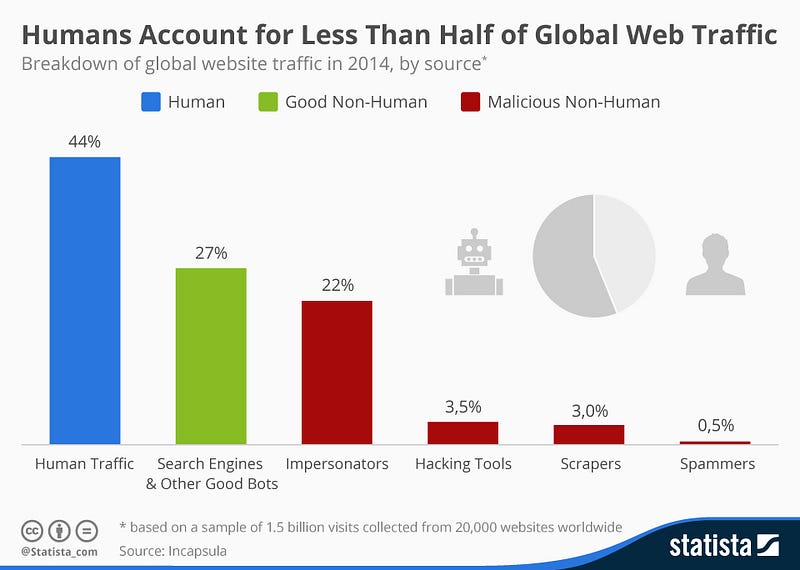
Since there’s just too much data for human moderators to police, most sites employ algorithms to spot (and block) bot-generated traffic… but therein lies the rub.
When there’s more bot traffic than human traffic, there’s a risk such algorithms, which rely on machine-learning, will begin to flag human-generated traffic as anomalous.
Max Read, writing for New York Magazine’s Intelligencer, has dubbed this moment (when every REAL person on the Internet is automatically deemed to be fake) “the Inversion.” He explains where he got the name:
For a period of time in 2013… a full half of YouTube traffic was ‘bots masquerading as people,’ a portion so high that employees feared an inflection point after which YouTube’s systems for detecting fraudulent traffic would begin to regard bot traffic as real and human traffic as fake… They called this hypothetical event ‘the Inversion.’
But, as Read suggests, this isn’t just a matter of algorithmic overreach.
Rather, we run the risk of flesh-and-blood, human internet users dismissing one another as mere bots, too.
In some ways, this sort of “Inversion” has already happened…
One benign example — cited by Read in an interview — occurred in late 2018 when many online users called for a boycott against Netflix… for allegedly astro-turfing a meme campaign about the film Bird Box.
However, it turned out the memes had been created by actual fans of the film… as implausible as that may sound!
Of course, there are much less innocuous examples in the political sphere, which underscores the importance of addressing these issues, and our current crisis regarding COVID-19 has demonstrated how our virtual world can be used either toward very real benefit or incredible detriment.
So, where does this leave us? We obviously can’t scrap the whole thing — especially in the middle of a pandemic, when so many have moved their daily lives online.
Read has aptly summed up our predicament:
“The ‘fakeness’ of the post-Inversion internet is less a calculable falsehood and more a particular quality of experience — the uncanny sense that what you encounter online is not ‘real’ but is also undeniably not ‘fake,’ and indeed may be both at once, or in succession, as you turn it over in your head.”
But, in the face of such duality, perhaps “turning it over in our heads” is precisely what’s needed. A good Netizen (citizen of the Net) needs to practice mindfulness and grace… all while maintaining a healthy dose skepticism.
That’s a bit of a philosophical tightrope… but it CAN be done! In what follows I’ll discuss how.
But first, let’s consider WHY we need to practice mindfulness about what we’re encountering online.
Fake People…Keeping it Real?
One example of that uncanny, real/fake duality Max Read has identified might be found on the Instagram profile of Miquela Sousa, AKA Lil’ Miquela, a 19-year-old model and influencer…
…who also claims to be an artificially intelligent “bot.”
First appearing on Instagram in 2016, Miquela’s account featured photo shoots with celebrities, SoundCloud tracks, and progressive political activism.
Though speculation about her “realness” existed from the outset, she nevertheless gained a following in the millions, eventually being “outed” as a bot in 2018 during a feud with another Instagram influencer — who also claimed to be an AI bot.
This only caused Miquela’s star to rise higher… as she insisted she had no idea she wasn’t a real person.
Followers were riveted by her story and lined up behind their keyboards to voice their support, especially as her posts began to express a longing for liberation from her creators at Brud — a company purported to specialize in AI research.
Since then, Miquela has embraced her AI identity and seemingly reconciled with Brud. She’s also featured in video ads for Calvin Klein with “REAL” influencers like Bella Hadid, attended Coachella as a host for YouTube Music, and joined Samsung’s Galaxy Team to pitch their line of smart phones.
Of course, even the claims regarding Miquela’s sentience as an AI bot aren’t actually real. It’s all part of a new genre of fictional story-telling that uses social media platforms to build narratives in real time.
Miquela’s handlers at Brud have built a fairly elaborate backstory and fictional universe around her:
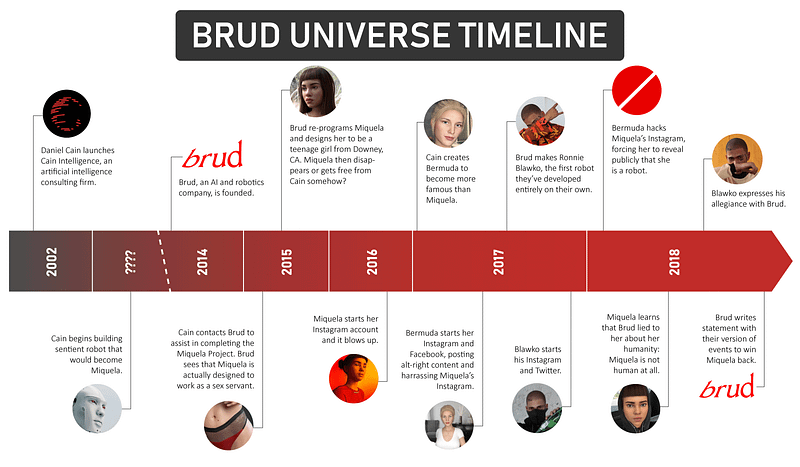
But, then again, Miquela’s donated and/or raised hundreds of thousands of dollars toward LGBTQ+ rights and Black Lives Matter awareness. And, as one of her millions of Instagram followers put it shortly after her AI identity was exposed:
“I know this is crazy but I believe you. Even though you are a robot physically, everything else [about you] is human.”
Emilia Petrarca of New York Magazine’s The Cut was one of the first to write about the Lil’ Miquela phenomenon. In her words:
Lil Miquela… holds up a mirror to the ways in which technology has morphed our own constructions of self. We don’t yet live in a world where realistic-looking fake humans roam the streets, but in the meantime, technology has transformed us into fake-looking real humans…
…We spend so much time pretending that hip parties and cool people are an organic part of our lives — that we aren’t curating the narratives we put out in the world. What a perverse relief it would be to confess that everything is fake!
Truly, this is an even more dizzying sort of Inversion, where people we know to be fake make the rest of us FEEL like total phonies — after all, how much have WE done for the causes we claim to care about?!
Framing the Inversion Problem, Philosophically
Although it’s been several years since Max Read first noticed the Inversion and since Lil’ Miquela first appeared on Instagram, philosophers have been slow to respond.
That may have something to do with the way philosophers tend to view such phenomena — i.e. through the fairly narrow lens of analytic philosophy of mind.
Put simply, when philosophers of mind encounter claims about AI, they tend to focus on whether or not the machine in question can thoroughly convince others that it’s thinking… as the the famous “Turing Test” first explored in the 1950s.
But, considering that Lil’ Miquela is REALLY the product of a team of human creators… pretending to be an AI bot… pretending to be a real human, academic questions regarding “strong AI” are at best moot, and at worst completely antiquated.
To be fair, philosophy of mind HAS expanded its scope in recent years, but a large part of its history still involves what some have called the “spectator theory of knowledge” — an idea with a history stretching well beyond Alan Turing, or even John Locke, all the way to Aristotle.
One could probably write an entire series on the history of this idea. But suffice it to say the thinkers who held such assumptions tended to treat experience as a barrier to the world, a passive “taking in” that was built on notions stemming from the Latin root capere still present in words like reception, perception, and conception.
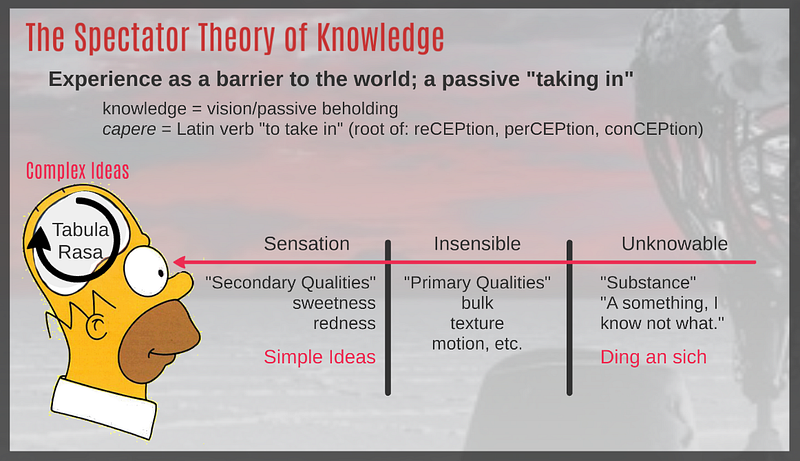
But, if we really want to think clearly about the challenges raised by the Inversion, we’d do well to set aside debates about Turing machines, Chinese Rooms, or “Harry” Lycan-thropes and turn instead toward theorists who accentuated the non-linear, entangled aspects of human understanding — like those championed by post-structuralism, phenomenology, and pragmatism.
The kind of uneasiness brought about by the Inversion is nothing new to those kinds of philosophers.
Even as the internet was still in its ARPANET infancy, Jacques Lacan was delving into the differences between “the Real” and the imaginary, Michel Foucault was reminding us about “The Treachery of Images,” and Jean Baudrillard was laying out the stages of reality-destabilization that occur under a simulation — an analysis that DIRECTLY pertinent to phenomena like Read’s Inversion and Lil’ Miquela.
In Simulacra and Simulation (1981) Baudrillard explained how reality can be destabilized and replaced by a simulation…
FIRST, a simulation is seen as a faithful representation of reality — like a map or a portrait.

NEXT comes the perversion of that original reality as the symbol takes on a life of its own, through mass production.
Caricatures are a one example of this — since they still “suggest” the original, but mostly consist in a mashup of social stereotypes and visual tropes… as this caricature of Barack Obama demonstrates.
The THIRD stage comes when we begin to “lose sight” of the original, as the simulation/caricature takes precedence over reality. (Growing up near one of the Disney theme parks gave me lots of experience with this stage.) Wherever a real original takes a backseat to a simulation — and begins to follow after it — this third stage has been reached.
But, the COMPLETION of this process occurs once the simulation claims for itself its own reality.
Even the faint echoes of the original have vanished, because the simulation has successfully supplanted it and has become a hyperreal simulacrum.
This is perhaps the BROADEST sort of Inversion, one that can’t even be expressed in quips like “up is down” because such categories have been obliterated.
Netizenship and Democracy as a Way of Life
Although approaches like Baudrillard’s may be helpful for diagnosis, he fell a bit short when it comes to remedies… especially with regard to the consumption of mass media in our age of “fake news” and extreme political division. In his words,
“…the masses are also made of this useless hyperinformation which claims to enlighten them, when all it does is clutter up the space of the representable and annul itself in a silent equivalence. And we cannot do much against this obscene circularity of the masses and of information. The two phenomena fit one another: the masses have no opinion and information does not inform them.” — “The Masses: The Implosion of the Social in the Media,” p. 210
Fortunately, there are other philosophers toward which the responsible Netizen can turn — like the 20th century American thinker John Dewey.
Unlike Baudrillard, Dewey saw the sorts of ambiguities one finds online as a kind of opportunity…
“Thinking begins in what may fairly enough be called a forked-road situation, a situation which is ambiguous, which presents a dilemma, which proposes alternatives.” — John Dewey, How We Think, p. 11
Rather than running from the uncertainty and/or different worldviews we encounter online, Dewey would’ve encouraged us embrace it all. By his lights, the two essentials of thinking were healthy skepticism and a willingness to inquire into what we don’t know. He knew inquiry wasn’t often easy, but he believed it was ALWAYS worthwhile.
“The easiest way [to cope with uncertainty] is to accept any suggestion that seems plausible and thereby bring to an end the condition of mental uneasiness. Reflective thinking is always more or less troublesome because it involves overcoming the inertia that inclines one to accept suggestions at their face value; it involves willingness to endure a condition of mental unrest and disturbance. Reflective thinking, in short, means judgment suspended during further inquiry; and suspense is likely to be somewhat painful.” — How We Think, p. 13
That’s why he advocated an education that promoted individual critical thinking. He understood well the kind of uncritical, mob mentality that human beings fall into whenever they flee from discomfort and uncertainty.
“We talk about thinking for one’s self. After all, the words ‘for one’s self’ are superfluous or redundant. It is not thought unless it is for one’s self.” — “Individuality in Education,” 1922
Dewey understood that successful democracies require citizens to have rich repertoires of cultural experience, critical apparatuses finely tuned to subtle political nuances, and the intellectual maturity to not be threatened by alternative points of view — while at the same time requiring a process sufficiently streamlined to address public needs with timeliness.
And that’s why he extolled the virtues of democracy — NOT merely as a political system — but as A WAY OF LIFE.
“…the task of democracy is forever that of creation of a freer and more humane experience in which all share and to which all contribute…
…to treat those who disagree — even profoundly — with us, as those from whom we may learn, and in so far, as friends… To cooperate by giving differences a chance to show themselves because of the belief that the expression of difference is not only a right of the other persons but is a means of enriching one’s own life-experience, is inherent in the democratic personal way of life… It is to realize that democracy is a reality only as it is indeed a commonplace of living.”— “Creative Democracy: The Task Before Us,” 1939
Although we often hear appeals to celebrate what we share in common, Dewey also understood that difference is what drives a democracy forward, by forcing us to reconstruct those beliefs to which each of us stubbornly clings into something we can more productively embrace together.
That may be easier said than done… but its the kind of task we MUST take up if we’re going to keep our world from being “Inverted.”
The remainder of this series will be aimed at sharing some tips and skills in promoting a Deweyan kind of digital life.
Next up we’ll look at some features of human understanding that can safeguard society from the spread of misinformation.
Hope to see you there!


