
The Insidious High Tech Robocall Threat Targeting Your Life
In the mind of a fraudster, you’re an easy target.

With technology comes innovation and lack of privacy. There once was a day when the phone rang and the worst thing that could happen is someone said, “I’m sorry. I dialed the wrong number.” They went on their way and you hung up.
Now, right number, wrong number, it doesn’t matter. You are a “Live” number and therefore, a target. Unscrupulous robocallers operate auto-dialers seeking to validate your number, sell you something, or steal from you.
Government Action Against Robocalls
Congress enacted Public Law 116–105 known as the TRACED Act. The “Telephone Robocall Abuse Criminal Enforcement and Deterrence” Act directs the Attorney General and the Chairman of the Federal Communications Commission (FCC) to create an ongoing working group to address the issues of robocallers.
The interagency working group convenes throughout the year to coordinate the identification, investigation, deterrence, and prosecution of illegal robocall activities. Historically, many of the schemes targeted the elderly and vulnerable individuals with fraudulent sales campaigns.
Millions of these calls originate from foreign countries, then when routed through U.S. networks, threaten innocent victims with false prosecutions by the IRS, or cancellation of their much-needed social security benefits… unless they pay a fine or buy gift cards.
On the surface, these attempts are clearly obvious. Yet, for elderly persons dealing with financial or health issues of themselves, or others, any element of fear can increase their vulnerability.
The Department of Justice (DOJ) began taking action against telecom carriers acting as a “gateway provider” allowing foreign robocalls through U.S. networks. To show the enormity of the problem, the DOJ photo below shows the number of robocalls during a 6-day period by just one of those gateway providers.
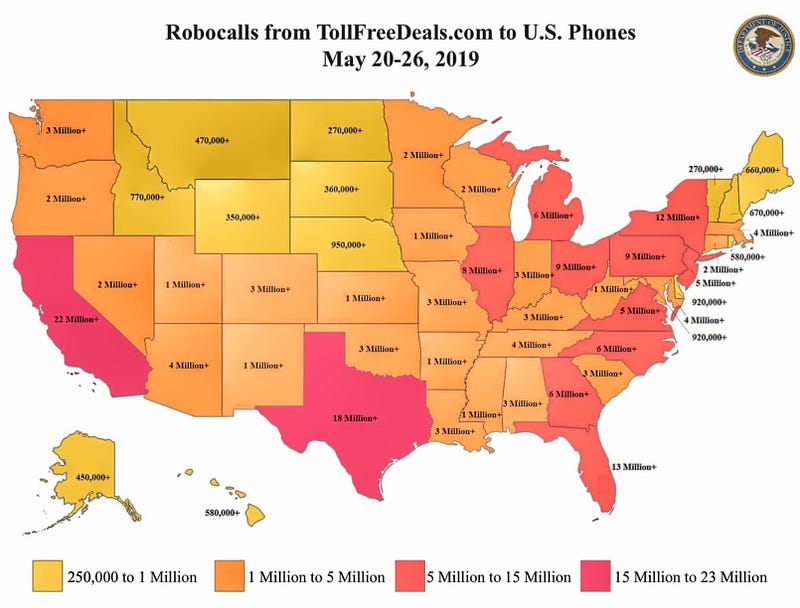
“These fraudulent robocalls included millions of calls impersonating the Social Security Administration, threatening the recipients of the calls with arrest or asset seizure if they did not immediately transfer funds to the caller.” ~ Dept. of Justice Press Release
The government warned gateway providers of over 100 instances of fraudulent calls being transmitted through their telecommunications network. Yet, even with the warnings, operators maintained business affiliations with those conducting fraudulent calls.
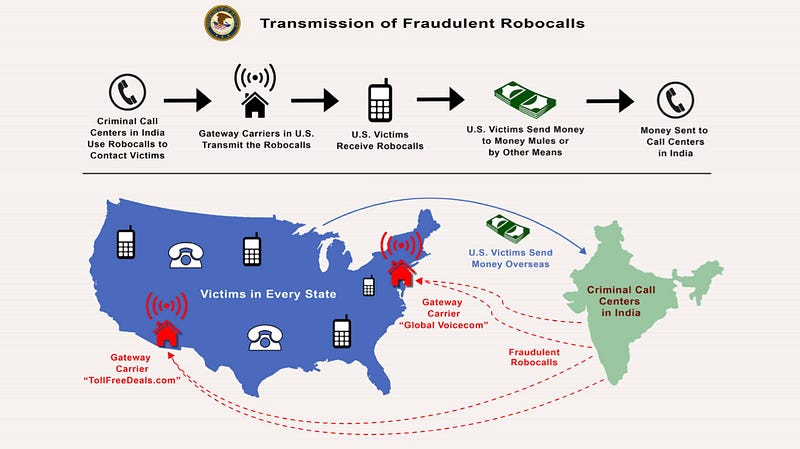
The graphic below shows a good depiction of the event chain of a robocall fraud scheme. Through robocalls, manipulated victims send money, purchase gift cards or bitcoins, or other tangible financial payment that ends up at foreign call centers.
How to Protect Yourself
Aside from moving into a cave or a small cabin in the woods with no connectivity, there’s little chance that fraudsters won’t target you. Be sure to register your phones with the National Do Not Call Registry, or call the toll-free number: 1–888–382–1222 with the phone you want registered. After 31 days, it should register your number.
Will Registering Prevent All Unwanted Calls?
I wish I could say “Yes”. Unfortunately, some calls can still come in. For more details, here’s an article from the FTC describing limitations.
Still, it’s important to register your phones. When you register your numbers, telemarketers should not call you. If they do, that’s a violation with a fine of up to $42,530.00 per call.
While on the surface it appears the government has a viable enforcement tool through civil penalties, many judgements have statements that include verbiage like the following:
“They, collectively, are subject to a monetary judgment of $7.5 million, which is largely suspended due to an inability to pay.” ~ FTC Press Release
Reporting Robocallers
After 31-days from registering your phone number(s), if you continue to receive robocalls, there are two online reporting mechanisms available at:
Federal Communications Commission or Federal Trade Commission
If you receive calls on a cellphone, it often includes the call data in your call log. If you have a voip phone, your service provider often has a record of the number and time in your online account. This information is helpful when reporting the calls.
I recently reported a bogus Medicare call and included the audio file of a voicemail provided by my voip service provider. I wish the reporting form was easier to fill out, but I have gotten responses to my reports.
If no one reports these calls, then they continue and you or someone you care for might get ripped off.
Consumer Tips From the FCC
(Source: This section comes directly from the FCC site, with the exception of my notes below.)
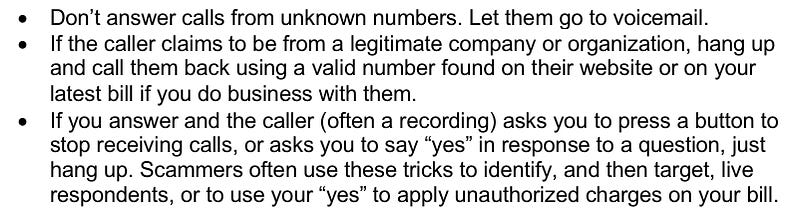
Note: I frequently get these calls. They are high-quality recorded messages that sound like a live call. The message is, “Hi, My name is Emily. This is a recorded line. Can you hear me okay?” I’ve received a few variations of this call. If you get calls like this, just hang up. They are recording the call to get the sound of your voice saying “Yes”.
If a robocaller can get you to push a button in response to their message, they are a validating you as a live target. Don’t do it — Just hang up or you’ll get a LOT more calls from this robocaller.
Another one I receive often is from purported police charities. Know that they already have your name. I just got one a couple weeks ago. The call had a spoofed local number and the voice on the other end said, “Anthony???” (Or in your case, your first name)
This is a mental challenge because it’s easy to say, “Yes”. Unless you know without a doubt who’s on the other end of the line, expect a fraudulent call.

Note: As noted in my example above, robocallers are spoofing local numbers. Fraudsters are using this approach because a non toll-free number seems less suspicious. Given the large number of spoofed calls, expect a fraudulent call. My home number is a local area code and my cellphone is an out-of-state code. I’m getting regular spoofed robocalls on both lines. Additional Call Blocking Tools and Resources are available at: https://www.fcc.gov/call-blocking
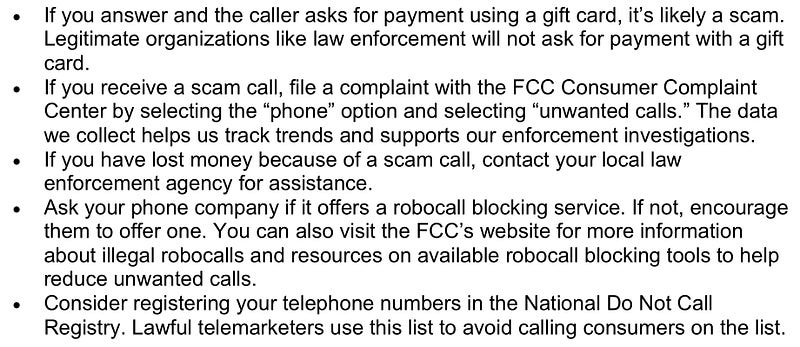
With technology, we live in a virtual fish bowl. Swindlers are looking through the glass, searching for ways to steal your money, identity, or ruin your life. You have the power to stop them.
If you can stop only one robocall operator, you are stopping millions of calls.
⭐️ About Anthony M. Davis
Anthony M. Davis is a Leadership, Success & Stress Coach, Board Certified Therapist, and Top-100 International Travel Photographer. His free book, “Keys to Your Success” is available. Get your copy now.