
The Inheritance of Words: Writings from Arunachal Pradesh
Of literatures, old and new, from Northeast India
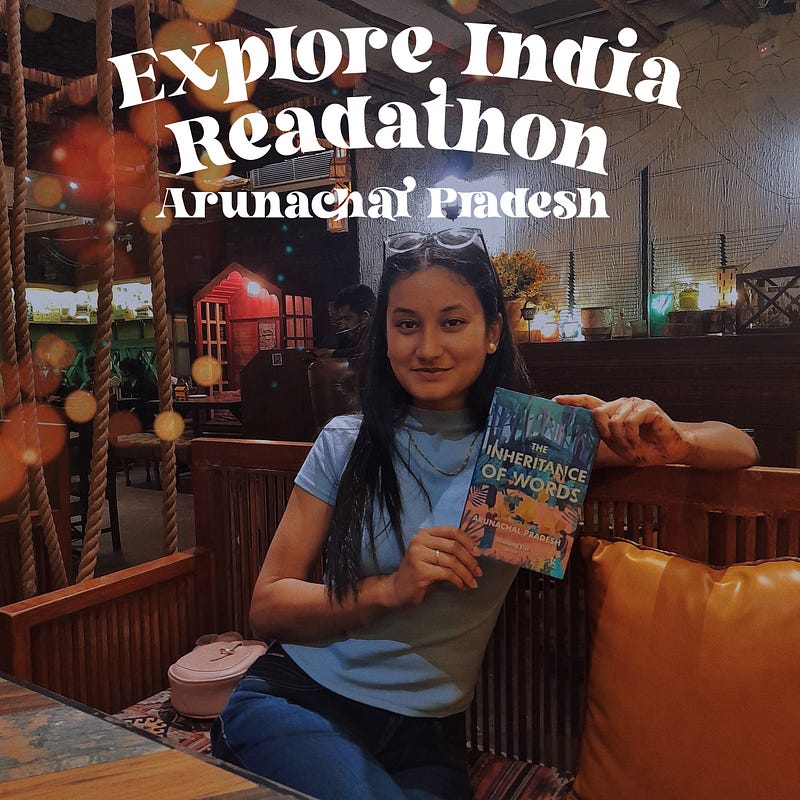
I think one of the best ideas I have ever had, was to come up with the Explore India Readathon, a reading challenge where I (and whoever joined me), would read a piece of literature from each of the 28 states and 8 Union Territories of India.
In September, I started this initiative with my book club, and I decided to start with Assam. You can check out the post I wrote, for Chinatown Days, by Rita Chowdhury, here:
In November, going alphabetically, I decided to read a book from Arunachal Pradesh. There are quite a few amazing works, but for my first time delving into the literature of this state, I thought an anthology that has writings from various Arunachali authors, would be a better option for me. And the book I chose was The Inheritance of Words, a collection of writings from the state, edited by Mamang Dai. Here is a short synopsis from Goodreads:
A first of its kind, this book brings together the writings of women from Arunachal Pradesh in Northeast India. Home to many different tribes and scores of languages and dialects, once known as a ‘frontier’ state, Arunachal Pradesh began to see major change after it opened up to tourism and once the Indian State introduced Hindi as its official language. In this volume, Mamang Dai, one of Arunachal’s best known writers, brings together new and established voices on subjects as varied as identity, home, belonging, language, Shamanism, folk culture, orality and more. Much of what has been handed down orally, through festivals, epic narratives, the performance of rituals by Shamans and rhapsodists, revered as guardians of collective and tribal memory, is captured here in the words of young poets and writers, as well as artists and illustrators, as they trace their heritage, listen to stories and render them in newer forms of expression.
Contributors: Ayinam Ering | Bhanu Tatak | Chasoom Bosai | Doirangsi Kri | Gedak Angu | Gyati T. M. Ampi | Ing Perme | Jamuna Bini | Karry Padu | Kolpi Dai | Leki Thungon | Mamang Dai | Millo Ankha| Mishimbu Miri | Nellie N. Manpoong | Ngurang Reena | Nomi Maga Gumro | Omili Borang | Ponung Ering Angu | Rebom Belo | Rinchin Choden | Ronnie Nido | Samy Moyong | Stuti Mamen Lowang | Subi Taba | Takhe Moni | Tine Mena | Toko Anu | Tolum Chumchum | Tongam Rina | Tunung Tabing | Yaniam Chukhu | Yater Nyokir
You can also check out the video/reading vlog I made for it:
First Impressions
My first impression while reading this book was that it is quite diverse in its collection of genres — there are poems, photo essays, non-fiction essays that are more so historical in nature, stories — both fictional, as well as narratives based on family members’ lives and so on.
For the longest time, the ‘literatures’ of the northeasternmost region of India has been sidelined and put in the backseat. But no more. Today, courses are being taught in the foremost educational institutions of the country and even abroad — that revolve around the literature, culture, sociology, history and so much more, of the Northeast.
Storytelling and Orature
What was furthermore interesting was how the art of story ‘telling’, or more specifically orature, that is so unique to Arunachali people, was imbibed in the written aspects too. For instance, what would begin as a ‘telling’ and ‘narrating’ of one’s culture, would morph into the story of one of their relative’s life. My attempts at describing this process will perhaps be futile and so I must endeavor to tell you to read this book.
So much of these works are about narration — these authors, storytellers, poets, writers, are all essentially telling us stories and once the reader delves in, it is an inextricable merging of the conscience.
Historical Aspect
Source: “Bards from the Dawn-lit Mountains”, by Yater Nyokir.
In this essay, situated second-to-last in this collection, lies the crux of the matter — of why reading this book, this collection; and compiling this literature, is so very important.
Arunachal Pradesh is a diverse land — there are more than 26 major tribes and hundreds of sub-tribes. This brings us to the languages — of which there are more than 90!
For the longest time, because of a lack of a written script, oral literature was how stories were told, and that is how so much of their imagination, and culture was passed down the generations. It was only in the 20th century that written literature came into being — but even then, it was mostly Assamese that was used as the written language.
Folklore, myth, cultural beliefs (which were really diverse if you consider the number of tribes and sub-tribes present), were crucial and important condiments to the literature that was produced during this post-partition era.
It was only in 1972 that English and Hindi were introduced in schools, and from then on, a change occurred. Like Yater Nyokir points out, “English became the medium of learning and Hindi became the lingua franca by gradually replacing Assamese”.
Then came the Arunachal Pradesh Freedom of Religion Act in 1978, that “enacted for the protection and promotion of indigenous culture and faith”, because of which various works and research were done on anthropological issues.
Some significant works to be produced are Jumsi Siram’s Aye-Aluk (1993), the first novel in Hindi; Yumlam Tana's The Man and the Tiger (1999) and Mamang Dai’s The Legend of Pensam (2006), both of which marked the first entries of Arunachali literature into the English literary canon.
Experimentation
A few years ago, due to the adverse effects of globalization and therefore, Westernization, a cultural ‘amnesia’ had gripped the state. Age-old traditions and customs had been abandoned and oral literature had begun to disappear.
But as we can see in this collection, with the oncoming of the new generation, things have improved. From experimenting with prevailing customs and bringing in new styles and genres, the literature of Arunachal Pradesh is unique and yet retains flavours of the age-old folklore while also adding a contemporary twist.
My Favourite Segments
Some of my favourite pieces from this whole collection are:
- “A Man I Know”, and “I Am” by Samy Moyong (Poems)
- Tradition: An Illusion of Continuance, by Rinchin Choden (Photo Essay)
- My Ane’s Tribal Love Affair, by Ngurang Reena (Poem)
- The Interpreter of Dreams, by Tongam Rina (Non-fiction Essay)
- Those Idle Days, by Jamuna Bini (Poem)
- The Spirit of the Forest, by Subi Taba (Short story)
- The Spectre Dentist, by Millo Ankha (Non-fiction Essay)
- Bards from the Dawn-lit Mountains, by Yater Nyokir (Non-fiction article)
Verdict
Having read this collection, I now consider it a crucial milestone in learning more about the state and its progress through the ages, its traditions, customs, and diverse cultures.
I am very glad I read it and I hope you too will consider picking it up soon! If you are interested in participating in this reading challenge along with me, simply comment below, or reach out to my book club’s Instagram page.
Following is the list of all the reviews I have written for the books I read from the 8 Northeast Indian states:
Nayanika Saikia graduated summa cum laude with a Bachelor’s degree in English Literature and was also a Dean’s List student. She is currently pursuing her Master’s degree and is also a Booktuber and Bookstagrammer. She can often be found on her Instagram account Pretty Little Bibliophile.
You can support her by Buying Her a Coffee or by using her Referral Link while getting a Medium membership!