
The Indus Showdown: How the Mongol Empire’s Turning Point Changed History
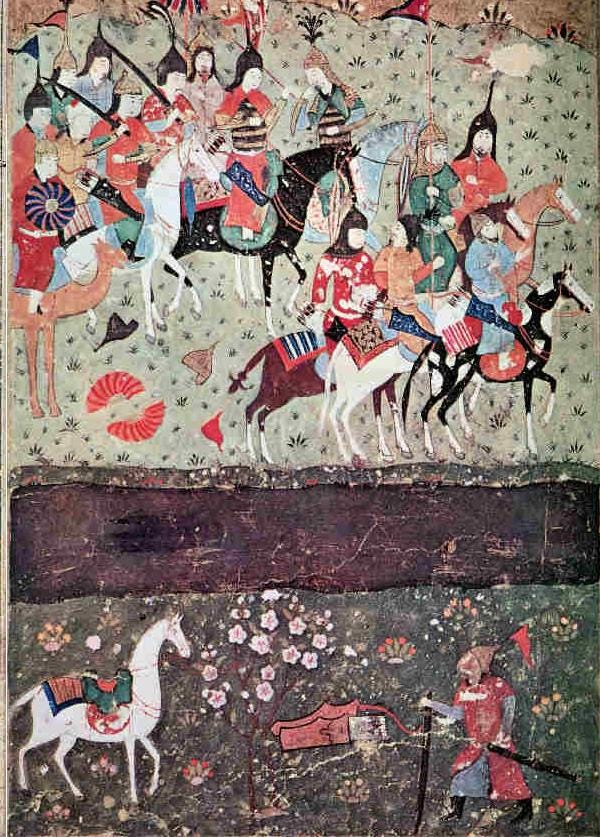
In 1221, history witnessed a defining moment at the Battle of the Indus, where the legendary Mongol leader Genghis Khan’s forces collided dramatically with those of the Khwarazmian Empire. This confrontation not only charted a new course for Mongol expansion but also imprinted a lasting legacy on the region’s cultural and political fabric.
This epic battle had its roots in the fraught relationship between the Mongol Empire and the Khwarazmian Dynasty. The destruction of a Mongol trade caravan by the Khwarazmian Shah sparked the conflict, igniting Genghis Khan’s wrath. In a formidable response, he mobilized an extensive campaign against the Khwarazmian Empire, culminating in this historic clash at the Indus.
A tactical and raw display of military might characterized the battle. The Mongol army, despite being outnumbered, leveraged its agility and exceptional archery skills, under the command of the innovative and ruthless Genghis Khan. They engaged the Khwarazmian forces, led by Jalal ad-Din Mingburnu, in a fierce showdown.
The consequences of this battle were profound. The Mongol triumph over the Khwarazmians set the stage for their further incursions into the Islamic world’s heart. This victory’s cultural and political ramifications were transformative, altering the power dynamics in the region significantly.
The Battle of the Indus is etched in history not merely for its strategic importance but also for its broader historical impact. It symbolizes the Mongol military might and their influential role in shaping the medieval era.
For historians and enthusiasts, the Battle of the Indus continues to be a topic of significant interest. Studying this event offers deep insights into Mongol military tactics, the geopolitical intricacies of the era, and the overarching narrative of medieval history.
To appreciate the Battle of the Indus’s true import, one must immerse in the historical milieu of the early 13th century. It was a time of significant upheaval, especially in Central Asia and the Middle East. Under Genghis Khan, the Mongol Empire was rapidly expanding, forging what would become one of history’s most extensive empires.
The pivotal role of Genghis Khan in this battle and his wider ambitions are undeniable. His unparalleled military acumen and relentless resolve were instrumental in the Mongols’ victorious campaigns. His strategy, marked by psychological warfare, unmatched mobility, and a profound grasp of enemy tactics, was masterfully deployed at the Indus.
Meanwhile, the Khwarazmian Empire stood as a formidable adversary. As a significant Islamic state of that era, it boasted a robust military and a rich cultural heritage. Their decision to confront the Mongol assault was a testament to their strength and determination.
The aftermath of the Battle of the Indus resonated deeply and enduringly. This pivotal conflict spelled the downfall of the Khwarazmian Empire, a watershed moment in Islamic history. It cleared a path for the Mongol hordes to sweep into Persia and beyond, profoundly reshaping the Islamic world’s cultural, political, and economic landscape.
The Battle of the Indus transcends its role as a mere historical episode. It stands as an emblem of history’s relentless progression, reminding us of the ephemeral nature of empires and the ongoing saga of conquest and resistance that has sculpted the human narrative.
Reflecting on the Battle of the Indus invites us to ponder broader concepts: the dynamics of power, the essence of resilience, and history’s unyielding march. Such contemplation not only casts light on the past but also imparts valuable lessons for today and tomorrow. It emphasizes the critical need to grasp history’s complexities and the interplay of diverse forces that steer the human journey.
Venturing into the realms of what-if, we imagine a world where the Mongols suffered a decisive defeat at the Indus in 1221. This alternate reality proposes a drastically different trajectory for world history across various domains.
Had the Mongols been vanquished, their famed rapid expansions and merciless campaigns might have been halted, perhaps even leading to internal conflicts and power struggles within their empire. Such a scenario could have left vast territories like Eastern Europe and Russia untouched by Mongol influence.
In this alternate history, a victorious Khwarazmian Empire might have risen as a preeminent force in the Middle East and Central Asia. Such a development could have fortified Islamic empires in the region, significantly influencing the cultural, political, and religious landscape.
One often-overlooked impact of Mongol conquests was their role in fostering trade and cultural exchange along the Silk Road. A Mongol defeat could have resulted in a less secure, fragmented Eurasian trade network, potentially hindering the cultural and technological exchanges that marked the Mongol era.
The Mongols’ role in shaping the 13th and 14th centuries’ geopolitics was crucial. Their hypothetical defeat might have crafted an entirely different global power balance, influencing the evolution of nations and empires across Eurasia.
Moreover, the Mongol invasions had an indirect yet significant impact on Europe’s Renaissance. The flow of knowledge and ideas, facilitated in part by the Mongol-dominated regions, fueled Europe’s cultural rebirth. Absent the Mongol influence, the Renaissance might have charted a different course, affecting the speed and nature of Europe’s development.
Had the Mongol Empire not unified Central Asia and the Middle East with its iron grip, a patchwork of smaller, competing states could have emerged in its stead. This fragmentation might have ignited numerous, albeit more localized, skirmishes rather than the sweeping devastation often brought by large-scale wars.
The impact of the Mongols on the course of global history was nothing short of monumental, influencing a wide array of aspects from demographic shifts to the spread of catastrophic diseases like the Black Plague. Imagining a scenario where the Mongols met defeat at the Indus suggests a radically different trajectory for world history, possibly altering everything from population dynamics to the course of pandemics.
This speculative journey into a world where the Battle of the Indus concluded with a Mongol defeat is not just an exercise in historical curiosity. It opens a window into the delicate web of historical causality, showcasing how crucial junctures can pivot the flow of human events in unexpected ways. Delving into such alternate histories enriches our comprehension of the past and casts a light on the intricate and often unpredictable nature of historical progress.