
The Indian Bride and Her Beautiful Dresses
GiaB writing prompt #8: apparel
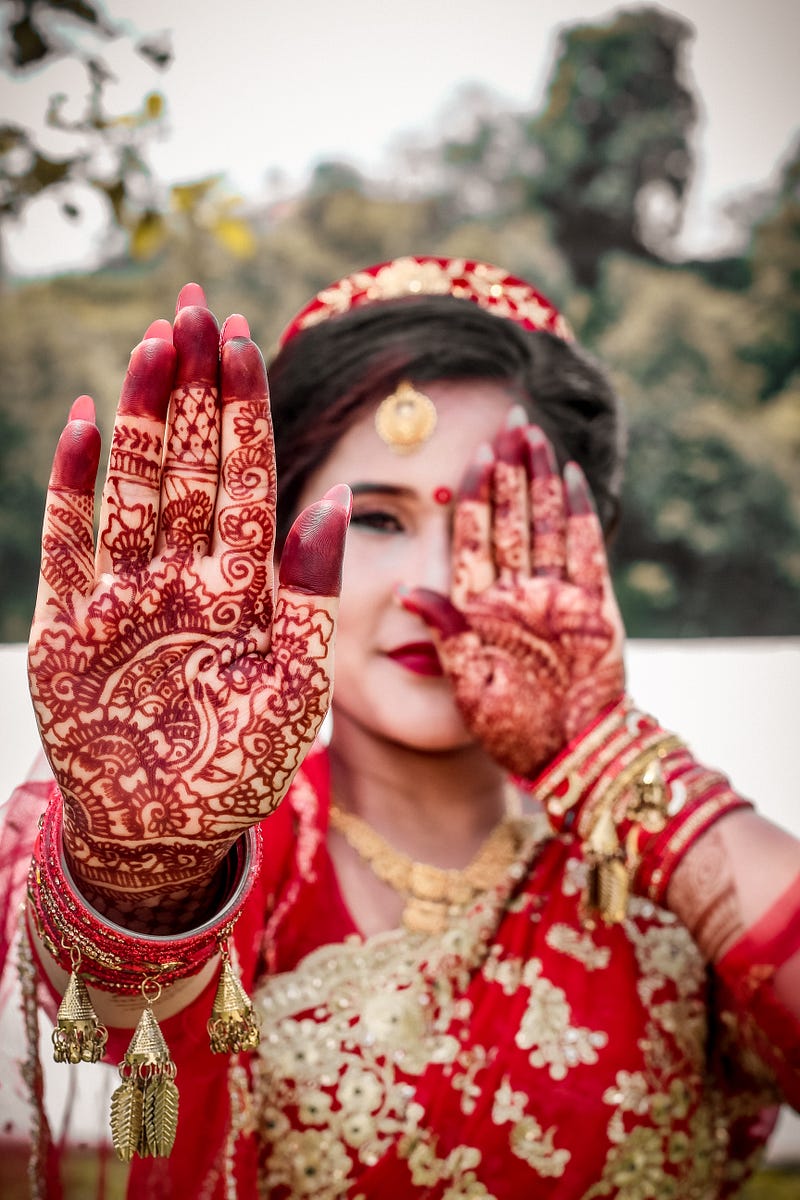
Indian weddings are known to be elaborate and have a collection of as many people as possible on the occasion. So all the relatives, close and distant, are invited. Next, are the neighbors, acquaintances, designers, friends, and then friends of friends, store owners, and suppliers of wedding accessories and decorations.
A medley of people is invited who do not even know each other but receive a wedding card. It is like the whole community must be invited.
In the fitness of things, the bride, her family, and the spectators require many different kinds of apparel.
The wedding card usually contains leaflets with many different functions. Some functions are restricted, so a choice is made as to who should be invited for the particular function. In all these functions the bride’s dresses have to be the best.
The final day, on which the wedding takes place, has the largest gathering. The importance of the bridal dress knows no bounds. Parents, friends, cousins, and relatives all give their suggestions. Everybody is used as a soundboard, and the bride goes for the ultimate choice.
After endless mulling over and going through the choices, again and again, the bride chooses her dresses.
The dresses are then specially designed and embroidered as per samples shown by the shopkeepers and designers. It takes days to make the apparels. The bride is then informed that the dresses are ready for inspection.
The next step is even more tedious. Every dress has to be meticulously worn and tried. A friend or a cousin usually accompanies the bride. This takes many days. The bride is never satisfied and the designers play up to the moods of the bride and her relatives.
The bridal industry is huge. If the bride's dresses are good all her relatives will also get it made by the same designer and of course they are told strictly not to make it as elaborate or as beautiful as the bride’s apparel.
The bride’s dresses are usually pink, red, maroon, or orange. Black and white are not worn by Indian brides as it is considered to be a bad omen.
These days Bollywood and high society brides of rich industrialists have started opting for pastel pink, silver, or gold.
The dresses are very ornate, and the embroidery is very fine. They are specially embroidered in places known for the art of the stitches. Some of the places where these fine dresses are made are Lucknow, Bareilly, Jaipur, Ahmedabad, Kutch, Patiala, and Amritsar.
The Lucknow Chicken work is classic, traditional, made with a single thread, and is known for its very fine thread work.
Some of my foreign friends who attend weddings in India like to buy Indian apparel for their fine handwork.
Apart from these embroidered dresses, there are certain woven clothes too. There are many types of weaves available, as India is rich in looms, but the current popular choices are Paithani, Kanjiwaram, and Banarsi.
The Paithani sarees are the pride of Maharashtra and are very elaborate and very expensive. The bride will usually wear the best one. The patterns are beautiful. Birds and flowers are woven in it, and it takes a long time to make it. Each color has to be woven in it.
The Kanjiwaram saree is usually said to be in pure gold. No longer so. It is now made in silver and dyed into a golden thread. In India, the golden thread is called Zari. The silver can be sold later by weight, and the price can be received of the equivalent of silver. However, no one sells it until the apparel is old and worn out.
The Kanjiwaram shines from far and gives a glamorous look. Brides want to look their best and so the choice is evident.
The sarees from Banaras have intricate patterns and are a delight to see. They are also woven with a pure silver thread called zari in India. The weaver never gets the right price for his creation.
The major takeaway is that in Indian weddings there is a great emphasis on clothes. They have a big budget for apparels for a wedding.
The bride wears the apparel that she thinks is most suitable for the wedding day. After all, it is her day, and she must look the best.
Indian weddings are usually large and clothes are very important to the bride as well as her relatives. The clothes are meticulously selected for all the functions. There are many programs and celebrations that go on for at least 10 days.
This article was written in response to GiaB# 8: Apparel. I would like to invite some friends to write on this theme. Bhavna Narula Caroline de Braganza Rochelle Silva Susannah MacKinnie Robin du Plessis Amy Marley Alexandra Forsyth Carolyn Hastings.
The original GiaB writing prompt with submission details are given by Victor Sarkin and Chirag below.