
The Inclusive Genius of Owl House
How people of all non-standard stripes are included in this magnificent show.
My partner and I got Disney Plus a few months ago for the sole purpose of watching Muppet Haunted Mansion on Halloween. That was great, but then I “forgot” to cancel our subscription, and we’ve been catching up on Disney stuff ever since.
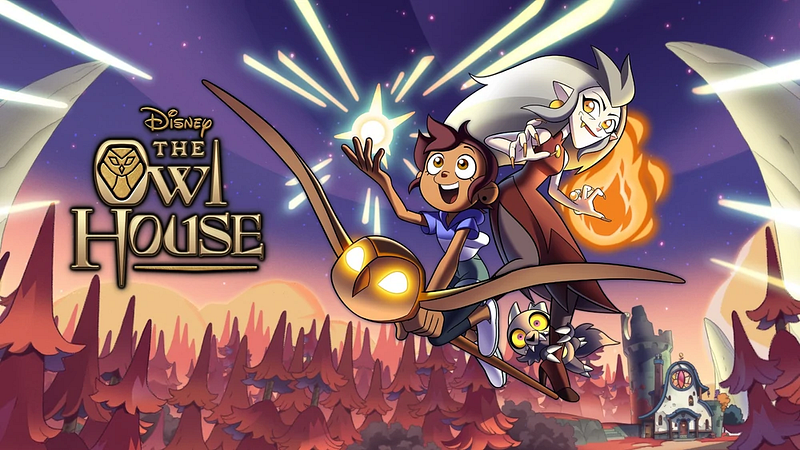
One of the shows that we have been wanting to watch has been Owl House. For those unfamiliar, it is a cartoon show about a young teen, Luz Noceda, a Dominican-American who stumbles upon a portal to a realm of magic called the Boiling Isles. She meets a witch named Eda Clawthorne, her companion, a demon named King, and her sentient house Hootie, the titular Owl House. Eda is known as “The Owl Lady,” which is thanks to a curse that was put upon her that causes her to transform into an owl-beast.
There are a lot of major spoilers beyond this point, so be warned and aware.
On the surface, this is a setting rife with opportunities for kid-friendly mischief and mayhem, but as with many kids’ shows these days, there is so much more than that. The opening two-part episode establishes Luz as disruptive and distractible in school, prone to hijinx and trouble. She is literally being shipped off to a summer camp with the tagline “think inside the box,” where she will ostensibly learn to be an adult and enjoy things like taxes.
Instead, a random owl steals a book she likes about a good witch, she chases said owl through the portal into the magical world of the Boiling Isles, meets Eda, and the adventure begins. Luz is immediately taken with the magical world, as she has always admired the witch in her favorite series of books and aspires to learn magic in her new surroundings.
The opening to the series includes a prison break scene where Luz gives a rousing speech to the prisoners, who have all been imprisoned for “crimes” such as writing fanfiction and just generally being weird. The implication is that it’s okay to be weird and different, and as long as you’re not hurting anyone, you can and should do whatever makes you happy.
The whole thing sets up a series that feels very much like the “pro-weirdo, whatever-makes-you-happy, everyone can do it” kind of surface inclusiveness that a lot of kids shows have these days. That said, if you dismiss it because of that, you are absolutely missing out on a lot of deep, interesting allegories and layers of depth.
Luz is very much coded as neurodivergent, and a lot of ADHD people identify strongly with her. Her distractibility, a well-known aspect of ADHD, and her hyperfocus, an aspect that is less well-known, resonate with a lot of neurodivergent folks that I have talked to. She was very fixated on that series of books about the good witch having adventures, so when presented with an opportunity to do actual magic, she throws her entire being into it.
However, there is more to it than that. One of the early challenges that she has to overcome is her inability to do magic in the way that everyone else on the Boiling Isles does it. For a person like Eda, who becomes Luz’s mentor, magic is an innate thing that she can simply do. Luz does not have that ability because she’s human, so she has to find a way around it.
And she does. Luz is so fixated on learning magic that she does not let the fact that it is impossible for her to do it in the “standard” way stop her. She tries a bunch of different approaches until she finds one that works for her, and once she finds it, she focuses all of her energy on refining it and making it her own. By the time you reach the current part of the series (it is still in Season 2), she has become a competent witch in her own way.
Luz’s neurodivergence is the topic of many articles by people much smarter than I am, so I will leave you to do your own looking there. The other bit of inclusivity in Owl House that people are going on about is the same-sex relationship that occurs between Luz and Amity, a rival-turned-friend-turned-romantic partner.
Luz is explicitly bisexual and this is made clear fairly early on in the series, with her having crush-type reactions on people of various gender identities. This causes her some trouble at various points but is a useful lead-in to the main romantic plot.
Amity Blight is a mean girl, at least at first. She is from a rich and powerful family that manufactures weapons and takes her status as a top student and powerful witch-in-training very seriously. Our introduction to Amity is when she bullies another witch-in-training named Willow, who Luz befriends immediately.
Their first meeting is one of pure rivalry. They dislike each other immediately, and that is the foundation for the start of their relationship. However, while first impressions are a lot, they often miss who we really are in a lot of ways. So naturally, after their second meeting where they wind up in a duel in front of a huge audience and both get caught cheating (thanks to their respective mentors), their conversation afterward starts to show that Amity isn’t what she’s cracked up to be.
The relationship between the two develops very, very naturally. They become friends, then develop mutual crushes, then (with a little push) wind up becoming a couple in Season 2. They bicker, they do stupid things for and with each other, they share victories and defeats and touching moments together, and they eventually grow together.
They’re both a couple of dumb teenagers who don’t know what they’re doing but know that they really, truly like each other. It all happens in the same way two teenagers in a standard-issue rom-com kids show would. The only thing different is that they’re both female. This is never treated as anything strange or out of place, it just happens organically like a lot of relationships do.
And that right there is part of the genius. Nothing about it is treated as weird. If this show was a bunch of straight cis white people, nobody would be talking about this relationship as anything groundbreaking. Plenty of other shows have done relationships that have felt like an awkward but ultimately organic teenage relationship. And that’s the point.
Speaking of straight white cis people, do you know who in the series is not? Raine Whispers. Raine is introduced late in the series (as of this writing — their first speaking appearance is Season 2 Episode 7), and is the head of the Bard Coven. They are nonbinary and use they/them pronouns, have darker skin, and are voiced by a nonbinary Latine voice actor, Avi Roque.
Once again, none of this is treated with any kind of gravitas or importance, it simply is. Even though they only appear for one episode (again, as of this writing — they will likely play a big role later), everyone addresses them using their pronouns and nobody ever comments on it. They even have a history with Eda, a past romance that is a key point in the episode, which is treated as perfectly normal because it is.
(I really want to talk more about Raine and their impact on the series so far, but because they only have one episode of development while every other point here has been a series-long thing, I don’t have that much to say. I wish I did, and I hope I do later, but right now, I have to keep it at this, and for that, I am very sorry. Holy crap do I hope they become a bigger part of the series.)
So we have neurodivergence representation and LGBTQIA+ representation, but what else can Owl House cram in there? How about disability representation?
Let’s go back to Eda for a minute. Eda is the Owl Lady, a name she gets from a curse that causes her to transform into an owl beast. She mitigates this curse with the use of potions that keep it at bay, and these potions play a big role in how she manages her curse.
All of this occurs in ways that people who deal with things like chronic pain or other physical disabilities know all about. Eda’s curse is tied to her magic use, so using too much in a short amount of time causes her to transform. This causes her a lot of consternation since she is considered “the most powerful witch on the Boiling Isles.”
Heck, simply getting too stressed out will cause her to transform, so there are several key points where Eda is shown trying to calm herself down or manage her emotions to prevent her curse from flaring. She is also shown to be tired a lot and often takes a lot of extra time to rest or sleep in.
Eventually, through magic, her sister Lilith takes on half the curse and Eda starts teaching her how to manage it as well. When Lilith is learning how to cope, Eda shows her the many, many potions that she keeps in obvious and not-so-obvious places in case something comes up. She even keeps some taped to the living room ceiling because she knows that Lilith likes to lay on the couch a lot.
There is even the concerned family member, Eda and Lilith’s mother, who will do anything to cure Eda of her curse. This includes being taken in by a snake oil salesman who drains her of her money with false promises and fake cures. Thankfully she learns a lesson and makes it right in the end, but many well-meaning parents don’t ever get to that point.
And, once again, this is all treated incredibly well. Eda has a disability, yes, and while she lives a reasonably normal life (well, normal for an outlaw witch who sells human trash in an illegal bazaar stall), she still has to manage her disability. It is part of her, and while people acknowledge it, life goes on and everyone does the best they can to help her cope.
Even though the “curse as a disability” trope is often misused — Harry Potter’s Remus Lupin is a great example of this — it is played very well here. Lupin’s curse is seen as an inconvenience and a bad thing, and werewolves are portrayed as 99% evil with Lupin as seemingly the sole exception. Heck, the werewolf who bit Lupin explicitly tried to spread lycanthropy to his enemies as revenge, which feels a lot like an allegory for people intentionally spreading AIDS or something similar.
Everything about Lupin and his curse is seen through the lens of how it affects everyone around him. He is viewed as a dangerous creature that cannot be trusted, and when it flares up, it reflects poorly on Lupin. Eda’s curse, on the other hand, is about how it affects her. When she has a flare-up, the people around her make sure that she’s safe and try to minimize the damage, and when it’s over, they ask how Eda is doing and make sure that she’s okay.
Lupin is treated as a danger to everyone around him because of his curse; while Eda’s curse is treated as dangerous, she is never treated badly because of it. Eda’s friends know and understand that she has the curse and that while she’s afflicted by it, she is not herself. The Boiling Isles are full of weird, dangerous, and terrifying things, so an owl-beast rampage isn’t terribly unusual. As a result, everyone is instead concerned about how Eda is and how she feels after a flare-up.
All of these things could have an individual article written about them, and again, it doesn’t take much looking to find many more pieces about these different parts of Owl House. There is also a lot more to unpack here.
I haven’t even gotten into King’s character at all — he is an orphan who is in search of his real family, and much of his character development comes from not knowing his past and discovering who he really is. Additionally, Luz is the only child of a single mother who is doing her best, and even though she seems to not be the best parent at the beginning of the series, she legitimately loves Luz and just wants what is best for her. There is also the “found family” trope that is common these days but I feel is exceptionally well-played here. However, I am over 2,000 words into this already, and I need to sleep at some point.
I know that I should probably have stated this in the beginning, but I am woefully unqualified to comment as much as I have. I am a straight white cis guy who grew up in a loving two-parent household. I can’t relate to much of what I’ve written about here. What I can appreciate, however, is that again, all of it is treated as perfectly normal.
You could have done this show with a completely white-bread cast and some people would still call it great. Nothing about it would be considered unusual, and the romance between whatever boring Luz and Amity stand-ins there would’ve been would be seen as fairly well-developed for a teen romance.
However, all of the representation — neurodivergence, LGBTQIA+, and disabilities, among others — is what really makes this show shine. There have been shows in the past that have paved the way for Owl House — The Legend of Korra was one of the earlier ones to introduce a queer relationship, and the Netflix reboot of She Ra carried that torch a bit further. However, those two only gave us a relationship as the payoff at the end of the series, and there was no real relationship development after they got together in the last episode.
Steven Universe took it from there, baking queer romance into part of the lead character group and ending with a same-sex marriage and kiss, but the relationship was still just a small part of the series. Even still, they had to fight tooth and nail to kick that door open, and they had to make a lot of compromises along the way.
Owl House has burst through that door with its flag held high. All of the queer representation, along with neurodivergence and disability representation (and probably a lot that I couldn’t cover here or otherwise completely missed) is front-and-center in this amazing show. It absolutely kills me that the show’s third “season” will be a handful of specials instead of anything solid, but it’s something that we didn’t have before.
Ultimately, I hope we can get some sort of satisfying conclusion from this show, and if not, I hope the fanfic writers keep things going. I also hope that, once it has finished its run, another show that is just as good and just as iconic will take that torch further than Owl House could. I hope that we eventually get to a point where, instead of me writing 2,500 words about how great it is that there is some representation in kids’ shows these days, we can just have that representation without it being weird or novel.
Go watch Owl House.
If you appreciate my work, why not join Medium as a paying member, which allows you access to unlimited stories (not just three free stories per month). Click this link or the image below. I will receive a little portion of your membership fee, but it won’t cost you any extra.
If you liked this, please subscribe to my publication, Thing a Day. I publish something every day on a variety of topics, so you never know what you’re going to see!


