
The Importance of Sample Size and Standard Error in Statistical Analysis
Standard Deviation vs. Standard Error

Introduction
Sample size and standard error are fundamental concepts in statistics that play pivotal roles in research design, data analysis, and drawing reliable conclusions from data. Understanding these concepts is essential for researchers, analysts, and decision-makers across various fields. In this article, we delve into the significance of sample size and standard error, their interrelationship, and their implications in statistical inference.
Sample Size
Sample size refers to the number of observations or individuals included in a study or analysis. It directly impacts the reliability and generalizability of study findings. A larger sample size generally leads to more precise estimates and greater statistical power, allowing researchers to detect smaller effects with higher confidence.
# Required Libraries
library(ggplot2)

# Parameters
population_mean <- 50  # Mean of the population
population_sd <- 10    # Standard deviation of the population
num_samples <- 1000    # Number of samples to generate
sample_sizes <- c(10, 30, 50, 100)  # Different sample sizes to consider

# Function to generate samples and calculate sample means
generate_sample_means <- function(sample_size) {
  sample_means <- replicate(num_samples, mean(rnorm(sample_size, mean = population_mean, sd = population_sd)))
  return(sample_means)
}

# Generate sample means for different sample sizes
sample_means_data <- lapply(sample_sizes, generate_sample_means)

# Prepare data for visualization
plot_data <- data.frame(
  Sample_Size = rep(sample_sizes, each = num_samples),
  Sample_Mean = unlist(sample_means_data)
)

# Create a density plot to visualize the distribution of sample means
ggplot(plot_data, aes(x = Sample_Mean, fill = factor(Sample_Size))) +
  geom_density(alpha = 0.6) +
  scale_fill_manual(values = c("#E41A1C", "#377EB8", "#4DAF4A", "#984EA3")) +
  labs(title = "Sampling Distribution of Sample Mean (Different Sample Sizes)",
       x = "Sample Mean",
       y = "Density") +
  theme_minimal()
Here, it is evident that larger sample size results in tighter distribution of sample means and smaller standard deviation. This standard deviation of sample means is also known as standard error.
Key Points Regarding Sample Size
Precision: Larger sample sizes typically result in more precise estimates of population parameters. This precision is crucial for accurately characterizing the underlying population and reducing sampling variability.
Statistical Power: Adequate sample sizes are essential for achieving sufficient statistical power, which is the probability of detecting a true effect if it exists. Studies with insufficient sample sizes may fail to detect real effects, leading to Type II errors (false negatives).
Generalizability: Larger samples increase the generalizability of study findings to the target population. Small samples may not adequately represent the population, limiting the external validity of the study.
Standard Error
Standard error measures the variability of sample statistics around the population parameter. It quantifies the uncertainty or sampling variability inherent in estimating population parameters from sample data. The standard error is influenced by both sample size and the variability of the population.
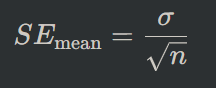
Here, σ is the population standard deviation and n is the sample size. If population sandard deviation is unknown, sample standard deviation can be used.
Key Points Regarding Standard Error
Inversely Proportional to Sample Size: The standard error decreases as the sample size increases. Larger samples provide more information about the population, resulting in more precise estimates and smaller standard errors.
Precision Indicator: Standard error serves as a measure of the precision of estimates derived from sample data. Smaller standard errors indicate greater precision and reliability in estimating population parameters.
Confidence Intervals: Standard errors are used to calculate confidence intervals, which provide a range of values within which the true population parameter is likely to fall with a certain level of confidence. Wider confidence intervals are associated with larger standard errors, reflecting greater uncertainty in the estimation process.
# Required Libraries
library(ggplot2)

# Function to generate samples and calculate standard errors
generate_samples <- function(population, sample_sizes) {
  results <- data.frame()

  for (n in sample_sizes) {
    samples <- replicate(1000, mean(sample(population, n, replace = TRUE)))
    standard_error <- sd(samples)
    results <- rbind(results, data.frame(Sample_Size = n, Standard_Error = standard_error))
  }

  return(results)
}

# Population (e.g., normal distribution with mean 50 and standard deviation 10)
set.seed(42)
population <- rnorm(10000, mean = 50, sd = 10)

# Sample sizes to consider
sample_sizes <- c(10, 30, 50, 100, 200, 500)

# Generate samples and calculate standard errors
sample_results <- generate_samples(population, sample_sizes)

# Visualize the effect of sample size on standard error
ggplot(sample_results, aes(x = Sample_Size, y = Standard_Error)) +
  geom_line() +
  geom_point() +
  labs(title = "Effect of Sample Size on Standard Error",
       x = "Sample Size",
       y = "Standard Error") +
  theme_minimal()
The plotted graph illustrates the relationship between sample size and standard error. As the sample size increases, the standard error decreases, indicating greater precision in estimating the population parameter. This phenomenon is a fundamental aspect of statistical inference and underscores the importance of adequately sized samples for reliable conclusions.
Practical Implications
Study Design: Properly determining sample size is crucial during the design phase of a study. Sample size calculations should consider factors such as the desired level of precision, expected effect size, variability in the population, and statistical power requirements.
Data Analysis: Researchers must account for standard errors when interpreting statistical results. Reporting standard errors alongside point estimates provides a more comprehensive understanding of the uncertainty associated with the estimates.
Decision Making: Policymakers, healthcare professionals, and other decision-makers should be aware of the influence of sample size and standard error on study findings. Sound decision-making relies on robust evidence derived from well-designed studies with adequate sample sizes.
Conclusion
Sample size and standard error are integral components of statistical analysis, influencing the reliability, precision, and generalizability of study findings. Researchers and practitioners must grasp these concepts to conduct rigorous analyses, draw valid conclusions, and make informed decisions based on empirical evidence. By appreciating the importance of sample size and standard error, we enhance the quality and credibility of research across diverse domains.