
The Impotence Of God Spelling And Gramar
An editor explains why clean writing and good grammar are so important
If that title made you spit your morning coffee, great! Today I want to talk about grammar, and why you should not take it too lightly when it comes to presenting your writing to the world.
I’ll also show some useful tools in the end. You will have a much easier time correcting the most common mistakes in your writing with them.
If writing was your first date, then grammar would be your attire
For personal writing, grammar isn’t that important. We all make millions of typos every single day. I’m no exception. When speed is more important, like in a chat-room or on Whatsapp, I neglect grammar too. But if your goal is to become a good writer, then going the extra mile can be decisive for your success.
I’d first like to point out that grammar says nothing about your intelligence. You’re not stupid, and those who say otherwise are too full of themselves. Language changes constantly, and the rules of today could be gone tomorrow. It’s not exactly set in stone.
But your grammar says a lot about how diligent you are; how keen you are on noticing details. If you’re looking for a job, the grammar in your resume will inevitably be judged. Most people suspect that you won’t be as reliable in your future position if you can’t write a clean resume.
“Your grammar is a reflection of your image. Good or bad, you have made an impression. And like all impressions, you are in total control.“ — Jeffrey Gitomer
The same happens to new writers who send their first manuscript to a publisher. The editors there will pay as much attention to grammar and punctuation as they pay to the story itself. Because if that story gets accepted, they will have to correct all the mistakes. And if there are many typos, misspellings, and punctuation errors, this would mean a lot of work they’d rather not do.
Despite its importance, many people try to avoid speaking about it. Pointing out bad grammar is often a cause of heated debates and hurt feelings. But it all depends on how you point out errors in writing. As with all things, criticism should be constructive, not down-putting. We all make mistakes and thinking of ourselves as above others will not help anyone.
I would never mark grammatical mistakes in anyone’s writing publicly. But if a friend asks me to beta-read their article or story, I’ll point out any errors I notice. They rely on me to give them an honest opinion and help them polish their work to perfection.
When it comes to your professional success, you should never settle for anything less than perfection.
Problems caused by bad grammar
Bad grammar can hinder the readability of your work. In rare cases, it can even end up twisting your intended meaning. Take a look at the following example:
Let’s eat Grandpa. Let’s eat, Grandpa.
A single comma can mean the difference between an invitation and cannibalism. But commas aren’t as important in my opinion. I won’t get into the predicament of Oxford-commas either.
Mistakes that immediately jump into my eye are the confusion between “your” vs. “you’re” “there” vs. “they’re” “its” vs. “it’s” “then” vs. “than”
“It’s hard to take someone seriously when they leave you a note saying, ‘Your ugly.’ My ugly what? The idiot didn’t even know the difference between your and you’re.” ― Cara Lynn Shultz, Spellcaster
Again, this has nothing to do with your intelligence. Confusing these words can be pretty easy since they look very similar. And once the misuse turns into a habit, it can be difficult to get rid of it. Those who read these words out in their head while reading will immediately pick up on the error.
This can take away from your strength and even appear as disrespect towards the reader. Here are some common mistakes I did for the longest time:
It’s and its
It’s is a contraction of “it is”. “Its” on the other hand shows possession. An easy rule to remember is to try and write “it is” instead. Does it sound right? Then use “it’s”. If it sounds wrong, you should go with “its”.
The dog chased its tail. (Because “The dog chased it is tail” would be wrong.)
It’s a common mistake. (Because “It is a common mistake” would be correct.)
I can’t remember when I started getting it right. But it was one of my prime mistakes.
Then and than
I’m guilty of this one too. “Then” is a synonym for “next” or “at that time”, while “than” is used to make a comparison between two things. I learned to get this right by imagining a timeline. “First we do X, then we do Y.”
Another reminder comes from programming: “If, then, else” is used as a chain of commands to set a trigger for specific events. I’m sure most programmers get the difference between “then” and “than” right.
If something is being compared by using adjectives like “bigger”, “smaller”, “older”, “younger” or any other word like these, then you will need to use “than”.
Less and fewer
This one is less common. I just recently realized my mistake. I wrote: “There are less people here than before.”, which is wrong. It should be “There are fewer people here than before.”
I remember learning the difference between “much” and “many” in English class. “Much” is used for things we can’t count. “Many” is used for things we can count.
The same rule applies to “less” and “fewer”. Oddly enough, I got that wrong and didn’t even notice.
When I started writing, my grammar was horrible
If you want to get a good laugh, head over to Amazon and take a peek into the first book ever published with my name on it. “Greater Than A Tourist: Okinawa”.
Disclaimer: Don’t buy it. I won’t see a cent from it, the money would go entirely to the publisher. Besides, it’s complete trash.
It was one of my first English freelancing contracts and brought me $10. I was asked to write a tourist guidebook for the place I currently live in, Okinawa island, Japan.
Despite the tips themselves being poor, you can see a huge amount of poor sentence structure and grammatical mistakes. Those poor ratings are all well deserved.
When I finished the first draft, I asked my client whether I should proofread and edit it, but the client told me that they would take care of that. Looks like they didn’t.
Now it serves as a constant reminder of how horrible my understanding of the English language was. I laugh about it now, but my ego took a serious hit back then.
Clean writing is part of my success
Since that first book, I made many more experiences before I was able to grow. I ghostwrote a German book for another client. I did the proofreading and editing too. Several times later, she’d still send it back with suggestions and red marks. I’m quite thankful that she put up with me. She paid me the full price, though she was way more capable of writing that book than I was.
This was the second push I got. I started to take it seriously.
Now — almost 5 years later — I’m a well-established freelancer, top-rated with 100% client satisfaction on Upwork. I also receive various client requests via LinkedIn and Email.
I started writing here on Medium on April 5th, 2020. Since then, I got curated 16 times by Medium in various topics. And I am almost certain that proper grammar and spelling played a major role in this.
I’m an editor of Illumination. The publication has more than 500 writers by now. I often see submissions with rejections from other publications on them. And sometimes, the article itself seems great. The only problem I can find is a notable amount of spelling and grammar errors.
Of course, this is only my assumption. But I know how time-consuming it can be to fix so many errors when you have a long queue of submissions waiting. I wouldn’t hold it against anyone if that was part of the reason for rejecting an article in other publications.
“People who cannot distinguish between good and bad language, or who regard the distinction as unimportant, are unlikely to think carefully about anything else.” ― B. R. Myers
So I can only recommend you to put your ego aside and focus. Be diligent and merciless with yourself. Make sure it’s perfect. Use tools to help you with that. Editors, publishers, and readers will be thankful in the long run. And this will be a major stepping stone for your success as a writer.
Tools to make your life easier
Practice makes perfect. But to make it a lot easier, there are plenty of useful tools you can use. I’ll introduce you to my favorite tools for correcting bad grammar on the fly.
Grammarly
Among the best free tools you could get, Grammarly easily takes the top spot.
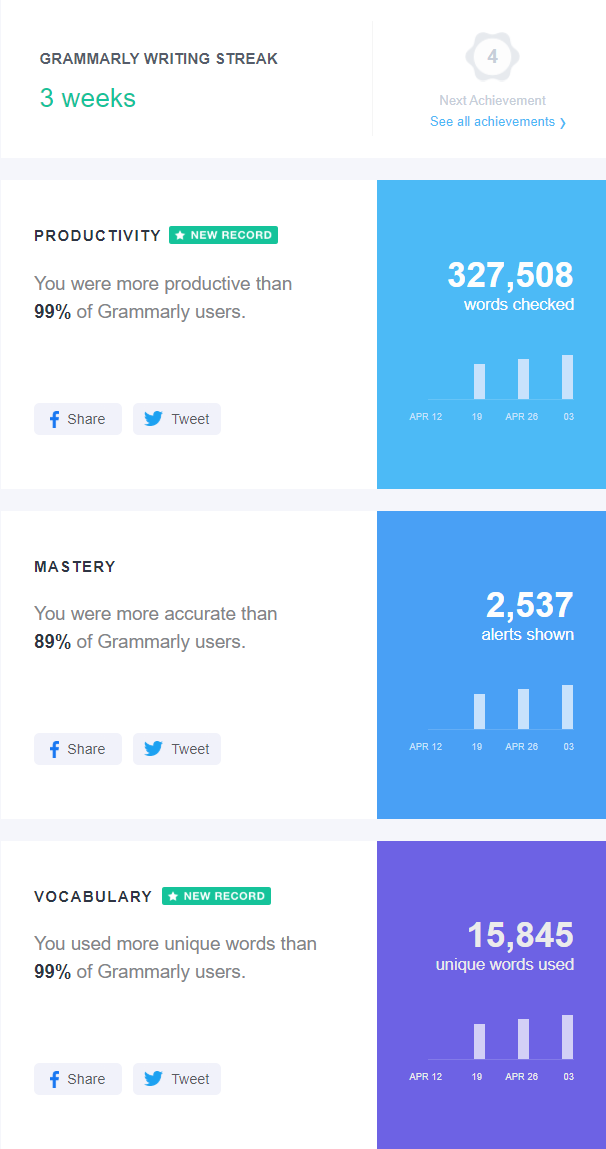
It integrates fully with the Chrome browser and allows you to check your writing on the fly. I have just started using Grammarly in April 2020, but now I wonder how I ever managed without it. It’s free, allows you to easily fix most errors with a single click and automatically corrects typos from writing too fast on the go.
Grammarly also offers a paid subscription with more advanced features, like a built-in plagiarism checker. But I have my own commercial tools for that, so I stick with the free plan for now.
Hemingway Editor
The Hemingway editor doesn’t help you with grammar and typos. But it will analyze your text for readability, overuse of the passive voice, and use of adverbs.
It will tell you if your article or story is too hard to read, allowing you to adjust it until it is perfect.
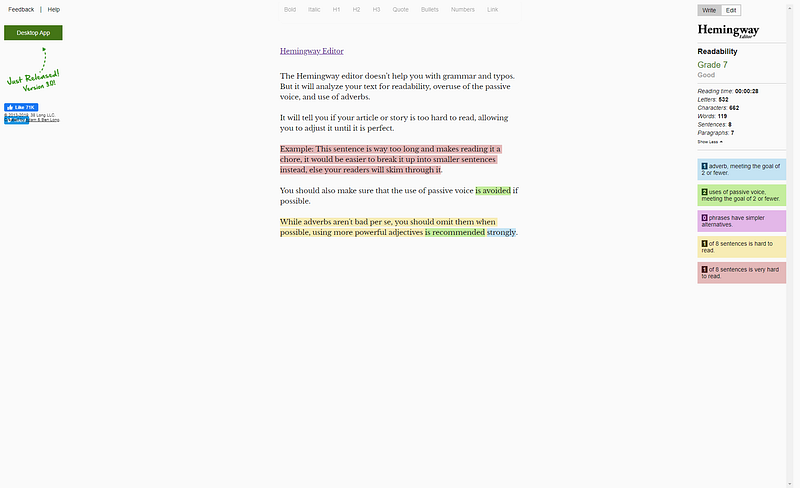
It’s a good addition to avoid bloating your articles.
Dict.cc
This website was at first just a German-English dictionary. By now, they offer a total of 25 languages. I use this one a lot and rely more on it than on for example the Google Translator.
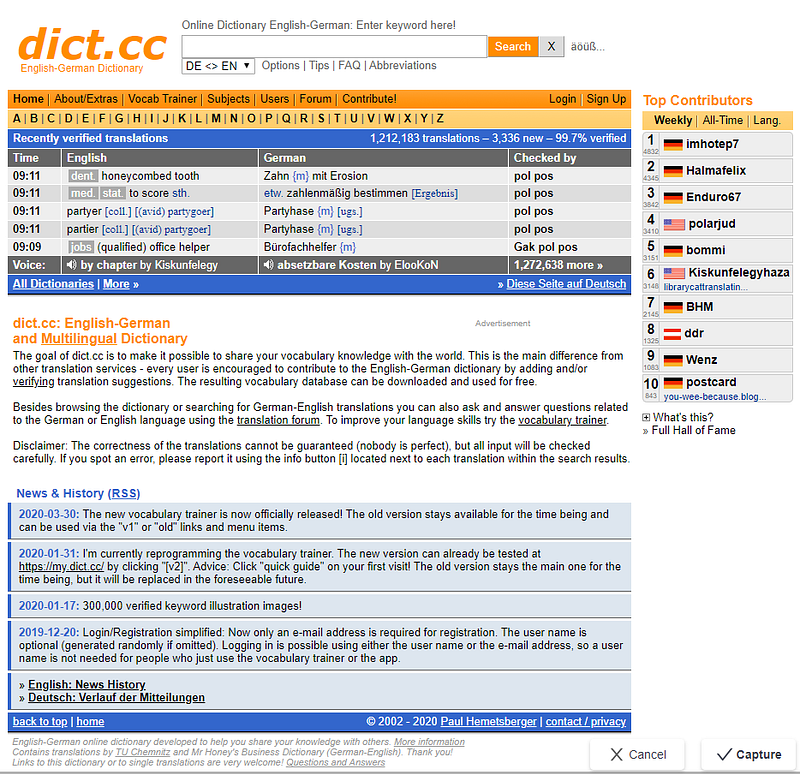
It offers an incredible vocabulary, including idioms, proverbs, and colloquialisms. If English is your second language, I recommend this website to assist you with your vocabulary.
Clean writing and good grammar don’t come overnight
But if you use the right tools and read what you write carefully, you will have a lot more success on your way. You may even be able to save a lot of money in the process.
As a professional editor, my average fee for proofreading and editing a manuscript of around 85,000 words is $1,700. I’m still quite cheap compared to most people in the industry. But if you’re about to publish your first book, I doubt you’d be willing to pay that much money for polishing it without knowing whether you’d even be able to break even.
By being more diligent from the get-go and utilizing all the free tools you can find, you can make this step entirely optional. You’d only need a fresh pair of eyes to focus on the content.
So, to recall the first headline of this article: Dress for success!
Kevin is an editor and writer for the ILLUMINATION and Polyglot Poetry publications. Follow him on Twitter and LinkedIn.


