
The Importance of Breathing Correctly
We breathe 15,000–20,000 times a day and every breath counts. Here are tools and techniques to create healthy breathing habits and work with them more closely.

There are two ways to think about breathing:
1. It just happens
2. We actively play a role in how it happens
Depending on your relationship to your breath and how much you know about it will naturally cause you to favour one over the other. That might make it hard or even strange to think about breathing as a habit.
However, our breathing habits belong alongside other daily habits such as eating, drinking, exercising, and sleeping. However, because of its ease and consistency, we can often take it for granted or completely ignore it.
Our diet, exercise routines, and sleeping patterns are much more tangible in that regard so they have been given far more attention of late. The big difference in the breath though is that we breathe thousands of times a day instead of the few times that we eat, drink, exercise, and sleep.
As the breath creates a bridge between our inner experience and our outer environment, it is constantly signalling, adjusting, and responding to all of life on a moment-to-moment, breath by breath basis. And it’s been doing so for some 4.5 billion years.
This ongoing relationship between old and new, past and present is happening 24 hours a day throughout our entire lives.
What other relationship is there that’s so loyal and present?
So, what are breathing habits and why are they important?
The good news is that there are only four that we are concerned with:
1. Nose breathing vs mouth breathing
2. Which area of the body do you breathe into most — the belly, chest, or throat?
3. How many breaths do you breathe per minute?
4. Diaphragmatic breathing — Is your diaphragm engaged?
So, let’s dive in.
Nose breathing vs mouth breathing
Part I — the nose
The nose as a technology is an incredibly strong, delicately subtle, and beautifully designed instrument that has multiple functions.
- As we inhale, the blood in the nose warms the incoming cold air through tiny capillaries before it travels down to the throat. The throat then continues to warm it further with mucus making it optimal temperature for the lungs when it arrives.
- Little hairs in the nose and throat called cilia help to trap any small airborne particles such as dust and bacteria preventing them from reaching the lungs. This provides a vital filtration device and is our first defence against illness, disease, and inflammation. It also helps to prevent many of the toxins found in the atmosphere from entering the body.
- The nose moderates the speed at which we inhale which helps to balance oxygen levels and prevent oxidative stress. Breathing through the mouth, on the other hand, breathes much cooler air into the body without filtering it nearly half as well as the nose and it breathes oxygen into the body much faster. This can result in more airborne particles entering the lungs whilst adding more stress and tension to the body through oxidation. So, choosing to breathe through the nose instead of the mouth might sound simple, maybe even too simple, but it can make the world of difference.
Nitric oxide
Another wonderful function of the nose is that it releases a very important gas called nitric oxide. Nitric oxide is produced by nearly every cell in the body but the easiest and most consistent way to release it is through (you guessed it!) nose breathing.
One of nitric oxide’s most important functions is that it helps to maintain the health of our blood vessels through vasodilation. Vasodilation is the art of relaxing the inner muscles of the cells to help them open. This then improves blood circulation and blood flow whilst also reducing inflammation, improving heart health, and lowering blood pressure.
Nitric oxide is a bronchodilator too which means that it helps to relax the muscles in the lungs which in turn helps the airways (bronchi) to widen. This improves blood circulation and blood flow whilst boosting oxygen levels and overall lung health.
Nitric oxide also provides an important antimicrobial function, killing viruses and bacteria in the nose and throat which helps to prevent illness and disease. I’m sure you can agree that in today’s world, this is extremely helpful!
*Note: NO nitric oxide is released while mouth breathing.
There are a few other ways to release nitric oxide naturally: Foods such as celery, beetroot, cress, lettuce, spinach, arugula, kale, and other vegetables high in antioxidants convert nitrates in food and turn them into nitric oxide.
Exercise also helps to circulate and increase blood flow and blood circulation that carries nitric oxide around the body.
However, these are things that we might do a few times a day or even a week rather than 15,000- 20,000 times a day. That’s how the breath provides 15,000–20,000 independent opportunities to continuously release nitric oxide every single day.
This process isn’t a complicated one either. Remember: On each breath, we only have two choices — to breathe through the nose or the mouth.
So, simply choosing to breathe through the nose is a fantastic opportunity to consistently maximise this wonderful little gas.
Cool fact — Humming releases nitric oxide 15x more!
Some precaution: The flow of nitric oxide can be reduced in a number of different ways. There are the more obvious ways such as smoking, high blood pressure, high cholesterol, and obesity but then there are the lesser-known ways such as the use of chemical mouthwashes. Chemical mouthwashes have been proven to kill a lot of bacteria in the mouth, some of which stop the flow of nitric oxide for up to 12 hours.
The two sides of the nose
Through the discovery of pranayama exercises 7,000 years ago, ancient yogis discovered that we have a natural “body rhythm” that alternates sides every 90 minutes or so. What they found was that during these 90-minute cycles, one side of the nose is more dominant than the other. Where this gets exciting, however, is that each side of the nose connects and communicates to each side of the brain.
The right side of the brain is associated with creativity, intuition, and relaxation, so if the left nostril is more open, the right side of the brain will be more dominant. The left side of the brain is all about analytical thinking and cognitive behaviour so if the right nostril is more open, the left side of the brain will be more dominant.
Which side of your nose is more open right now?
How creative or analytical are you feeling right now?
As each nostril and each side of the brain alternates through these 90-minute cycles throughout the day, it can mean that sometimes our creativity flows more easily while at other times it’s hard to access and sometimes solving complicated problems is easy while at other times it’s completely overwhelming.
You might have experienced such moments at home or work or in your relationships without ever knowing how or why. Well, one reason for this could be linked to which side of your nose and which side of your brain was more active during your natural body rhythm. So, if you can become aware of your natural cycle, you can get to know your body more intimately and then work with it more intentionally. This can then provide you with information as to why some things are flowing and others aren’t.
Breathing exercise — alternate nostril breathing
- Sit in a comfortable position with your back straight.
- Place your left hand on your left knee.
- Lift your right hand up toward your nose.
- Exhale completely and then use your right thumb to block your right nostril.
- Inhale through your left nostril and then close your left nostril with your fingers.
- Open your right nostril and exhale through this side.
- Inhale through your right nostril and then close this nostril.
- Open your left nostril and exhale through your left side.
- This is one complete cycle.
- As your breath deepens allow a couple of seconds to pause at the top of each inhale and at the bottom of each exhale.
- Continue for up to 5 minutes.
Nose breathing vs mouth breathing
Part II — the mouth
The mouth as a technology is an incredibly sensitive, eye-wateringly delicious technology that helps us to swallow, communicate, breathe, and make love. However, as much as communicating, making love, and even breathing to a large extent are important functions of the mouth, its main function is to digest food and drink. After all, the nose can breathe but it can’t eat or drink and there is a reason for that.
So, to put it simply: they serve different purposes.
(I say different purposes in a generalised sense. I am, of course, aware that smells activate our salivary glands that prepare and signal the body that food or drink is on its way. And I am aware that during life and death situations, the speed at which the body needs oxygen can only happen through the mouth — imagine a person gasping for air after nearly drowning, for example — so I know that it’s not as simple as saying the nose does this and the mouth does that, but rather to show what they do most often and why that’s important.)
Of late, mouth breathing has become more normal in day-to-day life. These recent turn of events might be a reflection of how fast the world has become, or how much stress and anxiety people are experiencing today, or from rising pollution levels, or more recent health conditions such as allergies, blocked sinuses, asthma, and other respiratory, heart, and immune conditions that put the body under stress. Whatever the reason(s) might be, breathing through the mouth is a relatively new habit but however “new” it might be, it has had huge impacts, both on our short-term and long-term health.
The short and long-term effects of mouth breathing
The short-term effects associated with mouth breathing range from tiredness, fatigue, brain fog, inflammation, poor sleep, snoring, sleep apnea (holding the breath while sleeping), blocked sinuses, allergies, and high stress and anxiety levels. However, the longer-term side effects are somewhat more concerning.
Due to the way in which the nervous system operates, mouth breathing and the subsequent rise in oxygen levels stimulate the sympathetic nervous system — better known as our fight or flight response to turn on.
If sustained over long periods of time, living in this highly alert and aroused state can trigger a number of unfortunate side effects to show up. They can range from depression, inflammation, and chronic pain all the way up to heart attacks and even heart failure so this stuff is important.
Some scientists, medical professionals, and dentists have even linked mouth breathing to more intergenerational evolutionary conditions such as brittle/skewed teeth, cavities, overcrowded mouths, shallow mouth pallets, deviated septum’s, small jawlines and restricted airways, and overbites and underbites.
It might feel hard to entertain the idea that these conditions are linked to something as simple as mouth breathing, but think about how wind direction can influence and shape the direction of a tree over long periods of time or how water can shape and mould something as hard as rock. The way we breathe, where we breathe into (belly, chest, or throat), and the speed in which we breathe all have a major impact on how we grow too.
You might have been taught that these conditions are hereditary; that these conditions have been passed down from your parents, or your grandparents who had the same bad luck as you. So, you might feel like it’s ‘just the luck of the draw’. But as much as there is some truth in that, these conditions are as much to do with the lifestyle choices that we make (or were made for us in childhood) as much as our genetic make-up, so although you may have inherited an array of conditions from your ancestral line, these conditions aren’t life sentences and certainly aren’t life-sentences for the future generations that follow.
Phew!
That’s the good news!
Thanks to epigenetics (the study of how and what influences our genes) and the science that supports it, we now know that we can control how our genes (genetics) are expressed. The importance of this is that everything that we do, from the foods that we eat, the drinks that we drink, the thoughts that we think, the words that we speak, the actions that we take, and the breaths that we breathe all signal to our genes to either turn up or turn down or express healthily or unhealthily. And this dialogue never stops. That allows us to actively choose the direction of growth that we want to grow in and more importantly, redirect the body towards a healthier genetic makeup if wanted or needed.
- It’s important to remember that we have never arrived at any fixed evolutionary position as a species, but that we will always be arriving, just the same way we can never be the ultimate version of humanity, but rather be in a constant state of becoming the ultimate version of humanity. How we breathe plays an active role in the process.
So, as much as our genetic make-up will naturally move more easily in the direction that it knows — think of a person inheriting genes from their parents or grandparents that predispose them to an illness or disease, for example — but with a little guidance, support, and encouragement they can start to move in any new direction they are being shown. That guidance, support, and encouragement can happen on every breath that we take, some 15,000 to 20,000 times a day.
So, as every breath is evolution in motion and as evolution is happening right now — which direction do you want to grow?
People that have taken this question seriously have managed to cure themselves of unhealable diseases such as stage 4 cancer, reverse allergies, and even reverse blindness. They managed this by turning up their genes that promoted health and turning down their genes that promoted disease. It takes time, of course, but it’s possible. Epigenetics is proof of it.
Mouth breathing is not solely responsible for any of the conditions listed above, it’s far more nuanced than that. But I hope that you can see how it could have influenced where we are today and how it can influence where we’ll be tomorrow.
And moreover, we are all as important as each other in this game we call life.
Tuning a guitar
Imagine that our genes are like the strings on a guitar. While the guitar can be in or out of tune, assuming the strings don’t snap, the strings themselves never change.
There are always six strings on every acoustic guitar. How well each string is tuned and how well the overall sound of the guitar is, however, varies dramatically. So, just like how each string on the guitar expresses itself differently, each gene in the body does the same too.
When a guitarist tunes their guitar, they must carefully tune each string independently. And they must continue to do so over time otherwise the guitar will go back out of tune. But once it’s tuned, it’s a lot easier for the guitarist to make small adjustments as they go rather than let each string go out of tune and start from the beginning. A similar approach is true when tuning the body.
If our body was a guitar and each system represents a string (ignoring the obvious math differences, of course), then we could say that the digestive, respiratory, cardiovascular, skeletal, muscular, lymphatic, nervous, endocrine, urinary, and reproductive systems are the body’s strings. It’s only when all the strings on the guitar are tuned properly does the guitar sound good to the ear. The same is true of the body. If one string or one system is out of balance, the guitar and the body don’t sound good.
Cultivating good breathing habits is like fine-tuning a guitar to make it sound better. And once it’s tuned, we can make small adjustments as we go so we can stay well-tuned for longer.
One of the quickest and most effective adjustments you can start doing right now is to become aware of how you are breathing (through your nose or mouth) and then switch to nose breathing if you’re not. If this is all you take away from this book, then you’ll already have made a long-lasting change.
“A genetic contribution to a trait, if there is one, does not necessarily sentence you to a life with that trait.” — Feldman
A few exceptions
Day-to-day scenarios such as talking, eating, laughing, love-making, exercising, SCUBA diving/snorkelling, life and death situations, and certain breathwork techniques can make mouth breathing the more natural choice. So, this isn’t a rigid concept by any means. It’s more of a guideline.
A little bit won’t hurt anyone, and it won’t lead to any of the side effects mentioned above. What’s more important is to pay attention to how frequently you are breathing through your mouth during the day to see if anything wants or needs to be changed.
The effects I mention in this blog are for when the nervous system is put under that amount of stress consistently over many days, weeks, months, or in extreme cases, years.
A similar compassion can be drawn from how one glass of wine a night won’t hurt anyone but 10 glasses is far more likely. That’s because 10 glasses of wine put the body under a lot more strain as it works harder and longer to process all the alcohol. And if continued night after night, as soon as the body finishes processing all that alcohol (if it even gets that far), another 10 glasses are on their way down. This puts the liver, kidneys, bladder, bowels, and stomach under continuous pressure without any rest until ultimately, one or more give up. The same goes for mouth breathing — the heart works harder and longer, along with the brain and nervous system until eventually one or more burnout. Stress-related heart conditions are proof of this.
Diaphragmatic breathing — why is it important?
The diaphragm is a strong, dome-shaped muscle that sits just below the ribcage. Depending on how much we engage it when we breathe will determine how effective our breathing is. Posture is also important. Slouching, for example, can restrict its full range of movement. So, although the breath will move involuntarily, maximising its full potential is an act that’s required on every breath.
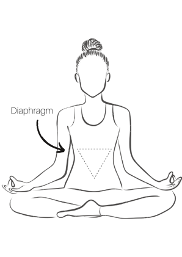
The diaphragm is one of the most important yet undervalued muscles in the body, yet without it, we would cease to exist. That’s because it’s not our lungs that breathe, but the pumping action of the diaphragm that inflates and deflates them.
As we breathe in our diaphragm contracts and flattens as the chest cavity enlarges. This contraction creates a vacuum, which pulls air into the lungs.
Along with inflating and deflating the lungs, the diaphragm performs other important tasks too.
- It increases blood circulation from its pumping action, and
- Helps to ‘massage’ internal organs as it contracts and expands.
A trusted formula for healthy breathing habits
Nose breathing + engaged diaphragm + slow, calm breaths
So, let’s now talk about the speed of our breath through each minute we breathe them.
How many breaths we breathe per minute
There’s a strong correlation between the number of breaths we breathe per minute to the level of stress we experience in the body. As stress is on the rise, learning how to take fewer breaths per minute could be a saving grace in a world that’s only getting faster.
Take a moment to review the table below. In it, you’ll find four different examples of the number of breaths we breathe per minute and how that relates to our overall health.
20 breaths per minute
Effect: High, consistent stress levels in all areas of life.
Location: Upper chest/throat
Nose or mouth: Typically mouth breathing (may partially alternate)
Possible side effects: anxiety, burnout, poor sleep, skin conditions, inflammation, chronic pain, extreme fatigue, excessive behaviour/addiction (overly talkative, binge eating, drug use, excessive coffee, alcohol, smoking, etc…)
15 breaths per minute (the average person’s breath count)
Effect: Medium levels of stress consistently throughout each day.
Location: Chest/throat
Nose or mouth: Both (may alternate)
Possible side effects: Alert, sharp mind. Anxious. Excessive behaviour/addiction (overly talkative, binge eating, smoking etc…)
10 breaths per minute
Effect: Calm, collective, peaceful, balanced. Stronger resistance from emotional and mental stressors. Less emotionally reactive.
Location: Belly/chest
Nose or mouth: Nose
Possible side effects: N/A
5 breaths per minute
Effect: Consistent meditative mind, optimal awareness.
Location: Belly/chest
Nose or mouth: Nose
Possible side effects: N/A
How many breaths do you breathe per minute on average?
A key thing to note of here is that this table is based on our day-to-day routine life. Exercising, eating, talking, lovemaking, and other daily activities will naturally fluctuate the number of breaths we breathe per minute but on average, it’s how many breaths we breathe most consistently throughout the day which is what’s important to pay attention to here.
This table also demonstrates how we can breathe stress into our lives but also how we can breathe it out. Below is one example of how to make that possible:
1 minute = 60 seconds
60 seconds divided by 10 (breaths) = 6
6 breaths divided by 2 (inhale & exhale) = 3
Inhale — 3 seconds
Exhale — 3 seconds
That’s very doable!
So, let’s now look at where we breathe in the body so we can better orientate ourselves towards this breathing pattern above if we so wish.
Where we breathe in the body — belly, chest, throat
If a full breath could be split up into three parts, roughly 30% comes into the belly, 60% comes into the chest/lung region and 10% comes into the throat.
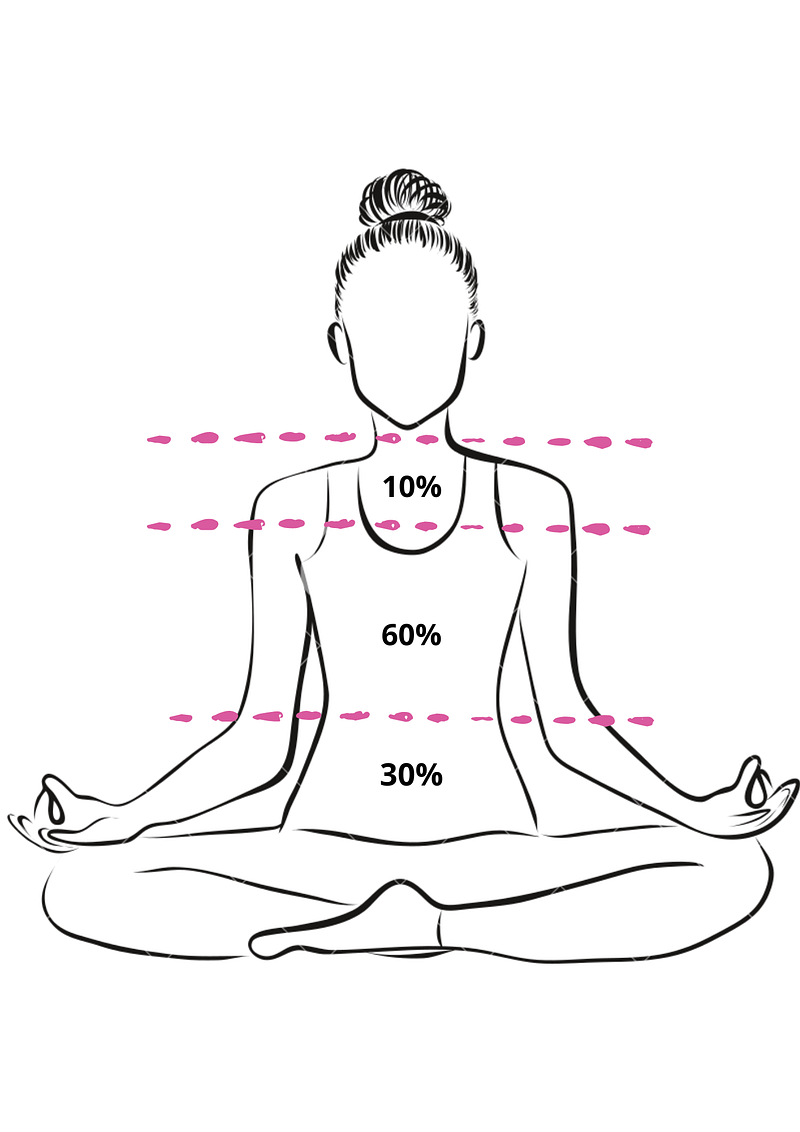
Depending on how deep you breathe, what physical shape you are in, if you have any physical health issues, how much stress you are under, if you exercise, or if you breathe through your nose or your mouth will determine which part of your body you breathe into most. Which part you breathe into most has a tremendous relationship on how your heart, mind, nervous system, and vital organs communicate. And how they communicate affects everything.
Which area of your body do you breathe into most consistently?
Some areas of the body breathe more stress into the body while others invite it to relax. High levels of anxiety, for example, live in the final 10% of the breath, right in the throat area, and are typically associated with mouth breathing. In contrast to that, a more open and peaceful state of being invites softer breaths that come into the belly area and are typically associated with nose breathing.
Whatever emotion is present in the body, it typically correlates to where the breath is moving — in the belly, chest, or throat — and whether it’s being breathed through the nose or the mouth.
It doesn’t matter if we’re talking about stress, anxiety, fear, arousal, excitement, joy, jealously, appreciation, boredom, peacefulness, compassion, empathy, disgust, anger, happiness, sadness, or anything in between, the breath will always be the first indicator as to what’s going on.
That’s why we can use the body and the breath to better navigate ourselves through our emotional body on a moment-to-moment basis by using specific breathing exercises or simple observation. If we do, we can actively choose what language our body speaks, and then take back control if/when things become unbalanced.
Closing thoughts
Changing any habit can be difficult, especially ones like the breath that can happen unconsciously. However, by just choosing one (say, nose breathing, for example) other healthily breathing habits come into effect too.
Nose breathing encourages diaphragmatic breathing, for example, and vice versa. So, my advice would be to simply become aware of your breath to start and then if you notice anything that wants or needs to be changed, start small.
Pick one.
Then see how many of the 15,000–20,000 breaths you can utilise to make it possible.
If you’ve been inspired by the breath’s power and presence, check out my favourite breathwork technique here
Or sign up for a free online masterclass here


