The Impact of Culture on UX Design
A hot topic corporates havent’t figure out yet
The importance of interculturality in business is a relatively new area in the working world. Before the world was truly globalized as it is today, it was rare to collaborate with people from other countries and cultures than ours.
The only exception would be large migratory groups, Mexicans in the US or North Africans in France. But before the ’90s, institutional racism meant that we did not care about their cultural particularities, on the contrary, we expected them to become invisible and adopt the culture of the country in which they resided.
Researchers in sociology, psychology, and organization has studied the impact of culture on work, first to understand the strategies put in place to carry out projects in different countries, then to understand how two people with different world views could complement each other in project management and finally to know how multiculturalism impacts (positively) on organizations.
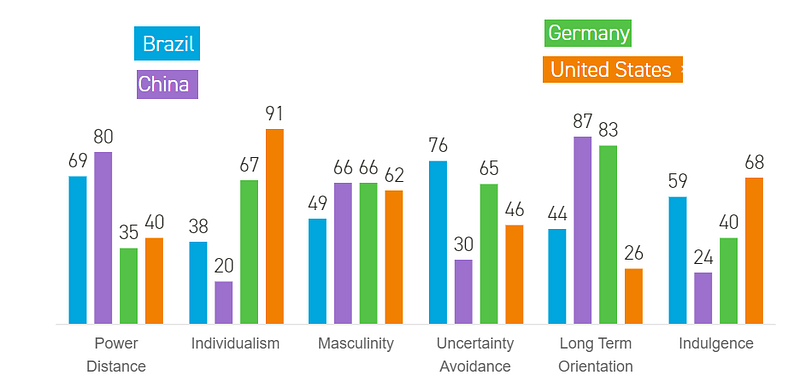
In the context of work management, Hofstede created a grid for understanding cultural relations at work. This grid appears in the book “Culture and Organizations: International Studies of Management & Organization” published in 1980.
Hofstede’s 6 dimensions were validated in a study for IBM.
Individuals differ culturally according to :
- Hierarchical distance This is the tendency to follow the orders of one’s hierarchy without questioning them.
- Individualism vs. communitarianism Is the tendency to think more for oneself or for the group
- Masculinism vs feminism Is the tendency to seek competition and power relationships or to seek consensus
- Control of uncertainty Is the ability to deal with the unexpected in a positive or negative way
- Long term vs short term Is the vision that cultures have of their work and the benefits that it should bring immediately or later
- Pleasure vs moderation Societies tend to want to satisfy individuals’ personal desires or follow strict norms to moderate personal desires
These dimensions have been studied in all countries to establish a cultural average. This does not preclude variations between individuals in the same country, but we can expect trends in their relationship to work.
Interculturality studies have been the basis for convincing companies that they should indeed diversify their teams to bring cross-cultural perspectives on how to carry out projects.
Today, we know empirically that mixing profiles leads to better results in most fields.
Interculturality applied to the world of design is a subject that is still little explored by scientific research. Designers from different cultures and countries work together on a daily basis, but this is due to globalization, the possibility to expatriate easily, remote work, and the general tendency of companies to hire diverse profiles today.
There are still some unresolved issues today regarding culture and design. American companies are not able to penetrate the Chinese market. Apart from the political implications, it is also a question of understanding the local culture in order to adapt the product design.

There is still an engineering logic in product design. Some things don’t appeal to certain user groups, but companies choose to ignore them.
Systematically creating profiles or registering credit cards is a practice that doesn’t shock in the US, but is problematic in Europe because the fear of leaving personal information on the Internet is still very present for many Europeans.
What does the research say today? Culture influences designers and people’s appreciation of certain types of designs.
The impact of culture on designers
Cross-cultural research has shown that strategies for dealing with problems differ across cultures.
The study “cultural influences on the design process” of Vivek Gautam and Lucienne Blessing, from Berlin’s University of Technology analyses this aspect from a macroscopic point of view by comparing the so-called western method and Asian cultures.
There are obvious differences between these two groups, but the studies say that there is an influence in the problem-solving behaviors that would be common.
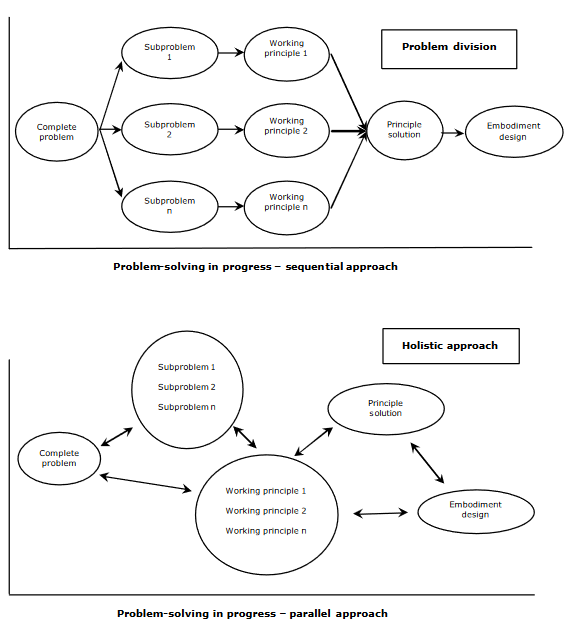
The Western methodology is called “reductionist”. Westerners tend to divide a task into subtasks and seek to solve each subtask independently of the others.
This approach is reminiscent of Taylorism with assembly line work or lean design which consists in modifying designs as problems are identified.
The Asian methodology is called “holistic”. Problems are approached as a whole, taking into account the environment in which they must be solved.
This method allows for better collaboration and ensures that aspects of a problem are not forgotten along the way. Since the work is not divided between several groups, everyone knows what the other is doing and what they need.
This can be reminiscent of Toyotism. Groups of all trades self-organizing to build cars.
These two ways of behaving in front of a problem to be solved have an impact on the way designers find solutions. With the reductionist method, the ergonomics, the Ux, and the Ui of a project are taken into account at different times and are clearly separated. With the holistic method, all aspects are treated at the same time by a single team.
The impact of culture on design
Taking into consideration the culture of a population is essential to ensure a good design.
Certain elements must be taken into account systematically because they will impact the users’ perception of a product.
- The reading direction Right to left left to right, or top to bottom will influence the usability of a product. The vertical reading of Korea allowed the country to export its comic strips because the format was perfectly adapted to phones.
- The colors Colors have implicit meanings related to cultures. Not taking this aspect into account can send the wrong messages. Rayman, Ubisoft’s mascot in the ’90s, had to change its color in Japan because purple is negatively connoted there.
- The symbols Every culture has its symbols and things that people recognize or not. It is also necessary to adapt the symbols to local preferences

People also like products more or less depending on their culture because they expect certain things from them.
“cross cultural HCI and Ux design : a comparaison of Chinese and westerne interfaces” by Pietro Romeo from the Technical University of Berlin studied the differences in Ux design of messaging applications, Whatsapp and Wechat.
Chinese users want to have a single application that allows them to do everything. Wechat is an instant messaging application similar to Whatsapp, except that Wechat also allows you to view contacts’ profiles like on Facebook, serves as a banking application, and much more.
The not very individualistic aspect of the Chinese culture (according to Hofstede’s grid) could be linked to a will to have a unique application allowing to do everything at the same time.
On the contrary, the individualistic aspect of European and American societies would be linked to a preference to have an application for functionality.
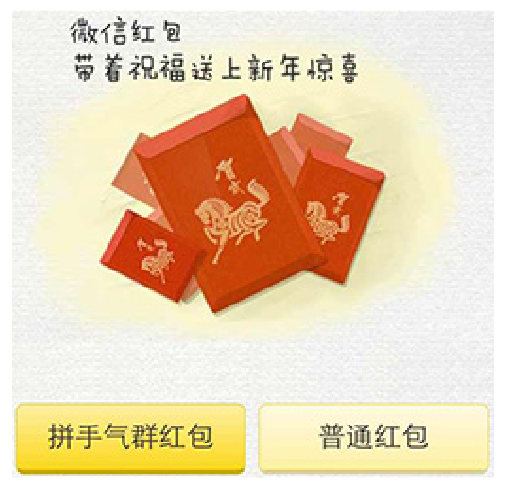
Other features of Wechat are really linked to Chinese customs. The application allows you to send “red envelopes”, a type of gift made on New Year. These envelopes filled with money can be sent to contacts or even on groups on which the fastest to see the message can get the contents of the envelope.
The relationship to money is different in the West, the idea of sending money via an instant messaging application at random seems strange and would bother users.
Hofstede’s criteria were linked to Ux design practices related to colors, architectural information, text tone, etc.
The cultural aspect of the design is still neglected today because of the desire of companies to impose their visions rather than adapt them to different audiences. Culture is an important aspect of the life of designers who are unintentionally influenced in the way they design and consume digital products.