
The Ignored Obvious of UX Design Interviews (and interviews in general)
This article focuses on the important steps to take to prepare for UX Design interviews. Following these steps could partially eliminate surprises during the interview and establish practices that result in a smooth process.

Past 8 months, I have been on a rollercoaster applying for UX Design roles first for internship and now for full-time. On this exciting ride, I have learned nitty gritty details about how interviews are conducted and factors that are overseen by the interviewees to make an impact. As I appeared for more interviews and discussed the interview experience with friends, the way I prepare for it evolved. I finally got into a nice rhythm of completing several steps to improve the interview experience.
Recently, I was helping several of my friends to prepare for interviews and while discussing their approach to interview preparation I realized that there are so many obvious steps that were being overlooked. I found myself stating the obvious more often than I expected. This made me wonder if things obvious to me are not very obvious to them. This is the reason I started to compile my process and thoughts to document it, and resulted in this article.
The suggestions discussed in this article have benefited myself to perform well at interviews. However, this is in no way a guaranteed approach to land a job. These are just a few tips for you to prepare well for the interview, but the decision would depend on a lot of other factors too that are not discussed in this article. Also, though I learned them from my experience with UX Design interviews, I think some strategies are applicable to general interview process. So let’s get started.
#1 Do Your Research
Being a UX Designer, I use research to understand the problem at hand, know my audience, and gather enough context information to make an informed decision for further steps. Research is an integral part of my design process and I apply the same to interviews.
In most cases, especially UX Interviews, the recruiter would share details like- name and role of the interviewer, the team you will be interviewing with, link to products that team work on, and link to company information. This is a good starting point for your research. Let’s go into details for what you can research about.
Explore the company
This is the foremost aspect you should research about because you are first an employee of the company and then a part of a respective team within the company. Each company have their own set of products, their business domain, culture and values that are developed overtime. It is valuable for the interviewees to read about these aspects and have a deep understanding of the company. It shows the interviewer and the recruiter that you are interested, and you care about the potential company you wish to work for.
Strategy to research about the company-
- Check the resources shared by the recruiter before the interview. This might include links to videos, articles and website.
- Check recent news articles published online by and for the company. Get a sense of what is the buzz around the company right now.
- Connect with existing employees, via LinkedIn or Twitter, and learn from them about what they admire about the company.
- Connect with previous interns and ask about their experiences.
Know your interviewer
This too is a key step since the more you know your interviewer the better you know what to expect. It is not very different from the UX Design process which starts with empathizing with your users and this helps you design better for them. I employ the same approach to interviews.

In most cases the recruiter will inform you in advance the interviewer for your interview. If not, you can ask the recruiter for details. Once you get the information, look them up on LinkedIn, Twitter, Dribbble, Behance and Medium. Check the past companies they worked for, what did they study and what was their career path. Identify their passion and personality as a designer.
To help with this, you can ask yourself the following questions-
- Do they value visual design more than functional design or vice versa or both?
- Do they focus a lot on the process?
- Are they more interested in different tools and techniques used in the UX Design process?
- What is their role and responsibility in the team?
- Is there any recent podcast or interview where the interviewer was featured? If yes, go ahead and listen to it.
This will help you anticipate their goals for the interview and expectations from you. Since this is all based on secondary research, the predictions will be based on a lot of assumptions and your understanding of all materials. There will be missing dots but, it is ok! You can learn more about the interviewer during the interview and connect the dots on-the-go. But this will give you a head start to prepare for the interview.
For example, for my UX Design intern interview with Salesforce, my first interviewer had a visual design background and was currently working as a Senior UX Designer. So my focus while explaining the projects was on product design process and UI design. I tried and avoid any development jargons and explained everything related to development in a very simple manner. My next round of interview was with the Director of Software Engineering and Manager for the CX Tools team. Here, I knew I had to focus a lot on the big picture thinking, project scheduling and management, product strategy based on research, and finally convey how effective the solution was for users. I would say this strategy worked out pretty well for me and help me prepare strongly for certain aspects in respective interviews.
How will this help you?
- Help you tweak your elevator speech and background information for the interviewer. You will know what key points to hit from your journey to get into design.
- Help you identify the right project from your portfolio to discuss during the interview.
- Help you tweak the project explanation based on interviewers interest.
Research the product
Once you know the interviewer, you should look into the product the interviewer works on. This might be a potential project that you will work on and it is good to have a sense of what you are getting into. Knowing the product will also give you an opportunity to ask questions and know more about the product during the interview. I will highly recommend reading as much as possible about the product.
Where can you look for product information?
- In this era most products have some form of open source GitHub repo. Visit the repo and go through it’s documentation.
- If there is a Twitter account for the product, skim through the feed to know the recent discussions.
- Checkout any articles about the product and it’s documentation. This should give you a good overview of the product.
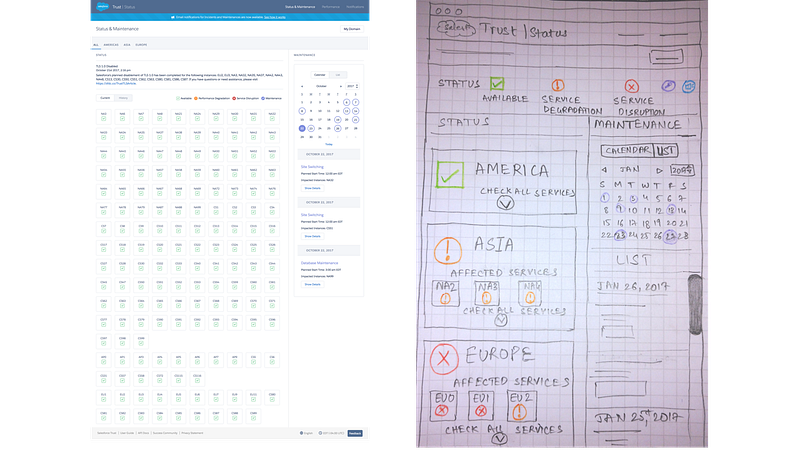
If you want to go above and beyond, try out the product and have feedback for the respective team member who is interviewing you. This will show that you are not afraid to take initiative to learn the product and share your perspective. But be very sure to mention the assumptions you have made to form your suggestions. Each team have to abide to respective principles, encountered challenges and are tied to constraints while constructing a product. These are hard to know without talking to them. Thus, be considerate and respectful while putting your feedback in front of them. Following is an example of a sketch I made to present my idea for redesigning Salesforce Status website. As I mentioned before, I detailed out all assumptions and considerations to accommodate the proposal, and it was taken positively by the interviewer.
#2 Take Control Of The Interview Facets Not Directly Visible
Interview is an obscured process and a short time to make an impact. And let’s be frank, to clear an interview, it is really important for the interviewer to feel convinced and positive. After your research, you should have a good context of the interviewer and the company, however, that is obviously not enough. There are a lot of factors to be managed during the interview to be successful. Let’s see what are some of those.
Being on the same page
One of the prime task for UX interviews is portfolio review where you explain a project step-by-step with the help of process laid out typically on a webpage. For this setup, the candidate and the interviewer access the candidate’s publicly available portfolio on their computer respectively, and then both scroll through the webpage as the candidate explains the project step-by-step. Simple, right? But this is not what happens.
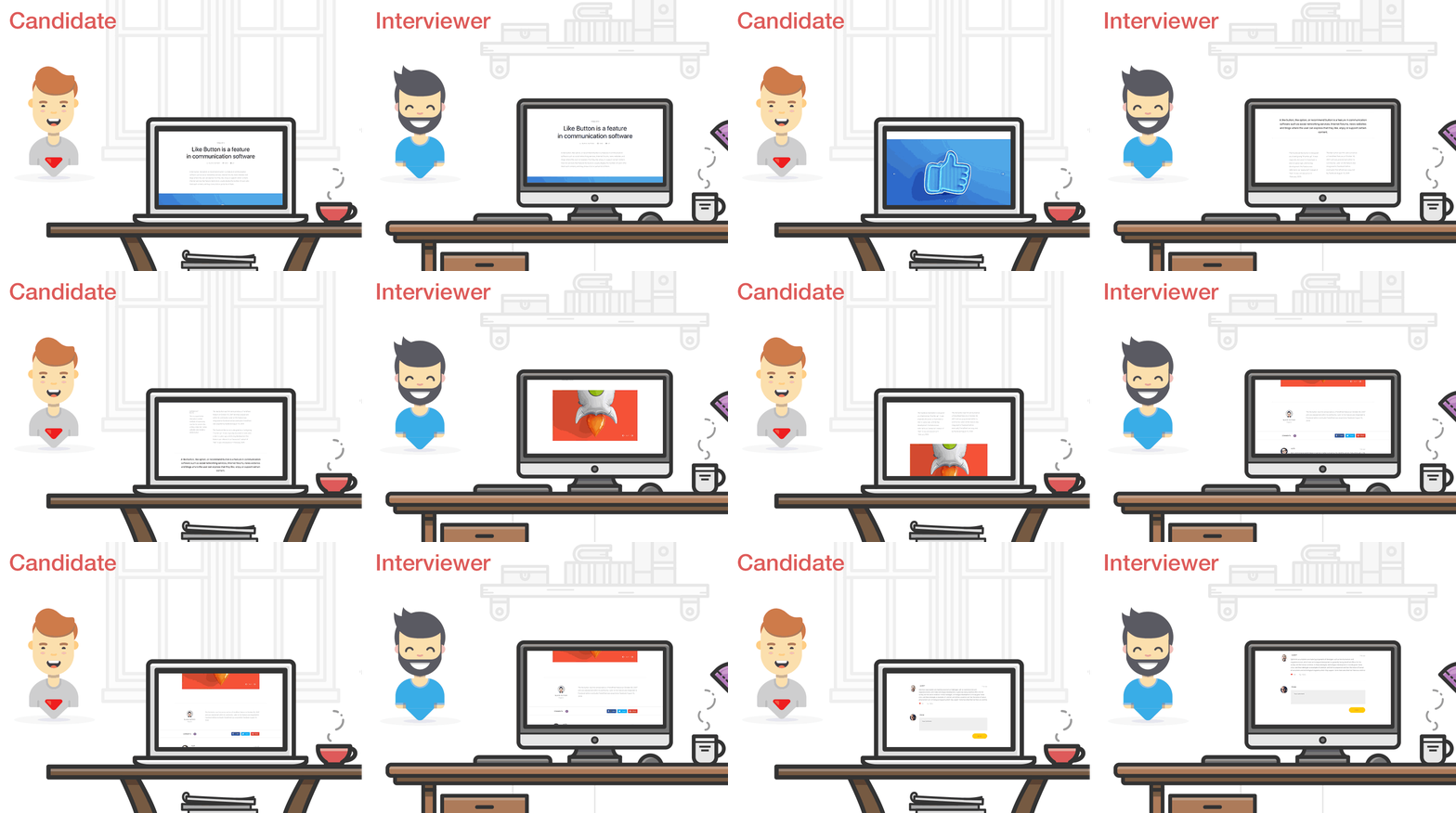
Considering the amount of content we access these days, the first tendency of the users is to scroll. The interviewers prefer to explore the project themselves while the candidate explains it. Thus, the interviewers are listening to the candidate and exploring the project content at the same time. This leads to divided attention and might result in a hard time attending to two stimuli at a time. Interviewers can get better with practice, but there is a possibility of this happening. As a candidate, we want them to be selectively focused on what we are trying to explain at each moment of the interview and then refer to the visuals and resources on the webpage to enhance the understanding of the interviewer. Undivided attention from the candidate and the interviewer would lead to better and thoughtful conversation.
To avoid the possibility of this caveat, I have the following suggestions that might help:
- Check with interviewer more often while you are explaining the project. Ask them if they have any questions, or something is not clear in your explanation. Ask them if they need more details on a particular section or step in the process. This will ensure clear communication between you and the interviewer during portfolio review.
- Instead of a project webpage, use presentation slides. You can share the presentation slides with the interviewer and go over it as you control it. Mentioning specific slide numbers gives you a better control over what the you and interviewer are looking at. This suggestion was shared by Akshay Potnis, a talented Interaction Designer who recently joined Google.
- Share your screen and you control the project webpage/presentation. This gives you an opportunity to make sure that the interviewer is looking at the section you want them to look at while explaining the project. This setup also opens up the possibility of presenting design files, reports, and more resources that are not accessible publicly on your portfolio.
Be easy paced since interviewers take notes
Job interviews are not very different than user interviews for UX Research. I see them as a semistructured interview where the interviewer is trying to understand the interviewee and get as much information as possible to make a decision. In this process it is the interviewee’s responsibility to share as much essential and relevant information as possible to help the interviewer make the decision. But in the process of sharing more information in limited time, we tend to talk swiftly.
We as humans can only remember limited things. There is so much information crunched into limited time of the interview, it is near impossible to recollect everything after the information. Thus, it is important to be aware of the fact that the interviewers take notes and it is our responsibility to enable them to take the best notes. Being easy paced during the interviews will ensure that you are giving enough time to the interviewer to note down information, to process the information shared, and ask follow-up questions back to the interviewee. This will result in a more conversational and interactive interview with meaningful insights shared.
Tell a story
The most salient part of explaining a project is to take the interviewer through the story from persona’s perspective. So instead of bluntly telling the problem, the process, and the solution of your project, take the interviewer for a tour using the persona. While explaining the story, first explain who is the persona, what and why is the persona facing the problem, how did you go about your process, what is your solution, and finally, how does the solution impact the persona’s problem. This will give them a good context for the problem and the solution you are trying to sell via your project.
In the article Getting Hired for Design at MailChimp, Chase Curry, a Senior Designer at MailChimp, explained the importance of storytelling for interviews. He stressed on how storytelling represents your ability to break down complex problem, synthesize important information and educate the interviewer in an effective manner as a part of the interview. I would definitely recommend a read.
Ask questions that interviewers can relate to
I believe, based on availability, a designer would conduct multiple interviews while working for a respective company. Thus, to get selected, it is critical to make an impression on them. Interviews are a short time to make an impact and the opportunity to ask questions is a significant step to make that impact and say that you think deeply about design or how designers work. If you ask common questions like ‘what does your typical day looks like?’ or ‘what do you like about working at the company?’ it might tell the interviewer that you are only looking for generic information. Also, these questions are easy to answer, and thus, easy to forget you after the interview. If you ask impactful questions that makes them think not only during the interview, but also after, you will be in their head for sometime.
Also, prefer to ask questions that the interviewers can relate to or you know they might be in a better position to answer. As I have learned in the dos and donts for user interviews, it is better to ask questions that can be answered based on personal/past experience, than taking opinions as input. If it is later, then it becomes a hit or miss situation which we want to avoid.
For example, if you are interviewing with a designer at Facebook in the messenger team, do not ask them questions about how the Facebook Design Language is maintained. I am sure Facebook will have a separate team just to maintain and innovate the design system and language. However, you can surely ask them, how do they utilize the existing design language and extend it for messenger. This presents more intentional approach to get the rich information.
I found the following article really awesome for UX interview questions-
#3 Use Analytics To Understand The Interviewers
Analytics is a free resource that is unexploited for UX portfolios. Analytics is a powerful tool to get a sound estimate what the interviewers are interested on your portfolio. It gives you the power to understand your audience even before interacting with them. This opportunity should not be neglected.
I use Google Analytics to understand where my bulk audience is coming from, spot any hits from companies I applied to, determine projects that are accessed more frequently and diagnose load time issues. However, if I want to take a deep dive into the elements users interact with, I use Heap Analytics. Few instances to make sense of analytics data relevant to your portfolio are provided below. If you wanna learn more about analytics, you can checkout Google Analytics certification course.
Real-Time audience
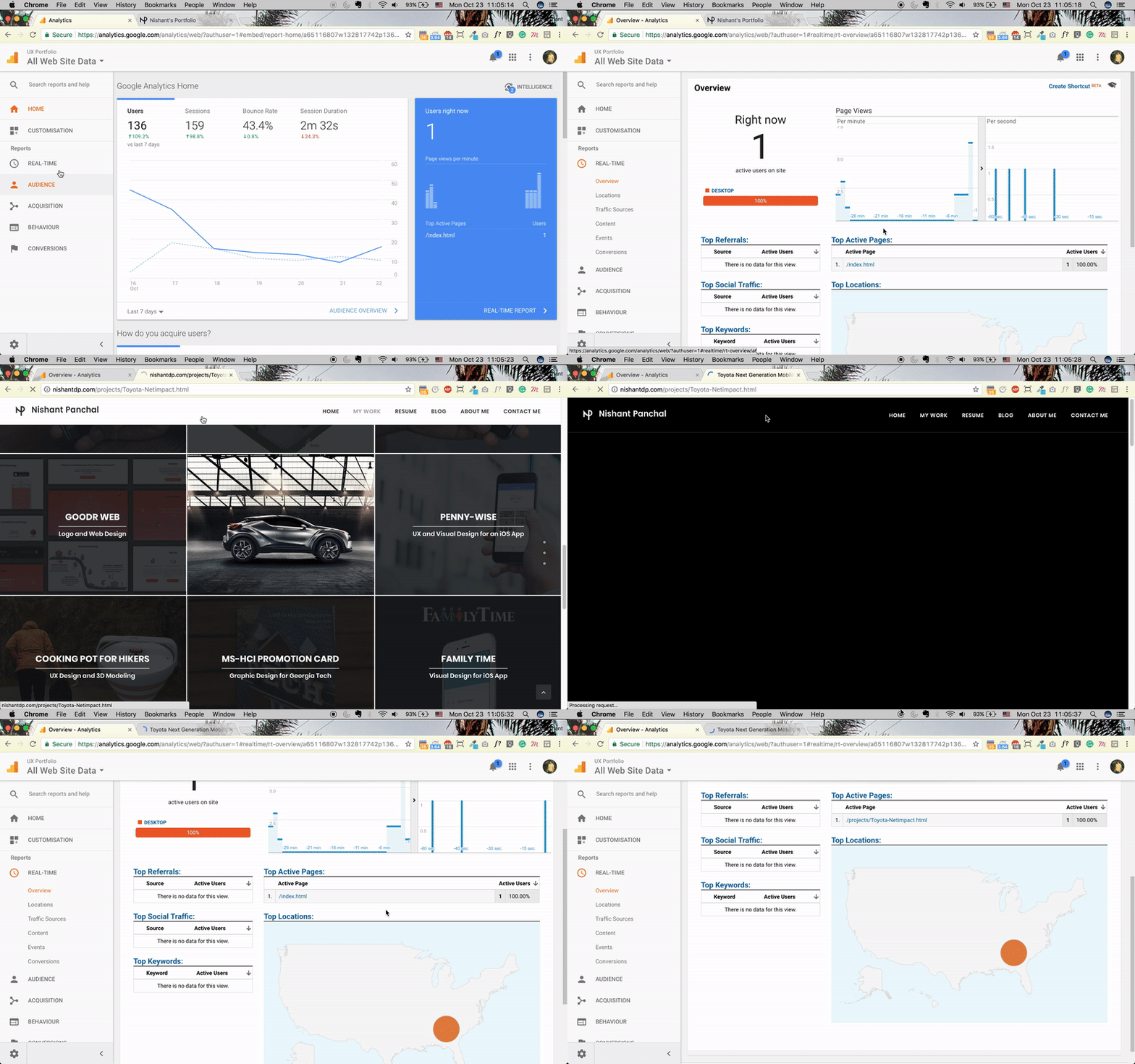
This option allows you to see number of users accessing your website in real-time. You can also see their location and the pages they are accessing. This information is particularly important right before the interview starts. In most cases, the interviewer will visit your portfolio 20–30 minutes before the interview starts. This is an opportunity to see which project the interviewer is visiting and prepare for them to discuss during the interview. This brilliant idea was shared by Geunbae "GB" Lee.
Audience details
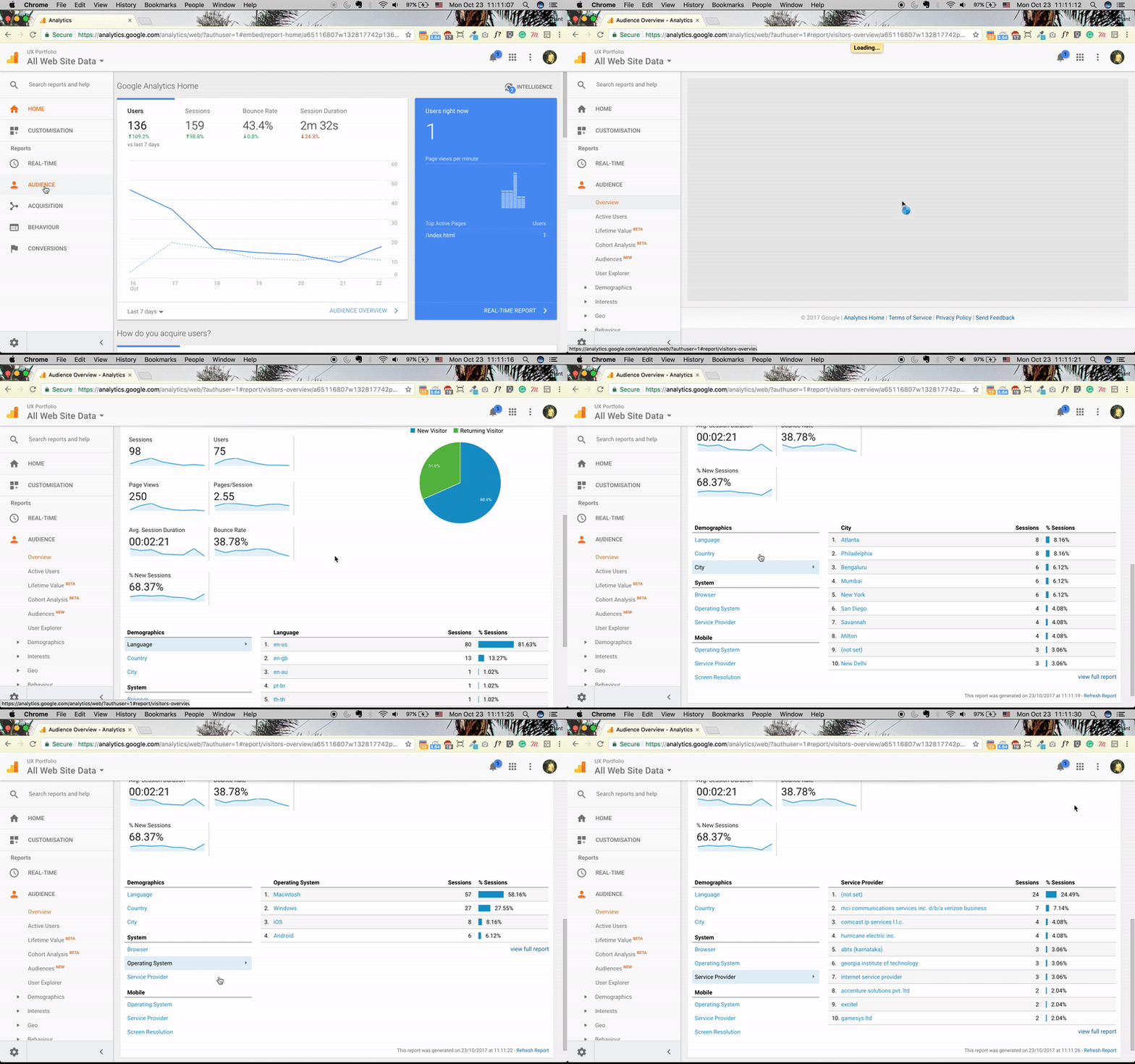
Using the Audience tab you can learn more about your visitors. There are a lot of terminologies that you can learn more about here, but some of the important attributes to check are-
City- This help you guess which companies (based on location) are visiting your portfolio after you submit your application.
Service Provider- Most of the information points can be ignored for this attribute since it contains the names of internet providers. However, in some occasions you will find name of companies. For example, Salesforce.com, Georgia Tech, Pinterest.com, etc. These are good indicators for which companies are actually interested in your candidacy.
Operating System- This attribute plays a big role in deciding whether you need to optimize the mobile version of your website. In todays world, having a responsive website is an implicit expectation, however, they may not be optimized for mobile view. Depending the % of hits you receive from mobile users, you can decide to focus on optimizing the mobile view.
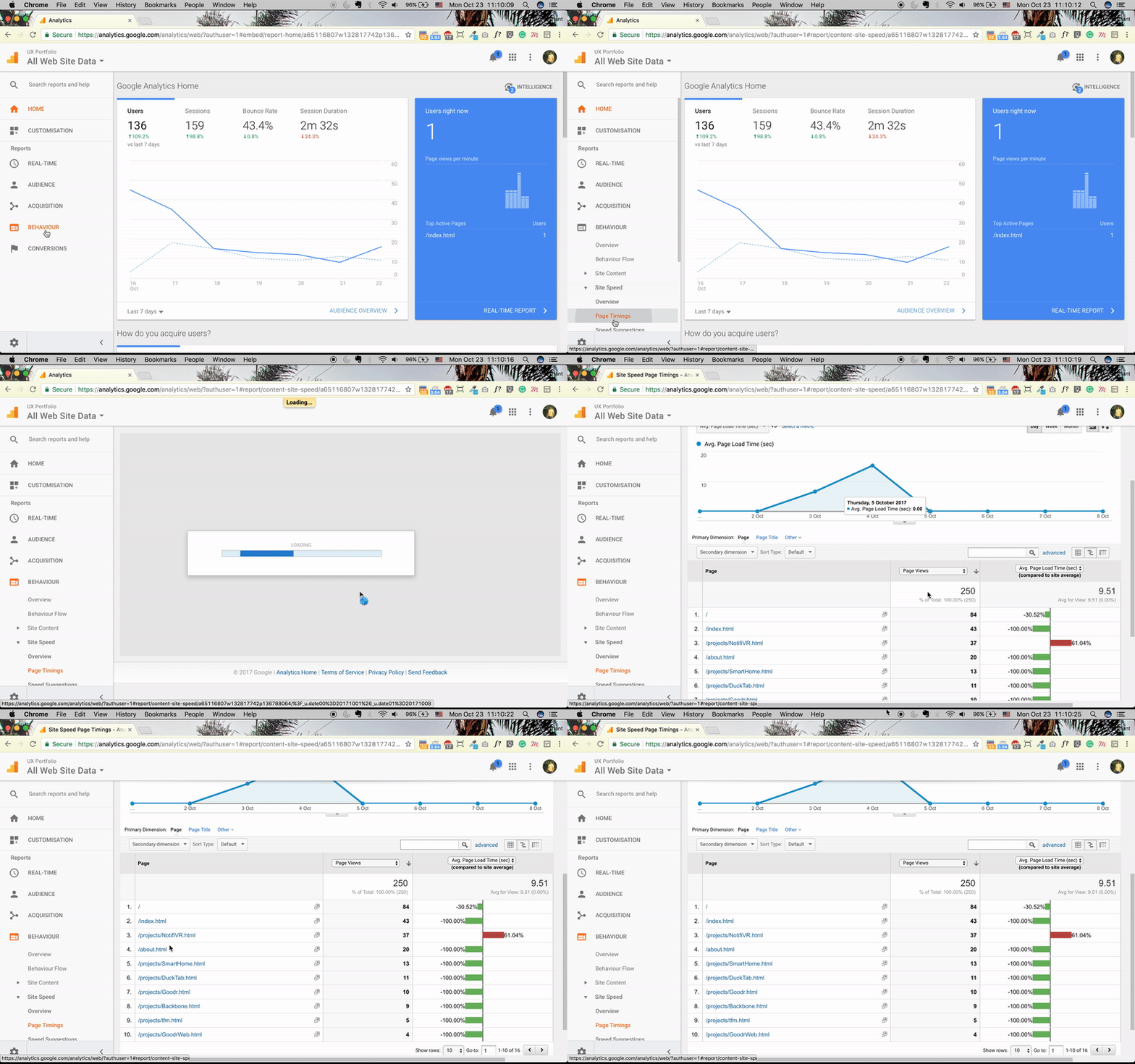
Check page load time
Recruiters and designers viewing your portfolio probably have 100 other candidate portfolios to go through to fill a single position. In this situation, the page load speed of your portfolio is vital. The Page Timings section gives you an overview of how all pages on your portfolio are performing relative to the average load time for your website. This will easily tell you which page is dragging the performance of your portfolio and you can debug it further. This is not directly related to interview preparation, however, it is important to solve this issue to make sure you have smooth performance during the portfolio review.
Conclusion
That’s all I have got to share in this article. I believe taking the UX approach for interviews itself lead to a better chance of having an effective interview. Start with research, prepare well, and finally be pro-active and take control of the interview process.
Thank You for reading!
A lot of amazing content is in works. I promise to write more about the Design Strategy, Productivity, and Interviews!

Thanks for the 50 claps👏🏼 if you enjoyed this article. This will tell me to write more of it! Also leave your valuable feedback on how I can improve.
Read another article on UX Design Interviews based on my experience interviewing with Salesforce, Google and Apple.
Wanna talk more about design? Get in touch.
LinkedIn / Dribbble / Portfolio


