
The Idiots Guide to Margin Trading on Bitmex
Warning: margin trading is not suited for beginners. You should have at least several months of trading experience before attempting to margin trade. Note that using the information below is done at your own risk. This is not financial advice blah blah blah….
Ok, now that we got that out of the way…
Let’s get you started making some of that Bitmex “short trade with 100X leverage” money you’ve heard so many people talking about (btw, never do that…and if you do, you’re an idiot).
Whether you love em or hate em, Bitmex has the potential to take you from zero to hero faster than any other trading method out there. This is potentially the biggest draw to the Bitmex trading platform.
If you have a solid understanding of technical analysis, a trading strategy with a proven track record, and lots of trading experience under your belt, Bitmex may be your “go to” cryptocurrency exchange for some of that quick crypto cashflow.
However, if you’ve only traded for a few weeks and don’t have a solid understanding and proven game-winning trading strategy, Bitmex will wreck you faster than Mike Tyson on acid.
This is for heavyweights only. If you haven’t been through a few battles yet, don’t step inside the ring.
How to Get Started Trading on Bitmex
I highly recommend you open up your Bitmex trading account by using the link here in order to register. You receive a 10% discount on all your transaction fees for the first six months at no additional cost to you. Now do it!
For US Residents…
If you’re a US resident, you need to make sure that you’re either using a UK VPN or private proxy when signing up. I recommend you use BuyProxies.org and purchase their lowest tier package which is $10 per month.
Once you’ve completed your registration, you no longer need the proxies (or VPN if you decide to go that route). You can sign in with your standard US IP (no proxy or VPN) from there on out.
Ok, now that we got that out of the way, let’s get you started with the fundamentals…
Also Read: The Best Crypto Trading Bots
Bitmex Margin Trading In Plain English
I’ll start off by defining a few terms that you’ll need to be familiar with in your early stages ….
Margin trading — this is the method of conducting a purchase using cash that is provided to you (the trader) as a loan. In reality, you’re not really “borrowing funds” from any centralized entity, you’re merely swapping out “contracts” with others utilizing the platform.
If you’re shorting, you’re swapping out with someone going long. If you’re going long, you’re swapping out with someone that is shorting.
That’s the gist behind it all. For the sake of this guide, I’ll loosely use the term borrowing.
Leverage — the amount of funds that you decide to borrow. The higher the leverage, the more funds you borrow, and the more risk you take at getting liquidated.
Example: $1000 with 5X leverage = $5000 your trading with. Your liquidation price is given to you before and during your transaction, so you should never be surprised at where it’s at.
Liquidation price — this is the price at which your account balance (or amounts of funds you’re using) is completely wiped out.
Example: $100 with 25% leverage at BTC entry price of $7500 = $6002 liquidation price.

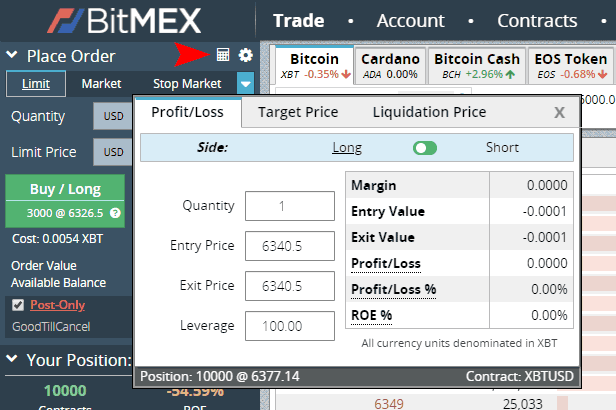
Don’t worry about calculating all this stuff by yourself. Bitmex was nice enough to provide you with a calculator. You’ll never be left in the dark when it comes to your profit, loss, or liquidation price.
Long position — betting that price movement will increase.
Short position — betting that price movement will decrease.
Limit order
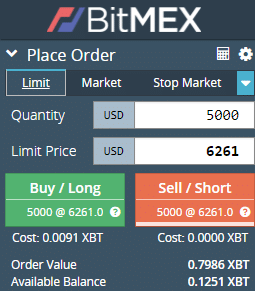
— (aka market maker) set a price and have it filled once the market reaches your set price. 9 times out of 10, you should be using this for all your trades to prevent paying high fees.
Market order
— (making you the market taker) this is where you’ll immediately exit your trade. For having this convenience, you pay 3X the fee (%0.0075 as opposed to %0.0025).
Take Profit — like the name implies, this is where you start taking profits as the price value increases. The opposite applies for shorts. You want to start taking profit below your entry price.
Stop Loss Limit — this is to prevent you from completely losing all your capital from a sudden drop (for longs) or sudden spike (for shorts) in price action. Once a stop loss trigger has been reached your trade initiates your stop loss limit price. Once this limit price has been reached, you’re exited out of the trade. This will ensure that your loss is minimized.
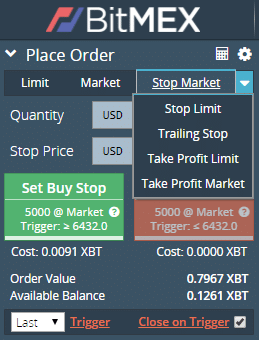
Stop Loss Market
— the same as stop loss limit, however your trade will be “immediately exited” at the market price. I highly recommend using this over the stop limit when you’re not close to your computer (or on any occasion for that matter).
When price drops, it drops fast. There’s a good chance that your stop limit price will not activate and you’ll be left holding the bags (debt). Using the stop loss market, ensures you that during a strong dip, you keep your losses to a minimum. You’re guaranteed an exit out of the trade, which again, is not always likely with stop loss limits.
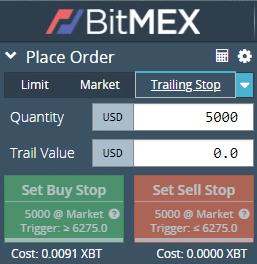
Trailing Stop
— think of this as a “moving stop loss” that follows the current price by a set value.
Example: $1000 at BTC entry price of $6500 with a trailing stop loss of $250 would mean that if the price action decreases to $6250, you would be stopped out (exit the trade).
However, if your price increases to $7000 and then drops $250, it would be stopped out at $6750. This is a great feature to use when you’re trade is already in profit.Trailing stops will ensure that you take advantage of quick spikes in price if you’re not by your computer.
Bitmex not only allows you to trade with borrowed money, but enables you to make a profit on both an uptrend or downtrend. No longer will you be confined to bull markets once your familiar with this trading platform. Hell, you might actually look forward to bear markets. You can make just as much during these periods of margin trading than you can within bull markets, if you play your cards right.
Now let’s look at the various ways to leverage your trades on Bitmex…
Leverage Trading on Bitmex

The cryptocurrency exchange allows you to create anonymous accounts without giving your real name or information. In order to start trading on Bitmex, all you really need to do it is deposit Bitcoin into your account. No other currency is accepted as a deposit, so don’t send you’re Ethereum, Litecoin, Ripple, or any other altcoin for that matter. Deposits are fairly quick, but this is highly dependent upon how busy Bitcoin miners are. I typically receive my deposited funds within 15 to 30 minutes.
Be aware that Bitmex doesn’t actually trade in Bitcoin, it trades in contracts. Contracts are an agreement to buy or sell an asset (in this instance cryptocurrency) without actually owning the actual currency. Once you withdrawal your funds, your contract for those funds are awarded to you and therefore “real Bitcoin” is sent to your destination address.
Bitmex offers two types of contracts…
Perpetual Contracts

Created specifically by the Bitmex team, this type of contract is also known as a “perpetual swap”. This is the type of contract you’ll be primarily trading when you’re first starting out, especially when you’re day or swing trading on a shorter timeframe (like 4 hour and below).
These contracts don’t have a specific date at which they will expire, so they are great for short term trading. They have a variable interest rate where cash flow is added or subtracted from your current equity. For more detailed information, click here.
As the name suggests, these contracts are continuously renewed. Perpetual contracts are also known supposed to be less volatile; however you wouldn’t think that’s the case when looking over their charts.
For having the ability to use these contracts, you’ll pay a fee every 8 hours of 0.0015% for longs and you’ll actually get a rebate of 0.0015% for shorts. Ethereum fees are much higher at 0.1562% for longs, but you receive a much larger rebate at 0.1562% every 8 hours.
For more detailed explanation of fees, click here.
Futures Contracts
This is basically an agreement between a buyer and seller to exchange a currency at a defined date in the future for an agreed upon price. Futures contracts tend to have a fixed interest rate which makes them great for longer term trading, like swing trading (using the 4 hour charts) or shorter term investing.
The great thing about these contracts is that they have a fixed interest rate which doesn’t fluctuate over time.
Now that you have a basic concept of margin trading terms, let’s move on to the next step and cover short trades.
Transform Your Diminishing Crypto Account into a Powerhouse Portfolio in Under 60 Days with Our HIGHLY PROFITABLE CRYPTO ACCOUNT BUILDERS >https://CryptoAccountBuilders.com — — — — — — — — — — — — — — — — — — — — — — — -
How to Short Cryptocurrency on Bitmex

Bitmex offers quite a few cryptocurrencies to short as of the release of this guide. The altcoins they include within their platform change constantly. At the present moment you can short these altcoins with the corresponding leverage.
Ethereum (ETH) up to 50X leverage
Litecoin (LTC) up to 33.3X leverage
Ripple (XRP) up to 20X leverage
Cardano (ADA) up to 20X leverage
Bitcoin Cash (BCH) up to 20X leverage
EOS (EOS) up to 20X leverage
Tron (TRX) up to 20X leverage
Bitcoin (BTC) is the only crypto that you can leverage up to 100X leverage, which I would not recommend. When you’re leveraging past 50X, you’re essentially gambling. With that being said, if you have spare change laying around and are feeling lucky, go ahead and roll the dice. Just know, the odds aren’t in your favor. With $100 at 100X leverage, you can make $1000 in less than a few minutes (or lose it). You obviously don’t want to do this with rent money!
Back to short trading…
Shorting works in the same way as a long position except you’re placing trades on the decrease in value of a particular currency. This would’ve been the ideal way of taking advantage of the extended bear market this year (2018 and still continuing).
As an example, if you kept $2000 in a longer term short with Bitcoin on January 6th where the price of BTC was ~$17,000, till today,, without touching it, you would have $3280 (64% gain + a rebate on your fees) during this period. Remember, that doesn’t account for all the times you might have cashed out of the short due to intermittent bullish trends, which would have potentially left you with 2–5X your profit…easy. A few of my friends made over 700% during this period, shorting BTC and made 3X as much shorting altcoins.
So just remember the wise old saying…. “The trend is your friend till the end”.
Don’t trade against the trend, trade WITH it!
For more information about shorting and how to create wealth for yourself during a bear market, check out our “Top 5 Ways to Profit in a Crypto Bear Market“
Shorting Altcoins
As a general rule of thumb, if Bitcoin moves up, then altcoins move down. If Bitcoin moves down, altcoins move down. If Bitcoin consolidates (moves sideways) then altcoins move up. If you can follow the simple rule, you’ll have no problem knowing when to short or go a long with margin trading altcoins.
Tip: TradingView will show you the altcoins that are moving with or against Bitcoin under the comparisons feature.
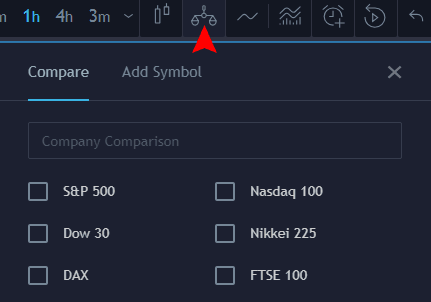
You can use this highly useful feature in order to view which altcoins are about to drop or rally before it happens. Bitcoin typically leads the way as far the trend so, for example, if you see Bitcoin starting to quickly drop and know which altcoin(s) move in the opposite direction, you can set up a long trade for those altcoins before it happens.
However, make sure to always keep a tight stop loss in case the altcoin decides to move in the same direction as Bitcoin.
How Much to Leverage: A Warning to All Newcomers
One of the more significant facets to margin trading with Bitmex is that you can leverage your trades with as much capital as you want. With that said, I highly recommend you keep the leverage to around 3X-10X to start. Anything above this and you’re risking liquidation. One false, call with a bit too much leverage, and your account can be wiped out in no time. If you’re trading with 20X and over on a longer term trade, you’re just looking for trouble.
If you do decide to leverage more than 20X, make sure you do it with a small amount. Experienced traders who scalp trade with 20X-40x are typically watching the charts like a hawk for any dramatic movements. If or when the trade moves against the trader, with strong full-bodied candles, stop losses are typically put in place. Never try this unless you have at least several months of Bitmex trading experience.
No matter what, remember to…
Always plan your trades out ahead of time and never trade in a rush. Typically, when you try to “catch a falling knife” or “catch a moving rocket”, things don’t end up going very well for you. The more adrenaline coursing through your body, the more idiotic your decisions become.
The Difference Between Isolated and Cross Leverage
You have two types of leverages with Bitmex, Isolated and Cross. You can switch between one or the other by simply adjusting the leverage slider on the “Your Position” box located on the left hand side of your trading panel. Use Cross leverage by moving the slider all the way to the left (obviously where it says “Cross”). Use isolated leverage for the remaining numbers (2x,3x,5x,10x,etc)
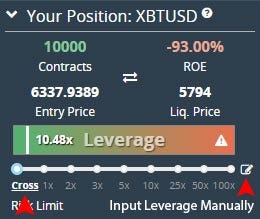
Now bear in mind….Isolated leverage does not automatically multiply your position. No one on YouTube seems to be explaining this properly. Once you move the leverage slider, this merely adjusts how much margin you can use. You still need to manually change the quantity yourself.
For example: if your account contains $1000 and you move the leverage slider to 3X, then you’re capable of trading with $3000. You need to manually input $3000 into the quantity box.
Regarding cross margin…
You no longer need to worry about moving the leverage slider. Cross will simply use all the funds available in your Bitmex account for the margin. Just think of it as an automated way of Bitmex calculating the margin for you.
Now, read this sentence carefully… your profit is determined by the quantity and not the leverage itself. Leverage has nothing to do with profit. The amount of profit that you make is dictated by the size of your position. The leverage simply sets a limit on how much you can borrow for the quantity of your position.
Here are a few examples of Cross margin…
Your account contains $1000 and you want to use 3X leverage. All you need to do is input $3000 into the quantity box and your account is automatically at 3X leverage. If you wanted to 10X your leverage, you would simply input $10,000 into the quantity box.
By using cross margin, you’re eliminating one step from the process of manually inputting the leverage (moving the slider). The only thing you need to worry about is inputting the amount into the quantity box. However, if you don’t want to utilize your entire Bitmex balance, isolated margin may be the right choice for you.
Transform Your Diminishing Crypto Account into a Powerhouse Portfolio in Under 60 Days with Our HIGHLY PROFITABLE CRYPTO ACCOUNT BUILDERS >https://CryptoAccountBuilders.com — — — — — — — — — — — — — — — — — — — — — — — -
I personally recommend using cross margin and only deposit a limited amount of funds into my account so I’m not tempted to lose it all in one trade.
Beginner Bitmex Quick Tips & Trading Strategies
Trading on Bitmex can be extremely fun or depressing depending on what strategy you decide to use. Here are a few tips I picked up along the way to help maximize my gains and lower the chances of losing a trade.
- Be the Market Maker, Not the Taker — don’t waste so much money on fees. If you’re using “Market” with most of your trades, you’re getting killed here.
If you’re not familiar with the terms market maker and market taker, simply put… a market maker creates limit orders within the order book (thus waiting for his trade to execute). A market taker uses the “Market” button when buying or selling into a position (thus executes a trade immediately at market price).
Always use limit orders (you’re the market maker) for your trades. The fees are 1/3 the price of a taker fee (market taker). Also make sure to click on the “post only” tick box so you’ll only be able to use limit orders.

Many times, depending on the market, you’ll receive a rebate on your fees. While the fees seem small at first glance (0.0075% taker fee), this adds up to a lot when considering that this fee includes your leveraged amount and not the actual funds in your account. For example, if you’re on cross margin at 100X, then you would be paying 7.5% on the total amount.
The only time I recommend using market is during stop losses. Use the stop market feature when setting your stop losses. The market moves so fast that most of the time, if you set a stop limit, it won’t get filled. You’ll be left holding the bags or worse, getting liquidated.
- Use Cross Leverage — I covered this above, but it’s worth repeating. Most of the professional traders use this leverage type because it helps guard against those crazy Bitmex fluctuations where you might have the right call, however you get liquidated right before that major pump.
- For example: If you have 1 BTC and you open a position worth .1 BTC, on normal 100x leverage, your liquidation would be ~$60 away from your entry price. With Cross, you have .9 BTC as margin, meaning your liquidation would be about $600 away from your entry.
- You’re risking your entire account balance with this margin type, however it’s well worth it considering all the major fluctuations (most notably Bitcoin). I recommend using a stop loss or better yet, only funding your Bitmex account with amounts that your willing to lose ($200 — $1000).
- Pay Attention to Contract Details: Funding Rate — you notice of the bottom left-hand corner Bitmex, there is a contract details box. Inside that box is your “funding rate”. This plays a massive part with the trading landscape. This fee will get to be extremely high if everyone is longing and very few are shorting. If this fee is positive and you have a long open, you’ll pay for that fee every eight hours on a perpetual swap. If you have a short opening that situation, you would receive that fee.
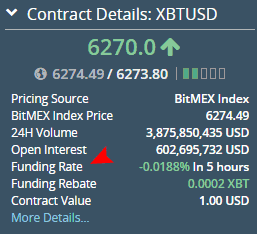
- Beyond the fee aspect to this, there’s a pump and dump associated with it as well. Roughly around 30 minutes before the funding time, everyone will be closing their longs in order to avoid the fee. Once the funding has completed, the price will skyrocket. Position your trades around this time and you can make a quick daily profit.
- Be Patient with Entry. Setup Limit Orders — never ever try to catch you can. By the time your order is filled, too late and you’re likely to get stuck with a horrible entry.
- Set up various limit orders at key positions before a rally (or short) begins. The best way of doing this is scaling in and out of the position. I cover more on this within my swing trading guide located here.
- In short, if you want to take a position at $7500 with $1000, then you want to scale in your orders at $7200 with $250, $7300 with $250, $7400 with $250, and $7500 with $250. This is the easiest and most effective way of gaining a good entry and exit positions up. Even outside of larger pumps, jumping into a massive rally is almost always a bad idea.
- If you miss an entry, just be patient as another one is around the corner. It’s a lot better to miss an entry than lose money.
- Stop Losses or Scaling In/Out — use one of these 2 strategies for protecting your capital. Here is my recommendation.
- a) If you plan on using higher leverage (20X+ riskier approach) then use tight stop losses. This will prevent you from losing all your Bitfinex funds in one bad trade.
- b) If you plan on using lower leverage (20X and below — less risky) then you can afford to scale out of a bad trade. I would highly advise initially testing this strategy with smaller amounts until you get a feel for it. Scaling out of a trade takes experience, but one where, if you master it, will allow you to walk away from most trades without a loss.
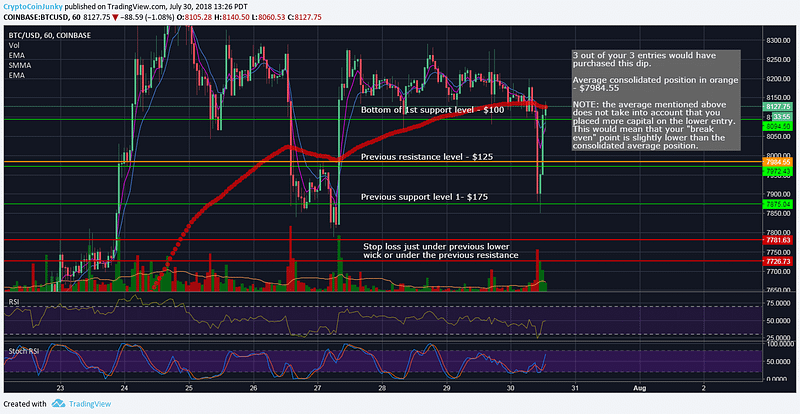
Neither one of these strategies is right or wrong. It’s a matter of personal preference and which one suites certain situations over others. If you’re more of a risk taker, you may prefer scaling. If you like to keep things conservative, then stop losses may be your “bread and butter”. Each one has their pros and cons.
Let’s Wrap This Up..
Bitmex allows traders to make money on bull and bear markets. This is why I highly experienced traders love it so much. The exchange has gained a ton of popularity this year due to its enormous volumes and rich array of features
This is a great exchange when you don’t want to risk too much of your own money trading, however would like to utilize the trading leverage (thus more capital) for higher profits.
Personally speaking, I like to fail fast. Time is too precious of a commodity to waste away trading $100 at a time for possible $5-$10 profits.
If you’re looking for reliable, secure exchange, look no further than Bitmex. It offers large leverage positions as well as a ton of functionality that other cryptocurrency exchanges don’t offer.
Save 10% on BitMEX fees with this coupon link. BitMEX fees are MUCH higher than your typical crypto exchange because the fee applies to the entire leveraged position, not just your margin (initial deposited amount).
I’d love to hear about some of your experiences with Bitmex. Let me know in the comments below. Who knows….maybe I can lend you some advice.
Transform Your Diminishing Crypto Account into a Powerhouse Portfolio in Under 60 Days with Our HIGHLY PROFITABLE MICRO CAP COINS> https://CryptoAccountBuilders.com
Join Coinmonks Telegram Channel and Youtube Channel get daily Crypto News
Also, Read
- Crypto Telegram Signals | Crypto Trading Bot
- Copy Trading | Crypto Tax Software
- Grid Trading | Crypto Hardware Wallet
- Best Crypto Exchange | Best Crypto Exchange in India
- Best Crypto APIs for Developers
- Best Crypto Lending Platform
- An ultimate guide to Leveraged Token
- Best VPNs for Crypto Trading
- Best Crypto Analytics or On-Chain Data | Bexplus Review
- 10 Biggest NFT MarketPlaces to Mint a Collection
- AscendEx Staking | Bot Ocean Review | Best Bitcoin Wallets
- Bitget Review | Gemini vs BlockFi | OKEx Futures Trading


