The hydrogen market will be larger than the LNG market by 2030
According to Deloitte’s latest forecast on the development of the global hydrogen market, production and trading of green hydrogen will surpass that of liquified natural gas (LNG) by 2030.
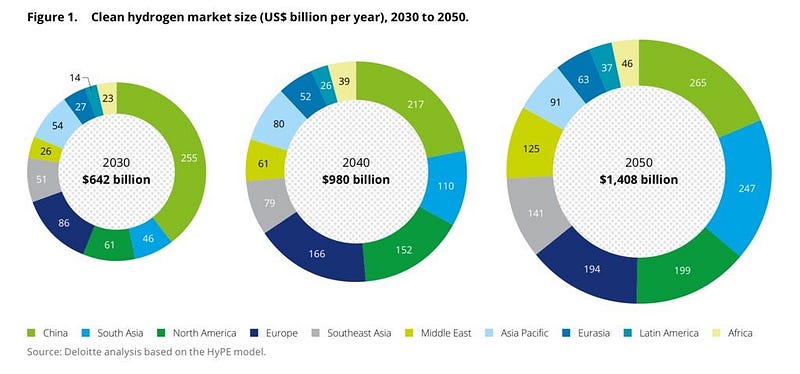
The paper predicts that its volume in monetary terms will reach 642 billion dollars in 2030 and exceed the volume of trade in liquefied natural gas (LNG). And by 2050, the hydrogen market will reach a staggering $1.4 trillion a year. In physical terms, sales of “clean” hydrogen will amount to 170 million tons in 2030 and 600 million tons in 2050 (this is a rather optimistic estimate compared to many similar studies). By mid-century, 85% of the hydrogen consumed will be green H2 and 15% blue.
The paper notes that developing countries have significant opportunities in this market. With suitable investments, they could account for almost 70% of projected green hydrogen production in 2050, which could provide employment for up to 2 million people annually between 2030 and 2050.
By 2050, the global hydrogen trade is projected to generate over $280 billion in annual export revenue, with North Africa expected to receive the most ($110 billion) due to high export potential.
Deloitte’s Hydrogen Pathway Explorer (HyPE) model evaluates the potential of clean hydrogen to reduce emissions. Calculations show that hydrogen could reduce CO2 emissions by 85 gigatons by 2050, more than double global CO2 emissions in 2021. At the same time, ferrous metallurgy has the greatest potential for reducing emissions from the use of hydrogen.
In 2050, industry and transport will account for 42% and 36% of hydrogen consumption, respectively.
Diversified transport infrastructure and inter-regional trade will play a critical role in unlocking the full potential of the clean hydrogen market.
The report contains recommendations on how to create an optimal regulatory environment for the development of the hydrogen market. This highlights the development of national and regional strategies, the creation of a transparent certification process, the definition of clear goals, the provision of fiscal incentives and subsidies to reduce the cost gap between clean and fossil technologies, etc.
The paper also notes the need for a combined investment of more than $9 trillion in the global clean hydrogen supply chain to achieve net zero emissions by 2050.
I have repeatedly noted that the issues of future consumption volumes, as well as the cost of green hydrogen, are very confusing and hotly debated. Opposite assessments are found in the extensive literature on the issues
- January 2022 — Rethink Energy published a report on the prospects for the hydrogen market, which stated that in two years “green” hydrogen will become cheaper than “grey”, and by 2035 its cost will be just over $ 1 per kilogram.
- December 2021 — Wood Mackenzie (WoodMac) published a report, “Hydrogen Cost 2021: Preparing to Scale”, which predicts that in some markets, the cost of “green” hydrogen may well fall below one dollar per kilogram by 2030.
- January 2021 — Norway’s NEL (a major electrolyzer manufacturer) stated that its goal is to green hydrogen at US$1.5 per kilogram by 2025.
Meanwhile, BloombergNEF (BNEF) argues that it makes no economic sense to produce blue hydrogen because green H2 would be cheaper in all of the 28 markets examined in their study.
At the same time, not everyone agrees with such forecasts. For example, German think-tanks published two siginificant findings about the green hydrogen results:
- 2020 — the consulting company Prognos commissioned the German Federal Ministry of Economics and Energy (BMWi) to prepare the report “Costs and transformation paths for energy sources produced from electricity”. Until 2050 — this is the time horizon of the analysis — the authors do not find signs of the competitiveness of “green” hydrogen, especially synthetic fuels that are produced on its basis.
- 2021 — the German research center Agora Energiewende calculated that even €200 per tonne of CO2 would not make green hydrogen competitive.