The Holocaust Survivor Who Swore Vengeance for the Murder of His Family
It is a story of justice and patience.
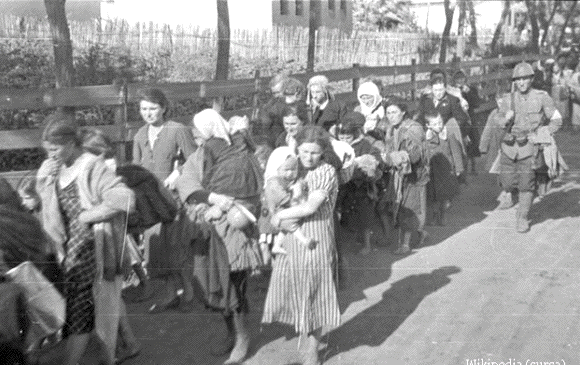
Eliahu Itzkovitz was born in 1932 in the town of Chișinău, Romania. As a Jew, when World War II broke out, he and his family were taken to a concentration camp in Romania.
In the camp, Eliahu witnessed the murder of his mother, father, and three brothers. They all died at the hands of a guard named Stănescu. Eliahu swore that if he survived the camps, he would have vengeance.
In 1944, the camp was captured by the Soviet Army. Eliahu searched for Stănescu, but the killer had fled. Itzkovitz went around Romania in an attempt to find his family’s killer, to no avail. However, he did find the man’s son, whom he stabbed to death with a butcher’s knife. He was sentenced to five years in a juvenile reformatory for the attack. Following his release, Eliahu was permitted to emigrate to Israel.
This could have been the end of his story. Like some other war criminals from World War II, it seemed that Stănescu had escaped justice and melted away. Eliahu could have moved to Israel and started a new life. And that was his plan when he became a paratrooper for the Israel Defense Force in 1953.
Then Eliahu learned something that made him change his plans. Stănescu had escaped to the French occupation zone in Germany and enlisted in the French Foreign Legion. The killer was now serving in French Indochina where Vietnamese Communists were rebelling against French colonialism.
The French Foreign Legion originated in 1831 as a way for Foreign nationals to enlist in the French army. The Legion was an important elite fighting force during French colonialism, especially in Africa. It was a tradition for the legionnaires to enlist under a fake identity.
This allowed men who wanted a new start in life to join with the burden of their past returning to haunt them. Some men joined for noble purposes, but it also attracted many of the lower members of society looking to escape their crimes. This may have been the reason that Stănescu joined the legion.
When this information reached Eliahu, he began to plot his revenge. First, he applied and was granted a transfer to the Israeli Navy. He then spent several months severing on destroyers and corvettes based in Haifa.
When the ship he was serving on docked in Naples, Italy, for supplies, Itzokvitz seized the opportunity to desert. He then crossed the border into France and enlisted in the Foreign Legion. Shortly after, Eliahu was on a ship to Algeria, the headquarters of the Foreign Legion.
When recruits arrive in Algeria, they are welcomed with a speech.
“It makes no difference if you have lost your job, your home, your business, or if your wife has thrown you out or the court has sent you to jail. There is only one place left where you can make a fresh start, where you can turn over a new leaf without having to explain your past — and no one will judge you there for what you did in your former life, but only for what you do in the current one. Welcome to the French Foreign Legion.”
However, Itzokvitz had no wish to forgive or forget. He was one step closer to his vengeance. His next stop was an assignment to French Indochina, the present-day countries of Vietnam, Laos, and Cambodia.
The next step was for Itzokvitz to be assigned to the same unit as Stănescu. This step was easier than one might think, as unit assignments were often based on language and nationality. As both men were Romanian, Eliahu soon found himself in the same squad as the man who murdered his family a decade before.
Stănescu did not recognize Itzokvitz when they were placed in the same company and paired together to go on patrol. Itzokvitz bided his time until the opportune moment, he planned to make the killing look as if Stănescu had been killed by the enemy.
That moment came one day while they were on patrol and were ambushed by some Vietnamese Communist soldiers. According to Itzokvitz, the men took cover in bushes along the road.
After the attack, and while the men were resting, Itzokvitz asked Stănescu, “Do you recognize me?”
Perhaps Stănescu thought he was the son of some acquaintance back home. He replied, “No…but maybe…”
Itzkovitz then asked, “You’re Stănescu, aren’t you?” and, without waiting for a reply, shot him several times in the chest. Stănescu was dead, and his vengeance was complete.
Itzokvitz then dragged the body back to their base and reported that Stănescu had been killed by enemy fire. His vengeance was complete, and Itzokvitz retired from the French Foreign Legion and received a letter of recommendation.
As he wished to return to Israel in 1955, Eliahu Itzokvitz presented himself to the Israeli Embassy in Paris. He then told his story to the diplomats, and two months later, he was court-martialed for deserting his ship for two years and sentenced to one year in prison. However, the court showed leniency, and he only served three months.
What happened to Eliahu Itzkovitz after his release from prison is unknown. He likely spent the remainder of his life quietly in Israel, hopefully with the demons of his past put to rest.
Gabriel Joshua Saada released a 2019 book, Revenge of a Jewish Child. Saada claims to have been a friend of Itzkovitz and that Itzkovitz wished him to write his story for him. According to Saada, Itzkovitz died in 2015.
https://podtail.com/en/podcast/casefile-true-crime-podcast/case-216-the-itzkovitz-family/


