
Freedom, not Freedumb
The Holistic Libertarian: Freedom for Grownups
Building a notion of “personal liberty” that actually works
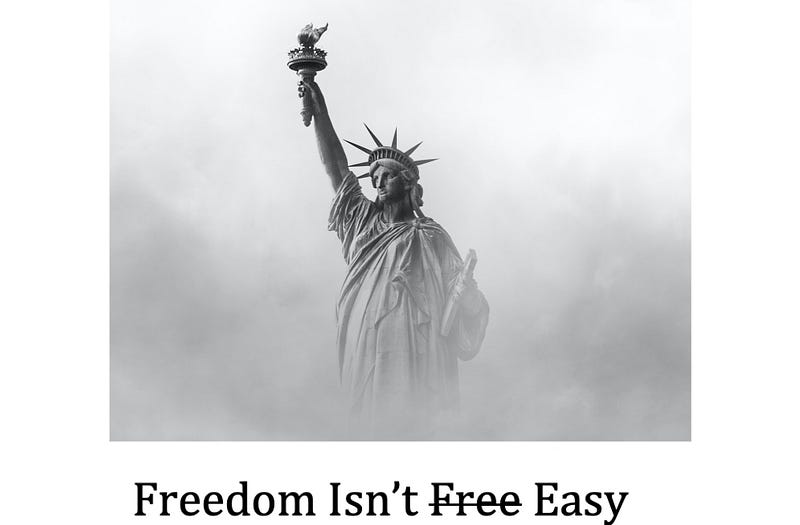
No right is absolute. It’s not a matter of black and white options, it’s a question of lines and where we draw them.
Resolved: everyone should be a libertarian…for a while.
It’s healthy for young people to discover Ayn Rand or Robert Heinlein or Rush and be interested in the merits of this philosophy. They should talk about freedom and limited government. They should have animated discussions with other young people about it.
And then they should grow out of it. Discussing Ayn Rand over beers is cool, but by the time you can do so legally it’s getting on time to stop. As the saying goes, there’s a time to put away the things of youth.
The argument for it would be more persuasive if there was a functioning libertarian society to study. Or had ever been one. You’d think if it could work we might have seen some evidence.
I once wrote a piece titled Does Freedom Even Exist? Or, when the doctrine of personal liberty was eaten by wild animals. It focuses in part on the book A Libertarian Walks Into a Bear (there is an interview with the author here), based on events in the town of Grafton, New Hampshire. A group of zealots decided to create their idea of utopia, so they took over the town council, eliminated all the rules they could, then sat back to see what they had wrought. If you want to read about it without any spoilers, now is the time.
The experiment in Grafton was, of course, a completely predictable disaster.
In particular, disposing of trash was a problem: without rules as to how everyone should do so, it began to pile up. And that’s where the bears come in.
If you know anything about bears, it is no surprise the town was soon overrun with them. With no rules or infrastructure to deal with either the trash or the wildlife, the town collapsed. Which would be funny, except by then the animals had lost their fear of humans and became dangerous to people in other towns. The instigators abandoned the Grafton experiment, leaving the libertarian bête noire — government — to clean up their mess. With other people’s money.
In other words, irresponsible people pursuing freedom in one town took it away from others by creating physical danger and financial hardship for them.
To have a coherent system of personal liberty, you have to prioritize the health of the system over any one person.
Freedom isn’t free…of responsibility
First and foremost, to the maximum extent possible I want everybody to keep their noses out of everybody else’s business. At first blush, this sounds like I’m a good candidate for libertarianism, and I can absolutely see where the appeal lies. I went through a phase, and it’s a romantic notion (in the non-happy-sexy-funtime sense of the word): the Man Apart, the Master of His Domain.
Until you actually think about it. If it were possible, sure. But it isn’t.
All the above being said, I am one of sorts — just not the kind you see toting a copy of The Fountainhead around a college campus or waving a Gadsden Flag at a political rally.
I’m the founder of Holistic Libertarianism, a philosophy of personal freedom that actually works.
Either everyone is free, or no one is.
This is the simple and seemingly obvious truth that negates almost all the supposed liberty enthusiasts out there: if by exercising my rights I take yours away, that’s just being a selfish asshole. As the saying goes, “the freedom to swing your fist ends where the other guy’s nose begins.”
But instead of defining a philosophy and living with where it leads, America’s libertarians prefer to engage on the age-old practice of reverse engineering a philosophical definition that lets them do what they want. They stop reading after “fist” in the same way the NRA pretends the first half of the Second Amendment doesn’t exist.
If you don’t want me setting my freedom above yours, you can’t put yours above mine, either.
The world is too complicated for simplistic notions
Human society mirrors nature, in that it is not some obvious collection of binary options. It’s an ecosystem, a huge non-linear web of interwoven connections that no one fully understands and produces unpredictable results. There is rarely an easily definable “free” option.
If you are an adult with a driver’s license, your rights include getting drunk and driving — but not both at the same time. The reason is clear: as a society, we recognize that letting drunks drive deprives everyone of a measure of safety. There is no way to eliminate all risk on the road, of course, but DUI is especially dangerous and can be prevented so we’ve agreed it should be. Similarly for stop signs and speed limits.
Consider other situations. Does the right to bear arms include portable nuclear weapons? Am I allowed to build a coal-fired power plant on the land next to yours, belching toxic smoke into air that doesn’t respect property lines? How about building a nuclear waste storage facility on the banks of the city water supply, given that if it starts leaking (actually, history tells us when it does) it could render the city largely uninhabitable?
You could have a dinner party for everyone in your town who believes in this absolutist idea and not have to put the extra leaf in the table.
In other words, we as a people have decided that there are no absolutes, and the framers of the Constitution didn’t intend there to be. Deciding on our “rights” isn’t a matter of black and white options, it’s a question of lines and where we draw them.
The whole COVID era has been very instructive. I would argue that the true libertarian position on public safety — the holistic one — is you should take the vaccine as soon as it is available, never leave the house without a mask, and encourage that everyone else do likewise.
Do vaccines and masks place limits on you? Absolutely. But what about everyone else’s right to be safe from you infecting them?
I guess you could say the freedom to spread your germs ought to end where the other guy’s immune system begins.
Doesn’t that mean we all have to wear masks all of the time? People have always died of the flu.
The point is that the flu is pretty well understood. It’s out there, people die from it, that’s sad. But COVID is something altogether other. Orders of magnitude more people are dying from it than flu. Healthcare systems are collapsing — if you live in an area with lots of “freedom” now is not a good time to get cancer or have a heart attack.
And that’s even with all the measures many people have been taking. If everyone just went about their lives normally it would be a bloodbath. In places it is.
More difficult still, what are the further implications of this disease? What’s happening with “long COVID”? Does it have even longer-term implications, in the way chicken pox leads to shingles? What if 30 years down the road everyone who had COVID develops some debilitating disorder?
Or, we could all just relax and wear a mask until we get a better idea of what’s going on.
The point is that to have a coherent system of personal liberty you have to prioritize the health of the system over any one person. Freedom needs a framework in which to function, and preserving that framework is the highest priority.
That sounds like Socialism!
This is where it gets sticky, because when you try to design a system for maximum individual liberty you end up with “the needs of the many outweigh the needs of the one.”
To allow some individuals to run roughshod over others means their personal rights are more important. It gives them a higher level of citizenship where they are free and others aren’t.
And thus Holistic Libertarianism: do whatever you want without harming anyone else…but what that means will be hard to figure out because nature and human society are insanely, incomprehensibly complicated.
In the meantime, if you don’t want me setting my freedom above yours, you can’t put yours above mine, either. We can have collective responsibility, or we can have what we have now — some people taking the rights of others away in the name of their own.
