
The Hole In The Sky
A practical solution to a choking planet
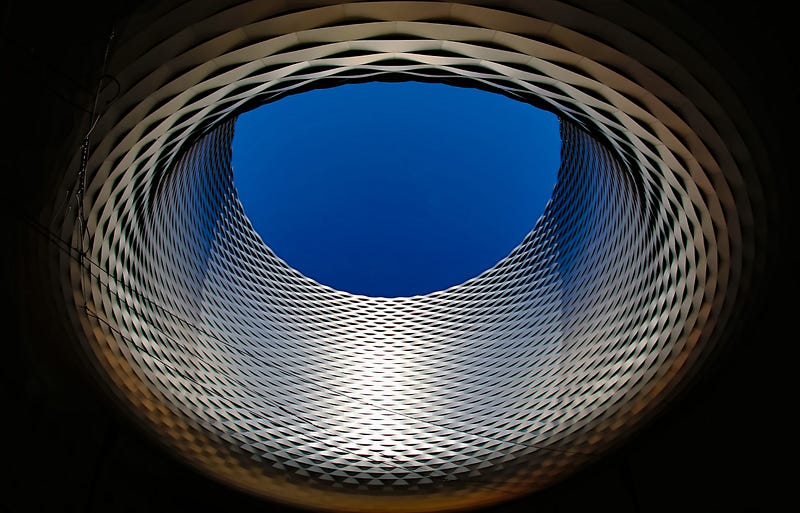
It started out being a military matter.
When the hole in the sky first appeared it was seen as an active threat, and the military of the world scrambled and united in a common defensive posture.
Until nothing was seen to come out of it in more than a year, after which, one by one, the nations withdrew their forces.
Thereafter it was seen as a passive danger, since anything the military sent through never came back. They put it on the maps as an area to be avoided by all aviation traffic and then proceeded to ignore it, although a few avid researchers continued to seek grants for further investigation.
The excitable media coverage died down too, as all plausible theories had been done to death and it just sat and did nothing.
It faded almost completely from the public consciousness.
Approached from the wrong angle, it couldn’t be seen at all. But come at it from below and it looked like a black moon cut out against the blue sky behind. No twinkling lights on the other side, just unbroken velvet blackness.
It sat almost exactly a mile above Ascension Island, and no other similar anomalies had appeared anywhere else on the planet in the two years since its arrival.
Malcolm Gladstone, an entrepreneur retired by the age of 40, had been sufficiently caught up in Hole fever to register a new firm at Companies House, under the name Hole in the Sky Limited.
The company registration gathered dust for a few years but, after the fuss had died down, he headed over to Ascension Island and St Helena to discuss a proposal with the Governor and, by proxy, with the UK government.
Shortly afterwards, a few large cargo containers, bearing raw materials and heavy engineering rig, were dispatched towards the islands from all quarters of the globe.
A fleet of large vessels on their way from China were also given revised sailing orders.
Six months later, the fruit of their labours was revealed. Using cutting edge bridge and tunnel building techniques, as well as an array of more old fashioned barrage balloons, a huge vacuum tube had been constructed, with its base suspended out over a newly constructed jetty and its apex positioned beside the Hole.
In a great unveiling, Gladstone showed how the rubbish which China was sending back to Europe could be fed in at one end and then thrown with great force through the Hole, never to appear again, at least in our ecosystem.
As an encore, he disposed of a decade’s worth of nuclear waste in the blink of an eye.
His firm’s IPO was scheduled for a week after the demonstration, and it was wildly oversubscribed.
Countries around the globe, tired of fighting their environmental protesters, got on board quickly with diverting all of their non-biodegradable refuse towards this mid-Atlantic rubbish bin.
Gladstone was assiduous in seeking out further ways to exploit this unique opportunity, all the while stressing the environmental benefits of his Hole.
There were a few dissenting voices who wanted to know exactly where all of the rubbish was going, how we knew this mass disposal wouldn’t come back to haunt us, and even whether we should worry about any unfortunate planet or civilisation which might exist on the other side of the Hole.
But since these same people had been bleating up to this point about unsustainable damage to our own planet, few paid them any heed and many accused them of rank hypocrisy.
As of now, the original tube has been upgraded with government assistance, the nations of the world are sending their rubbish through the Hole, and environmental research is focused on capturing carbon dioxide and other greenhouse gases in liquid or solid form so that these too can be binned.
And the governor’s palace in St Helena has been substantially refurbished.
Many thanks for reading!
It’s more of a thought experiment than a story, and I would be most interested to know whether you would be for or against such an approach.
More speculative fiction below:
#Race500


