
The HIV and Coronavirus Pandemics: A Morality Tale
We need to see ALL our neighbors
A lifetime ago, I grabbed my denim jacket out of the hall closet and ran to catch the A Train. I hustled down Manhattan’s 8th Avenue, jacket bristling with pink triangles and buttons that screamed, “Silence = Death!”
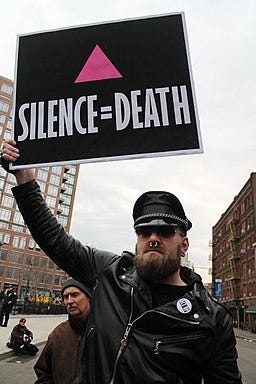
As much as my Act Up drag made me stand out, though, I knew people didn’t see me. AIDS activism was their background noise. Darting down subway station steps — late for a safer-sex education committee meeting — I noticed a woman see me.
Her eyes grabbed mine as she mouthed a silent, “thank you.” That’s when I spotted the miniature red ribbons covering her coat and purse. I stopped my rush for a second and nodded, grave and serious, returning the same sad smile she was giving me.

Yesterday, I opened an online newspaper and read a column by Ann Widdecombe, British politician and pundit, former member of the European Parliament. Urging people to be calm in the face of the coronavirus pandemic, Widdecombe wrote, “‘We have had the scare of SARs, bird flu, Ebola and of course AIDS. None proved as devastating as feared.”
I wasn’t shocked to read those words, though many were.
HIV will kill more people over time than coronavirus disease
I’m used to people not seeing HIV, a pandemic that has claimed 32 million lives globally already, which is now endemic in the human population, and which claims hundreds of thousands of lives every year.
As a gay man, I’ve been living through a pandemic since the mid 1980s. I know what it feels like already, because it’s my daily reality.
Roughly 40 million humans are infected with HIV. In 2018, the last year for which full data are available, 770,000 people around the world died from HIV-related causes. 1.7 million people became newly infected.
US CDC worst-case projections for total coronavirus deaths in the United States fall somewhere between 200,000 people and 1.7 million, a tragic number by any accounting.
But compare that to an estimated 675,000 Americans who have died of HIV to date, with the number still climbing. Between 6 and 12 thousand Americans will die of HIV this year, next year, and each year after that unless we take the necessary political and budgetary steps to end the epidemic.
I didn’t know that woman with the red ribbons on her coat that chilly day in Manhattan back in the mid 90s. When our eyes met, I felt her pain. People wore red ribbons in those days to plead for love and care. To ask people to see HIV.
My pink triangles and her ribbons accused a nation and a government that didn’t care about an epidemic killing Americans by the tens of thousands a year — nearly 50,000 in 1995 alone.
HIV is a virus that infects — for most people — the ‘other’ rather than the ‘neighbor’.
We paused for a second on those subway steps, me a young activist, her a woman old enough to be my grandmother, and we recognized one another as people who could SEE.
I spent my days working at an HIV service agency, teaching GED classes to people who were HIV positive and struggling for the will to keep living and hoping. Nights and weekends, I protested, attended rallies, and did safer-sex street theater.
I don’t know what she did, but HIV and AIDS must have touched her personally. She and I shared a bizarre world, living in the midst of a pandemic that was terrifying and mundane at the same time.
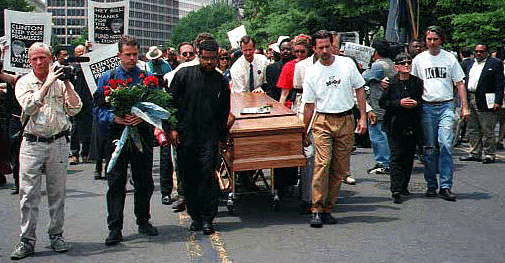
I wasn’t even 30 years old, and my friends and I had funerals to go to every week. People I loved were diagnosed with HIV all the time. We were often terrified, not knowing who would be next, though many of us pretended the fear didn’t eat at us as we fell asleep at night.
The bizarre part was that the world just marched right along as if nothing out of the ordinary was happening.
You could open up a newspaper and not read a word about the thousands of people filling AIDS wards in local hospitals. You could walk down 8th Avenue, like I did every day, and not see anything unusual. You could cover yourself with pink triangles that screamed, “Silence=Death!” and nobody would see you.
Nowadays, I live in rural Michigan, and I care for my elderly father who suffers from end-stage COPD. Respiratory infections are all potentially lethal for him. If he catches coronavirus, he will probably die.
The other day, I drove 30 minutes into town to pick up some of his medications and do a little grocery shopping. I needed toilet paper, but the store was mostly out. I was bemused, because … why toilet paper? Food shelves were mostly stocked.
I know people all over the United States are panicking about the coronavirus pandemic, and that shortages of toilet paper and hand sanitizer spring from irrational psychological reaction to threat.
Promoting my stories on social media later, I saw people everywhere panicking — expressing strong fear, repeating false and misleading rumors, obsessing over a threat that, while very real, is something we Americans ought to be able to take in stride.
As a gay man, I’ve been living through a pandemic since the mid 1980s. I know what it feels like already, because it’s my daily reality.
I took a nap after I got home, and I had a waking dream
As I slid in and out of consciousness, I drifted back in time to 1990. I picked up copies of the New York Times and read about a president and his cabinet addressing the nation every day about HIV. I turned on the television and watched news reports that covered my friends’ funerals.
I dreamed a world gripped with determination to end HIV, to put a stop to suffering and death, to spend national treasure to care for the sick and the dying. Just like with coronavirus.
The coronavirus pandemic is a morality tale
In the REAL world of 1990, nobody was gripped with determination to end HIV. As my friends and loved ones died in staggering numbers, we had to fight to be seen. We had to shout and march and protest and flirt with journalists for coverage.
Act Up leaders like Ann Northrup and Peter Staley gave up lucrative careers just so people would see us. Ann applied all her experience as a top-flight journalist to train Act Up members to stay on message and communicate with purpose. Peter quit his job on Wall Street and trained himself to understand and speak the language of virology and epidemiology.
Peter and Ann knew if we didn’t do the work ourselves, nobody would do it for us.
The global fight against the novel coronavirus is a righteous fight
As humans, we should be doing everything we can to prevent and alleviate suffering. Taking steps to slow this new pandemic is critical. Having family at great risk, I get that in my gut. But I still grieve.
I’m saddened when I contrast and compare the two pandemics.
I’m saddened when I think about why HIV is still a major threat, when we already possess the medical technology to wipe it off the face of the planet. I’m saddened because I understand that NEIGHBOR is a word that can be both inclusive and divisive.
How ‘love thy neighbor’ really works
HIV is a virus that infects — for most people — the other rather than the neighbor.
When I ran out of my apartment that day, late for an Act Up meeting, I knew too many Americans thought of AIDS as a disease that afflicted folks who deserved it — gay men, sex workers, drug users. I knew most Americans didn’t think HIV would ever trouble THEM. They didn’t worry, because they weren’t at risk.
And today? Even though hundreds of thousands of people die every year of HIV disease, most of those people live in Africa. But aren’t they still our neighbors, even if we aren’t personally at risk?
How ‘love thy neighbor’ should work
I dream of a world in which none of us is other, in which all of us are neighbors in the spiritual sense. I dream of a world in which we humans mobilize to combat threats that cause massive human suffering, whether or not we are personally at risk.
It took the coronavirus pandemic to drive home for me how very far we live from that dream world.
It took looking around at the global coronavirus response and realizing this is what it feels like to be seen.
James Finn is a long-time HIV/LGBTQ activist, an alumnus of Act Up NYC, an essayist occasionally published in queer news outlets, and an “agented” novelist. Send questions, comments, and story ideas to [email protected].


.jpg)