
The History of Silicon Valley — A Brief Summary (Part 2/3)
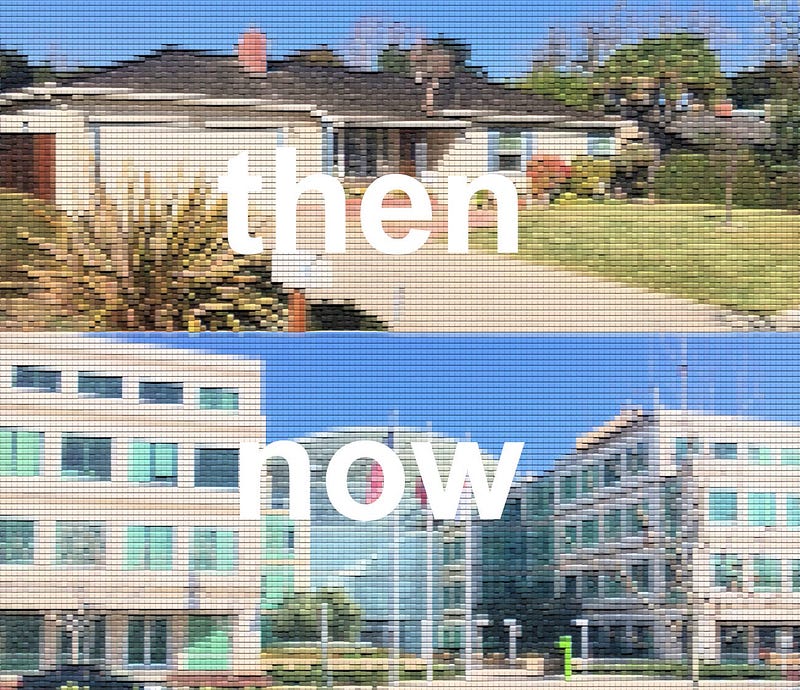
This is part 2 of my history of Silicon Valley series. If you haven’t read part 1, you can find it here.
Begin Part 2
William Shockley and Shockley Semiconductor Laboratory
After earning degrees in engineering from Caltech and MIT, the British inventor, William Shockley, and his two partners (John Bardeen and Walter Brattain) were working in New York at Bell Labs.
They were looking for an alternative to vacuum tubes for conducting electrons.
Can you guess what the alternative was? Silicon!
However, his partners made the discovery (which they named Transistor) while Shockley was out of the office… So they filed a patent immediately and didn’t include Shockley.
Shockley wasn’t known for being a nice person. So it’s no surprise he got very, very angry, shun his partners, and created his own transistor in 1951.
After getting the recognition he wanted, William Shockley left Bell Labs, left New York and returned home to Silicon Valley in 1956 (mainly because his mother was sick and lived in the area) to build Shockley Semiconductor Laboratory.
Side note: Shockley and Beckman (his professor at Caltech) signed a letter of intent to create the Shockley Semiconductor Laboratory on February 13 1956, what many consider to be the date Silicon Valley was founded.
The First Trillion Dollar Startup
William Shockley assembled a team of the brightest young minds in electronics.
However, remember I said he wasn’t the nicest guy? His terrible management style and personality drove eight of his employees to quit.
Naturally, Shockley called them “The Traitorous Eight” (Robert Noyce, Gordon Moore, Jay Last, Julius Blank, Sheldon Roberts, Eugene Kleiner (co-founder of Kleiner Perkins), Victor Grinich and Jean Hoerni).
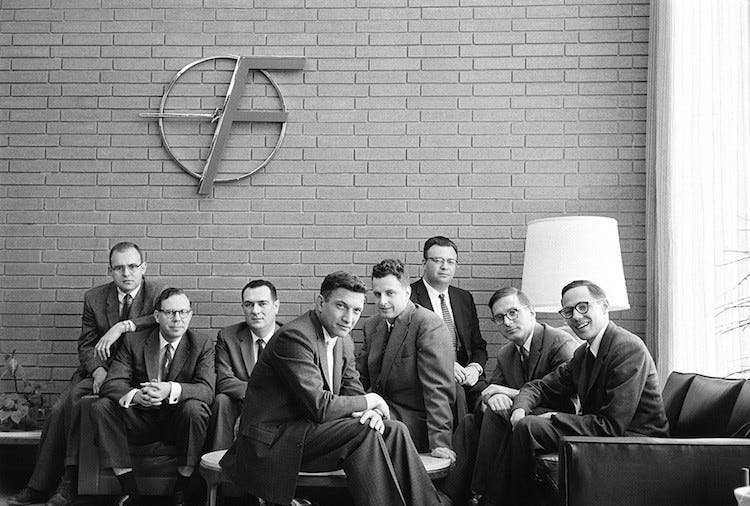
In 1957, this rebel group founded Fairchild Semiconductor.
Fairchild brought two great innovations to the world:
- Making Bell Labs’ mesa transistor (the first silicon transistor), commercially available in 1958.
- The planar transistor in 1959. This revolutionized the building of semiconductors (from being hand-made and slow, to mass produced). This is still the essence of how chips are made today!
Needless to say, Fairchild was one of the GREAT Silicon Valley Startups.
It would take an entire article just to talk about that. In fact, TechCrunch did!(check out the diagram at the bottom of “Silicon Valley companies that can be traced back to Fairchild Semiconductor”). Read it, and once you’re done picking your jaw from the floor, let me know what you think.
Unsurprisingly, they had a ton of competition. In fact, there were so many companies doing the same thing, they were nicknamed “Fairchildren.”
Sadly, Bob Noyce failed to see any profit for his computer chip. Therefore, in 1968, he, Gordon Moore, and Andy Grove left Fairchild and founded a company focused on Integrated Electronics… Intel.
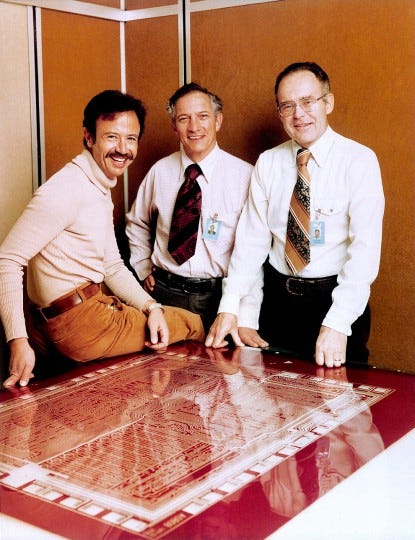
Intel — A Players only hire A Players
Picture this: If Shockley Semiconductor Laboratory (SSL) was a collection of the finest brains in electronics, Fairchild was a collection of the finest brains at SSL, and Intel was a collection of the finest brains at Fairchild!
In 1971, Intel created the world’s first commercially viable microprocessor.
To this day Intel is one of the world’s largest chip makers.
But arguably, Intel and its founders’ influence on Silicon Valley was far greater:
- In 1965, Gordon Moore wrote a paper describing how the number of transistors in an integrated circuit doubles every two years. He predicted it would last 10 years and yet we still use it to this day! That phenomenon became known as Moore’s Law.
- Andy Grove became CEO of Intel between 1987 and 1998 (during which Intel went from being worth $4 billion to $197 billion!). Grove also wrote two of Silicon Valley’s most influential books, “High Output Management” and “Only the Paranoid Survive.” For many in the Valley, Andy Grove was both a friend and a mentor, and his recent death on March 21st 2016 led to an outpouring of love from all over the world. You can watch the tribute Ben Horowitz dedicated to Grove a few months before he died.
- Intel also hired a young man by the name of Mike Markkula, who made a fortune in stock options and retired at age 32. He became an angel investor and abandoned retirement 3 years after (in 1977) to become employee #3 at a new startup: Apple.
On January 11 1971, Electronic News reporter Don Hoefler wrote a column about the local silicon computer-chip companies. He titled the column “Silicon Valley USA”… The name stuck.
The creation of the microprocessor was the beginning of an explosion in innovation. It led to the creation of the personal computer, turned hippies into super entrepreneurs, and truly changed the world.
End of Part 2
The History of Silicon Valley — A Brief Summary (Part 1/3) ← PREVIOUS
Thanks for reading! 😊
If you enjoyed it, test how many times can you hit 👏 in 5 seconds. It’s great cardio for your fingers AND will help other people see the story.You can follow me on Twitter at @richardreeze to find out whenever others just like it come out.📚 Do you like books? If so you might enjoy my latest obsession:
Most Recommended Books.📚