
The History Of Doors: A Travel Through Time

Here’s a history lesson.
The first recorded history of doors was found in Egyptian tomb paintings 4000 years ago. No one knows who invented the door, only that it was first incepted somewhere in central Egypt. In agent Egyptian architecture, a false door was a wall decoration that looked like a window, it was common in tombs and represented a gate to the afterlife.
In Biblical times, King King Solomon’s temple doors were made of Olive-wood, as were many doors of the past. In India, there are ancient doors made out of stone that was creatively designed with stone pivots to swing open.

As time progressed and advancements were made, the Romans used their creative architectural minds to create more advanced doors. These doors were usually made out of bronze and included the use of single, double, sliding, and folding doors.
In Roman Religion, Janus was the Roman god of doors and archways. As the Romans were suspicious people, during times of war, there were lucky and unlucky ways for an army to march through a Janus (door). The Janus Germinus is a famous door in Rome, a shrine for the Roman god Janus. It stands as a simple rectangular bronze structure with double doors at each end and was closed during times of peace, open during times of war.
The first recorded automatic door was created in the 1st century AD during the era of Roman Egypt by a Greek scholar known as Heron of Alexandria. If we’re talking about ingenuity, leave it to the Chinese to create the first foot-sensor-activated door during the reign of Emperor of Yang of Sui, ruling from 604 to 618.
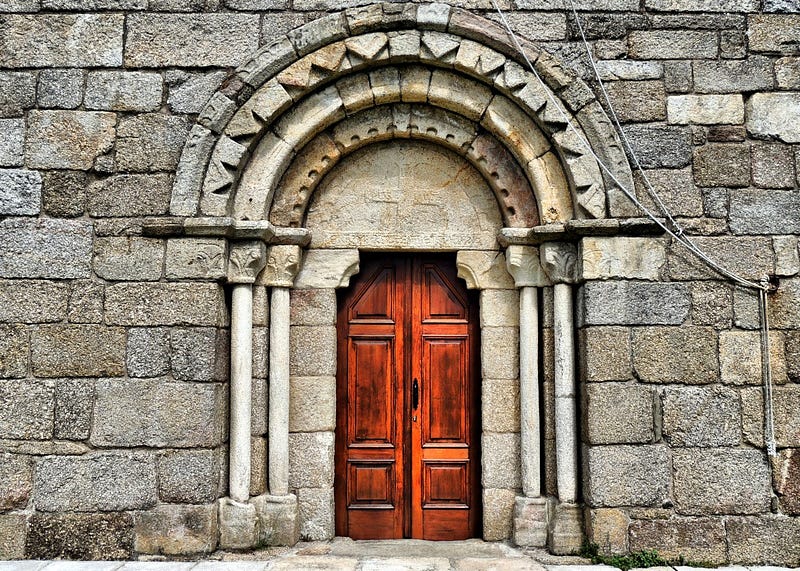
During the 12th and 13th century in medieval times, “The Symbol At Your Door” was significant. Differing seals could stand for reputation, prestige, status, and wealth. These doors were created from whatever material was available in the region and copper and bronze were integral materials for medieval architecture — the base material for doors were mainly strong oak.
Whether the door was for a cathedral or a castle, they were constructed in a plywood fashion and would be held together with steel studs, reinforced with steel iron bands — meant to proof against small forces.

Craftsmanship was at it’s finest in the 16th and 17th century, in a time period known as the renaissance. This era was considered the bridge between the Middle Ages and modern history. It was a time when intellectual pursuits prevailed and art techniques were refined by masters like Michelangelo and Da Vinci. Classical Greek designs were incorporated into cathedrals and monuments to bring forth a new realism in sculpture and craftsmanship.
Spanish style renaissance doors were studded with hundreds of hand-forged iron clavos or nails. Tuscan style doors from the hills of Italy were of great beauty, their borders were adorned with figures, birds, and foliage. In many of the doors, rectangular panels were filled with bas-reliefs (sculpture, carving, or mold) in which scripture subjects are illustrated with innumerable figures. Michelangelo described these doors as the “gates to paradise.”

As religion reigned supreme during this era, the finest French renaissance doors were first created for cathedrals. Characterized by their Gothic details, coats of arms, and/or royal and period motifs, French doors were mainly carved from fine cedarwood. The most majestic doors had high canopies and a double range of niches ( classical architecture reduced in size, retaining the half-dome) with figures.
Years later, French doors were enriched with bas-reliefs, landscapes, figures, and elaborate interlaced borders.
Doors have been symbolic and evolved stylistically in various cultures for centuries.
At Pinky’s Iron Door’s, we have taken inspiration and knowledge from each of these era’s to create exceptionally elegant and timeless wrought iron doors, steel doors, entry doors, wine cellar doors, french doors, dutch doors — all designed with high-quality materials and a medley of modern and old-world aesthetics in mind.
Our designs are second to none, and styles range from classical, modern, Tuscan, French, Modern, Classical, and many more.
Learn more about the timeless styles and history Pinky’s Iron Doors has expertly embraced for our exterior and interior door designs by reading, See The Top 5 Must Have Wrought Iron Door Designs Of 2019 and 10 Types Of Custom Iron Doors That Will Skyrocket Your Homes Value In 2019.


