
The Hilariously Serious Evolution of Programming Languages
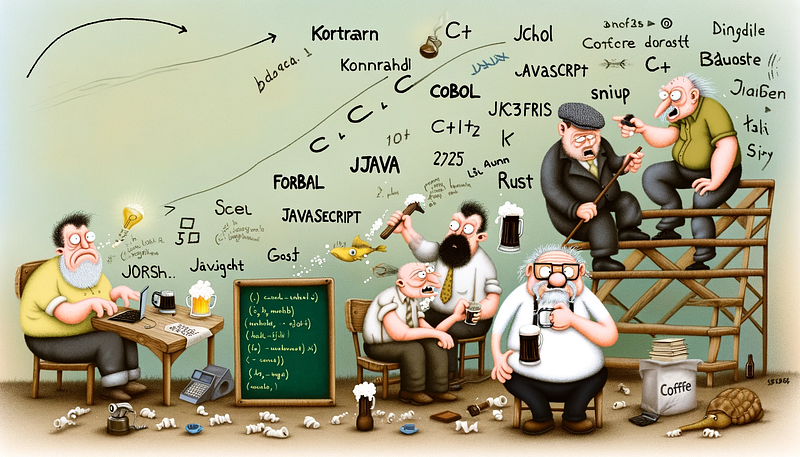
In the grand, absurd parade of programming languages, we’ve witnessed a cavalcade of characters, each more eccentric than the last. From their humble beginnings to today’s digital dominance, let’s take a tongue-in-cheek stroll down the memory lane of programming languages.
1940s: The Stone Age of Computing
Konrad Zuse’s Plankalkül: The “Beer Mat” Programming Language
In the 1940s, Konrad Zuse, presumably while sipping a cold one, scribbled down the world’s first programming language, Plankalkül, on a beer mat. Because, of course, all great ideas start in a bar. Plankalkül, which translates to “Plan Calculus,” never quite caught on, likely because everyone was too busy trying to figure out how to pronounce it. It was the first attempt to move beyond mere machine code, introducing concepts that wouldn’t be soberly considered until decades later.
1950s: High-Level Languages Take a Bow
FORTRAN: The “FORmula TRANslating” System for the Lazy Mathematician
Then came FORTRAN in 1957, developed by IBM. It stood for “FORmula TRANslation,” because why waste time spelling out entire words? Designed to make programming accessible to mathematicians, FORTRAN was the first to say, “Why do it the hard way?” Its creators aimed to simplify coding so much that even their grandmothers could write a loop. And thus, the first high-level language was born, paving the way for programmers everywhere to embrace laziness as a virtue.
1960s: The Birth of COBOL and The Accidental Tourist in Programming Land
COBOL: The “COmmon Business-Oriented Language” for the Bureaucrat
In the 1960s, COBOL entered the scene, aiming to bring programming to the business masses. Grace Hopper, a rear admiral no less, figured that if sailors could follow orders, so could computers. COBOL was like the bureaucratic form of programming languages: verbose, filled with redundancy, and designed to be understood by managers. Its legacy? Long, unreadable code that could outlive its creators by decades.
1970s: C — The “Sea” of Possibilities
C: The Language That Said, “Hold My Beer”
In the 1970s, Dennis Ritchie developed C, a language that was as close to writing in English as it was to talking to the machine. It was the Swiss Army knife of programming languages: powerful, compact, and easy to shoot yourself in the foot with. C said, “Why write in ten lines what you can obfuscate in one?” It became the lingua franca of operating systems, including Unix, which was pretty much developed alongside it in a beautiful bromance of code.
1980s: The Object-Oriented Odyssey
C++: The “C With Classes” or “How to Make Simple Things Complicated”
Then came the 1980s, when Bjarne Stroustrup took one look at C and thought, “This is great, but what if it was incomprehensible to mere mortals?” Thus, C++ was born, introducing “classes” and “objects” so that programmers could now simulate real-world confusion digitally. It was like taking the power of C and adding a layer of complexity just for the fun of it. “Object-oriented” became the buzzword that nobody really understood but everyone used at parties to sound smart.
1990s: The Internet Age and The Birth of Java
Java: The “Write Once, Run Away” Language
In the mid-1990s, Java burst onto the scene, promising to be the panacea for all programming woes. Its motto, “Write Once, Run Anywhere,” quickly turned into “Write Once, Debug Everywhere,” as programmers discovered the joys of platform-independent headaches. Java was like the universal remote that promised to control all your devices but ended up just turning on your neighbor’s TV.
2000s: The Scripting Language Showdown
JavaScript: The Language That Made Everyone a “Software Engineer” (Whether They Liked It or Not)
And then, there was JavaScript. Not to be confused with Java, JavaScript was the wild child of the web, born in the mid-90s but really coming into its own in the 2000s. It turned web browsers into playgrounds and made it possible for anyone with a weekend to spare to proclaim themselves a software engineer. JavaScript developers were like that friend who’s fun at parties but you wouldn’t trust with your house keys.
2010s: The Decade of Safety, Concurrency, and Modernity
Rust: The “Borrow Checker” Knight in Shining Armor
In the dawn of the 2010s, Rust emerged, brandishing its “fearless concurrency” and “memory safety” like a knight in shining armor. Developed with the intention of providing a safer, more concurrent alternative to C and C++, Rust enforced strict borrowing and ownership principles, ensuring memory safety without sacrificing performance. Its introduction marked a significant shift towards writing more reliable system-level code, embodying the decade’s focus on both safety and efficiency.
Go: The Language That Made Concurrency Cool
Also in the 2010s, Google introduced Go, a language designed to offer simplicity, efficiency, and built-in support for concurrent programming. With its mascot of a cheerful gopher, Go promised to cut through the complexity of existing languages, advocating for readability and simplicity while providing powerful tools for modern software development.
Swift: Apple’s Swift Move to Modernity
Midway through the decade, Apple unveiled Swift, aiming to replace Objective-C with a language that was safer, faster, and more modern. Swift simplified iOS and macOS development, making it more accessible and enjoyable for developers. Its introduction was a clear message from Apple: the future of software development should be both powerful and user-friendly, as-long as they don’t try to do anything with async.
2020s: The Dawn of Inclusivity and Sustainability
Kotlin: The Darling of Android Developers
As the tech world entered the 2020s, Kotlin rose to prominence as a preferred language for Android development, praised for its conciseness and interoperability with Java. Kotlin’s ascent reflected the industry’s ongoing pursuit of more productive and enjoyable programming experiences.
The Rise of AI-Driven Development
The current decade has also seen the advent of AI-driven development tools, like GitHub Copilot, which promise to revolutionize the way we write code. These tools suggest a future where coding becomes more about guiding and less about manual labor, with AI assistants offering suggestions and even writing code snippets.
Conclusion: The Never-Ending Quest for the Perfect Language
As we reflect on the evolution from Rust in the 2010s to the AI-driven development tools of the 2020s, it’s clear that the journey of programming languages is far from over. Each new language and technology brings us closer to a future where coding is more efficient, accessible, and, crucially, enjoyable.
The saga of programming languages, from Konrad Zuse’s beer mat to today’s AI-assisted code completions, illustrates our relentless drive to solve problems, express ideas, and innovate. It’s a journey marked by human creativity, ambition, and the never-ending quest for improvement.
So here’s to the future of programming, a future that promises continuous evolution, surprises, and opportunities for all. May our tools be powerful, our code clean, and our digital world inclusive and sustainable.