
The High-End Travel Industry Just Died in Morocco
And my boss was there to witness it.
Friday night. I was finishing the last details of a presentation for my boss. WhatsApp messages back and forth to adjust the script and photos. But at one point, the messages from Africa ceased. Suddenly, a message in the general work group: my boss’s real-time location. I don’t understand it; why would we need his location more than 12,000 kilometers away?
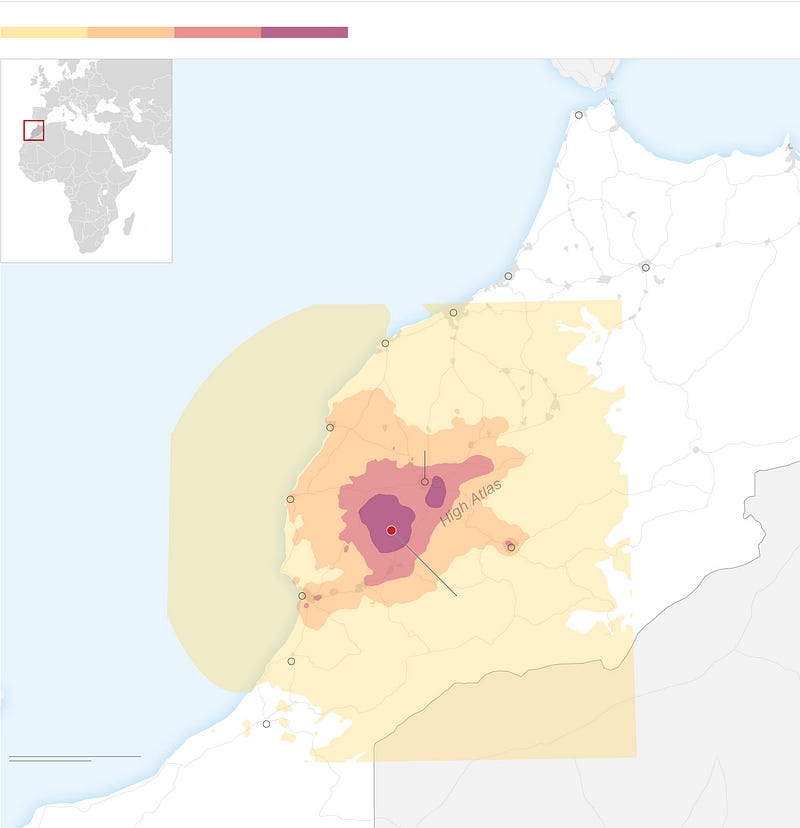
Google, for a change, has the answer. A 6.8 earthquake just hit northern Morocco, 72 kilometers southwest of Marrakech, from where my boss was writing me. And where, in two days, he would be attending the world’s most elite high-end tourism fair, The House of Beyond, exclusive to the most distinctive members of PURE The Show.
PURE The Show calls itself “the world’s leading experiential travel show, and a community with the attitude, commitment, and the belief that travel can be more than just an industry.” Belonging gives you the feeling of being part of the high-end travel industry. Well, the truth is you also pay for a membership of 5,000 to 15,000 USD per year for “belonging” rights. The House of Beyond, which you only get by invitation, is a private members’ club for leaders from PURE The Show. It’s basically where the big guns from the travel industry sit down and fight to see who has the longest…carbon footprint around the world.
In summary, PURE is intended to be a platform for sharing ideas, inspiration, and innovation, promoting meaningful and transformational experiences within the travel industry, and emphasizing the potential for positive change.
Since moving the show to Marrakech in 2021, it has allowed its participants to engage with local communities and supports the local charity Education For All. Their total in donations since 2010 is “an incredible £196,735!”.
You might have already guessed, but I’m very skeptical about all of this — though I’ve been a part of it for more than 15 years now. And it’s not the travel fairs where you have to pretend to like or smile at someone you just met because you want a share of their pockets; and far from being the inspiring values they promote, the jobs it creates, and the possibilities it provides; or even the people who attend these fairs, who seem like the friendliest, most honorable, and empathetic persons in the world, all smiles, and missions, and visions of a brighter future together.
No, the problem is that I’ve seen what’s behind the curtains once the show is over…
Those attendants, buyers, and agents are disguised Khaleesi’s trying to tame dragons, pretending, faking, and scheming — all for a piece of your pie or a dive in your pockets.
Been there, done that.
Working as a ski instructor in Aspen for nine years sure teaches you to fake smiles and sell storms for bluebird days. And that is just me, the one at the end of the feeding chain of a customer who usually pays for a Travel Company, a Travel Agent, a Local Company, and a Local Guide/Instructor. There’s a lot of faking till you finally meet the client on the hills.
These days, I am in the position of a Local Company. When we operate VIP clients, there’s usually an emissary from the Travel Company supervising that you provide what you were paid to do, not the direct clients who are probably having a once-in-a-lifetime day, far from being worried about the missing pie from the 20 promised pies. They are worried about that “pie” because, in the end, they are the ones paying for it, not the client. If they spared that “pie” from the final quote, they could have added it to their own piece of the pie instead of ours, when from the mouth outward, we are a “community.”
This is the usual behind-the-scenes behavior. In every aspect.
And don’t pretend I put the blame only on others. The company I work for is a B Corp Certified company. Though there are many positive aspects in the jobs it provides and the purposeful trips we (sometimes) operate, there’s an apparent downside in wasted resources, pollution, plastic contamination, and carbon footprint (though we have a carbon footprint fee that most of the agencies we work for negotiate and try to take off the final budget). What we preach isn’t what we always deliver; sometimes, it’s plain greenwashing.
Tourism, Climate Change & A Revelation During Quiet Times
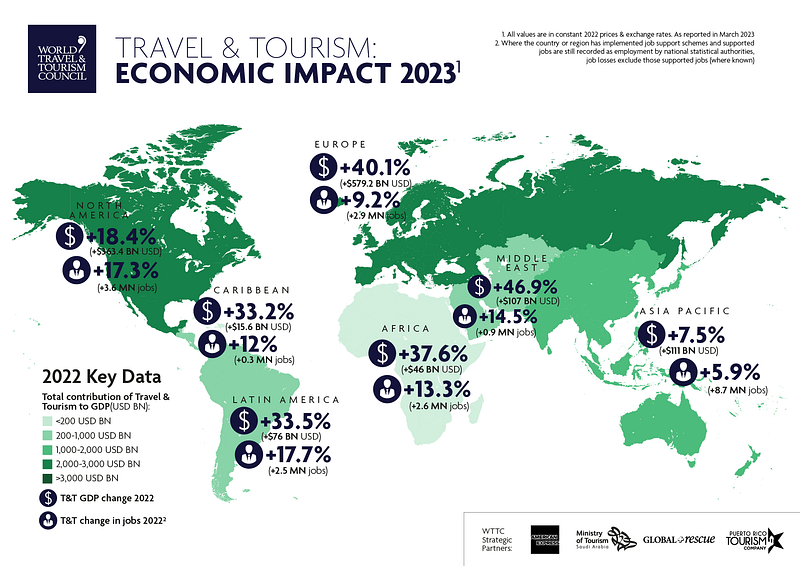
Some of the world’s most breathtaking destinations are also the most vulnerable to the climate crisis: glaciers, forests, coral reefs. Tourism isn’t innocent in this story. It accounts for approximately 8% of global emissions. And it also brings many other problems, from rampant overdevelopment to the degradation of precious natural landscapes and invading tourists.
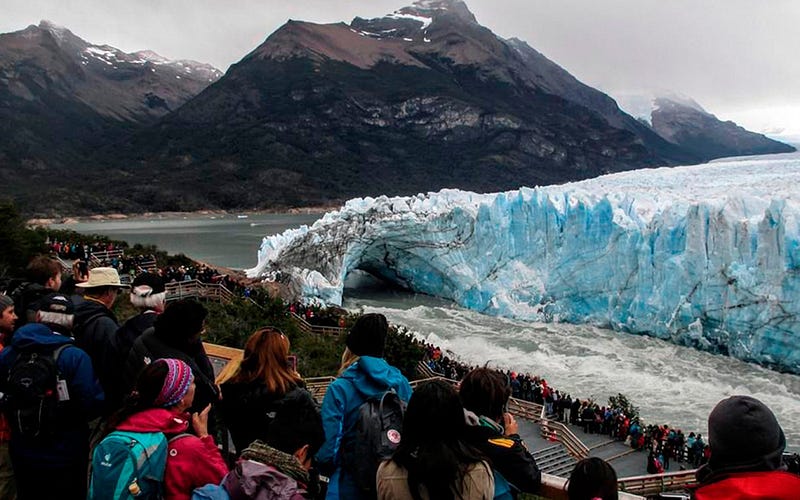
Yes, it’s a complex relationship. Many of these destinations, including my hometown, rely heavily on the revenue from tourists, often lacking other sustainable industries. Some might turn to extractive practices like mining or logging without tourism, harming the environment. Tourism is a powerful tool for raising awareness about environmental issues and providing funding for conservation efforts.
The impact of tourism on the environment became even more evident during the pandemic. As tourism stopped, carbon emissions plummeted, and wildlife thrived. For instance, leatherback turtles laid the most eggs in Thailand in two decades, enjoying deserted beaches, or people in India could see the Himalayas for the first time in 30 years. But this positive change came at a steep cost. The global tourism industry suffered enormous losses, and families struggled to put food on the table.
The distressing earthquake in Morocco, the strongest to hit the region since 1900, according to the U.S. Geological Survey, has probably nothing to do with climate change: most earthquakes occur far beneath the Earth’s surface, well beyond the influence of surface temperatures and conditions. The high-end travel industry should reflect on this catastrophe in its fancy and uptight face. Suspending the fair was the least they could do. Feeling good about donating goods to the affected, when in reality, the trips they (and we) plan for the wealthiest 1% cause double the CO2 emissions of the poorest 50%? Well, that is not even close to enough.
Yes, we can go and help affected communities, donate vaccines, move rhinos from an endangered hunting zone, plant trees after massive events, and collect garbage from beaches. But traveling in helicopters, drinking water in never-ending plastic bottles, eating shrimp, marlin, and red tuna while jumping from one destination to another, and leaving emissions behind definitely tip the scale heavily on the wrong side.
The infamous carbon footprint
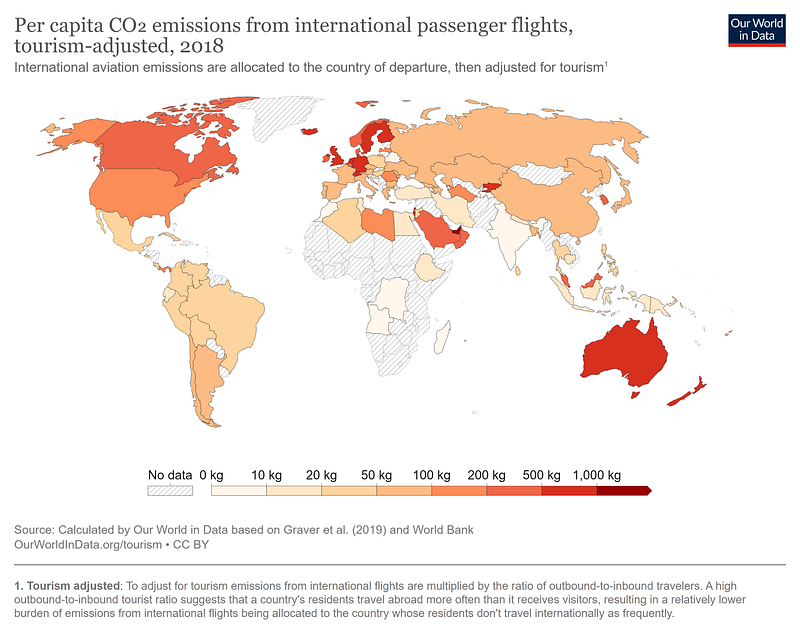
Our clients come mainly from the U.S., where the average person emits 386 kilograms of CO2 annually; people in Rwanda, just 0.14 kilograms. Yet consider that 20% of the U.S. population has never flown, and a tenth takes 66% of flights. This 10 % minority of “super rich frequent fliers” are responsible for five times the emissions of the poorest 50%. And let’s not forget that business and first-class seats are five times more polluting than economy class, as the larger seats mean fewer passengers can fly per kilogram of CO2.
And that is only their flights.
The wasted or overspent resources pile up: luxury meals, helicopters, boats; plastic, pollution, carbon emissions. That is why we charge for the carbon footprint. (So we can attend next year’s travel fair).
Between Environmental and Social Responsibility
Traveling is one of the most broadening experiences we humans can do. I am far from an anti-travel agent: some of my best memories come from trips. But we are at a point where the environment is telling us differently.
The industry is at a crux of definition: Do we continue to wear the mask of eternal growth, profit, and resources? Or do we assume a genuinely active role as the first line between the environment (our source of work) and the damage caused by our industry (source of income)?
People in Morocco are now suffering from the heartbreaking aftermath of the earthquake. But climate change is a far darker and extended shadow lingering over the country. Trends are already putting pressure on the land, identified as a very vulnerable country by the IPCC. Moroccan regions are affected by drought, increased average temperatures, heat waves, changing rainfall patterns, extreme rainfalls, floods, and rising sea levels. Disappearing natural resources are affecting the resilience of forest ecosystems and the agriculture sector due to water scarcity. The people from Morocco have neither fault for the devastating earthquake nor the climate crisis.
How do we sustain an industry that sucks up resources and mortgages our future while also providing for millions of people who depend on it?
My boss is arriving tomorrow. He was seemingly shocked after the catastrophe and collaborated with donations and rescue teams. But he also had informal meetings between ruins and palaces and sold some fancy trips for this upcoming southern summer in Patagonia.
I’ll have to find out by myself if the travel industry did really die in Morocco and something different was born.
Evidence was right in their faces. And no one was faking it this time.
Thank you for your thorough reading and support!
If you crave more insights into climate change, scientific progress, and geopolitics with a Patagonian twist, subscribe to the newsletter Antarctic Sapiens and dive into thought-provoking content weekly.