
The Hierarchy and Power of the Courtroom: How Tradition Shapes the Legal Process
I wrote yesterday, about the history of our legal systems and the way they have evolved across hundreds of years.
Given this long evolution, you might be forgiven for thinking that things have changed a lot since those “old days”. Yet in many respects, court proceedings have remained unchanged for centuries.
Walking into a courtroom today, although you might find more modern fixtures and a little technology, much of the pomp, ceremony and rituals of the past remain much the same.
That’s a little strange for our modern era though, isn’t it?
Why, for example, do lawyers still bow to the judge when they enter a courtroom?
Why do judges (and often lawyers) still wear old fashioned robes and sometimes pompous looking wigs?
And why do judges sit on elevated platforms, rather than sitting down with everyone else— as might generally be expected in more modern settings today.
The court rituals that are still observed in courtrooms today, in fact have their roots in the rituals and ceremonies that were performed in medieval royal courts.
These were rituals that served several functions, including:
- Legitimacy: In medieval times, royal courts were the ultimate source of legal authority. The rituals and ceremonies that were performed in these courts were intended to convey the idea that justice was being administered in a fair and impartial manner, and that the rulings of the court were legitimate. (Where either was true, was of course another matter).
- Symbolism: The use of elaborate rituals and ceremonies in medieval courts was also intended to convey symbolic messages about the power and authority of the monarch and the court. Whether there was any justice in such power being wielded and such privilege enjoyed, these symbols were intended to impress upon the participants the importance and solemnity of the proceedings and the rightful authority of the person wielding them.
- Order and decorum: The use of rituals and ceremonies helped to establish a sense of order and decorum in medieval courts. By following strict rules and procedures, the court could maintain control and authority over proceedings — purportedly with the aim of ensuring that justice was done.
Today, many of these same functions are still present in modern courtrooms, with the rituals and ceremonies that are observed, seeking to convey those same notions of legitimacy and authority, and to symbolise the power of the court.
In addition to the bowing, use of robes & wigs, and elevated platforms by judges, some of the other examples of courtroom rituals that resemble those of royal courts include:
- Addressing the judge with the elevated title of “Your Honour”, which is similar to the way that people addressed monarchs in medieval courts, using titles such as “Your Majesty” or “My Lord/Lady.”
- The use of courtroom etiquette, with specific rules and protocols that govern behaviour, such as standing when the judge enters the room and speaking only when recognised by the judge. This is similar to the strict etiquette that was observed in medieval royal courts, where everyone had to adhere to strict codes of behaviour and decorum.
- The use of formal, solemn & serious language, used to convey the seriousness and solemnity of the proceedings, including the use of specific terms and phrases particular to that institution, as well as a formal tone and manner of speaking. This is true of both modern courtrooms and medieval courts.
- Court dress codes specifying what lawyers and other officials can and cannot wear, on penalty of eviction (or arrest for contempt!) where strictly enforced rules are expected to be obeyed. This is similar to the dress code that was required in medieval courts, where specific clothing and accessories were also worn to indicate one’s rank and status.
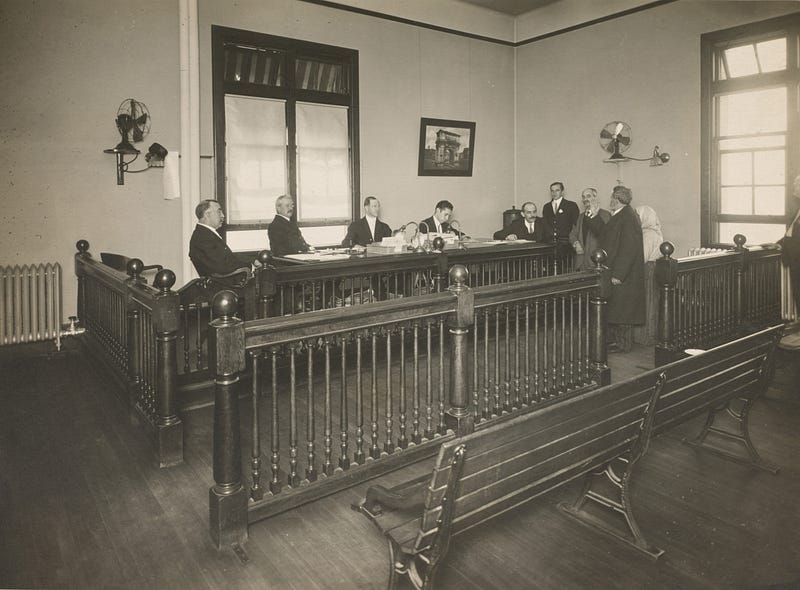
- Hierarchical layouts, with courtrooms generally designed to convey a sense of formality and authority, much as royal courts did: the judge’s bench often being raised above the rest of the courtroom, and the seating arrangement then also often hierarchical, with the lawyers and other officials seated in specific locations based on their rank and role.
- The use of court seals: in medieval courts, official documents were often stamped with a seal to indicate their authenticity, while in modern courtrooms, court documents are also stamped with a seal to indicate their authenticity and to signify that they are part of the official record.
- Grand architecture denoting grandeur and formality, such as high ceilings, ornate mouldings, and marble floors. While not all modern courtrooms still have this today, many still do, with architecture that is similar to medieval royal courts that often also featured grand halls and elaborate decorations.
- Symbolic props used in modern courtrooms, such as the scales of justice, the gavel, and the courtroom flag, are all intended to convey authority and legitimacy, much as those of medieval royal courts did, where similar symbols were used to represent power and authority.
- In both modern courtrooms and medieval courts, there is often also an opening statement that sets the tone for the proceedings. In modern courtrooms, the lawyers may give an opening statement outlining their case, while in medieval courts, the proceedings might begin with a statement from the monarch or other officials.
- In mostcourtrooms, there is a court crier (bailiff / associate / registrar) who announces the arrival of the judge and other officials. This is similar to the role of the herald in medieval courts, who announced the arrival of the monarch and other officials.
As in medieval courtrooms, these rituals serve to convey the purported importance and legitimacy of the legal system, with descriptions such as ‘order’ and ‘decorum’ used as justifications for the maintenance of power and control by a select few.
At the end of the day, courtroom rituals, as in the Medieval era, are all about power and the conveyance of authority.
This conflicts with the modern approach, which tends to reject the idea that kings and lords (read: judges and lawyers) should wield significant power, with such concepts now having largely been replaced with modern notions, like democratic governance.
In the modern era, most organisations and institutions have also adopted a more collaborative and inclusive approach to decision-making and conflict resolution, where communication, mutual understanding, and problem-solving, are the order of the day, rather than the adversarial tactics we see in courtrooms, which are arguably archaic by contrast.
The formality and artificiality of the courtroom, with its maintenance of strictly hierarchal processes, that overly privilege the voices of judges and lawyers, is from a time past.
Judges and lawyers, as guardians of these systems, with their inherently conservative tendencies and strong traditions of resisting change, actively seek to maintain and defend these outdated systems, apparently without any real awareness of the potential for something better.
Too often, this is also at the expense of more vulnerable, less privileged folk (something I have written about lots here on Medium!).
Modern prioritisations with respect to collaboration, inclusivity, transparency, accountability, and equity, would better ensure that all voices are heard and considered in decision-making processes, with the consequent effect (one might expect) of there being more just and equitable outcomes than those which our current legal systems provide.
It is time for our legal systems to explore and adopt these more modern approaches in order to evolve with the changing needs of society.
As a lawyer who practiced for many years, I believe that it is important for the legal system to adapt to a more modern and inclusive approach to decision-making and conflict resolution.
“Laying down the law”, which is very much what modern judges still do, is an archaic approach, that while very well may have fitted into the medieval world of kings and privilege, is not fit for today.
Time has moved on from what it was a few hundred years ago.
Enjoyed this story and wish to back its creator? Contemplate becoming a Medium member. By registering through my referral link, I’ll get a small commission without any additional cost to you! In return, you’ll unlock unlimited access to all stories on Medium.