
The Hidden Weave of the Universe
The Physics of circularity and coincidence

James Clifton had been working on his refutation of the big bang theory for over 20 years, nearly his whole tenure as a professor at the University of Oregon. He called his novel theory “The Great Cosmology” And he had received considerable criticism for what was considered his “quaint” ideas, especially from other physicists devoted to Stephen Hawking. They found his less than deferential critique of Hawking’s theories completely unacceptable.
Professor Clifton was a modest man, looking more like a day labourer than a professor, and people often mistook him for a custodian because of the way he carried himself and his manner of dress, except when he lectured, where he spoke with enthusiasm, in contrast to his demeanour outside the classroom where he was timid and more soft-spoken. His most common verbal tick was the phrase, “what a misbegotten thought,” which he occasionally punctuated into his more coherent thoughts. In the classroom, he more often than not, used that phrase as a retort to a wrong answer to the many questions he seemed to randomly ask the class. Though amiable and pleasant in every other aspect of his interactions, when he questioned his students, especially the more intelligent and self-important ones, he would often respond, “what a misbegotten thought,” and then explain in devastating precision, why their answers were acceptable. No one in his class is like to be the target of Dr Clifton’s questions and many who have been forced into a spotlight have begun to call themselves, “the misbegotten” or more specifically, “Dr Clifton’s misbegotten.”
In this current year, the leader of this particular edition was Taylor Morrisey, who in several of the October classes in astrophysics had been targeted a dozen times by Dr Clifton and not one answer had been acceptable, including the last one, which Taylor simply read from the textbook.
“Do you believe gravity exists, Mr Morrisey? Professor Clifton had asked him.
“There is something holding this bottle of tea to the tabletop,” Taylor countered.
“Do you believe gravity exists?” Dr Clifton repeated.
“As it says here on page 426, Einstein’s general theory of relativity has been corroborated numerous times in controlled experiments.”
“That is not an answer to the question I asked, Mr Morrisey. Do you ‘believe’ gravity exists?” Dr Clifton emphasised the word ‘believe.’
“Yes, I believe in gravity.”
“Another misbegotten thought, Mr Morrisey. I’m not convinced that gravity exists. Not in the way we think it does.” He paused.“Your assignment Mr Morrisey, is a 10-page paper due one week from today as to why gravity exists.”
“You can’t give special assignments to one isolated student in a class. There has to be some university policy against this. I will appeal.”
“I’ve been through this before. I am permitted to set any particular requirements I choose. It’s 10-page paper one week from today, gravity.”
Taylor Morrissey had appealed before and the university had denied him and he wasn’t going to challenge Dr Clifton after this incident. Such was the irony, inside the classroom Dr Clifton was as formidable an adversary as one could imagine, but outside the classroom, he was as soft-spoken and humble as many of the migrants who mowed the lawns for landscaping companies in the middle-class neighbourhoods of Portland. In fact, one of his own neighbours had once mistaken Dr Clifton for a landscaper when one Saturday morning, he was mowing his own lawn. The neighbour came and tried to solicit him for lawn work. He still found the encounter amusing when he thought about it.
“What are you looking at, James?” His wife, Yelena, asked him as she entered the kitchen and found him staring tortoise-like out a window at a landscaping company mowing his neighbour’s lawn across the street. It was eight o’clock in the morning on a Saturday and he would normally have been asleep, but he was awakened by the sound of the lawnmower and lumbered into the kitchen to get a glimpse of what kind of mower would make so much noise.
“I’m sorry, the noise of the mower woke me up. I’m surprised Teddy isn’t up. He’s a lighter sleeper than I am.”
“Teddy had a late night again. Nightmares. But he seems to be sleeping fine now.”
“He’s still up to going to the amusement park?”
“Wouldn’t miss it for the world,” Yelena acknowledged.
“What about his sister?”
“She went to bed early. She wants to have plenty of energy for the roller coasters.”
“I’m not looking forward to roller coasters. I much prefer the nice relaxing spin of a carousel.”
“You are always that way. Seven times you talk me on space mountain in Disney World if you remember.”
“So what time are we leaving?” he asked her.
“Eight-ish,” she responded. There was a slight tint of a Russian accent in her voice, though fifteen years have passed since she started living in the US.
“What would you like for breakfast?” She asked him.
“Pancakes would be nice,” he responded.”
“Sure. Pancakes would be great. Thank you.”
He stood in the kitchen a few moments, staring out the window again at the men mowing across the street.
“You are sure the weather is going to be okay today?” He shouted to his wife who had left the room.
“The weather is going to be great,” she shouted. “Keep your voice down. I don’t want to wake the children yet. I have a surprise for Teddy.”
She returned to the room with a small cardboard box with wrapping paper and ribbon.
“I have to wrap this package for him and then I will fix your breakfast.”
She sat down at the kitchen table and began to wrap the package.
“Go get dressed, James. I have a full day planned for all of us.”
James went upstairs to their bedroom to get dressed for the outing. He never knew what to wear, and he kept looking through drawers and closing them when he couldn’t make up his mind. Clothing had never been important to him and he deferred all his decisions on wardrobe to his wife.
Teddy was the first to come downstairs, nine years old and a miniature replica of his father. He walked with a lumbering gait to the kitchen table.
“Good morning, Teddy,” his mother greeted him. “I have your favourite pancakes.”
She placed the plate down in front of him.
“Do you want the strawberry or the maple syrup?”
“The strawberry,” he answered emphatically.
“Good choice,” she told him. She carefully poured the syrup in a spiral from the centre to the outer edge.
They both were surprised by how precise it was. But his mother had been a lab technician and had precise motor control in her hands from years of technical experience.
A half-hour later, his sister Angelica arrived, six years old and looking very much like her mother, she appeared more carefree than her brother and she was singing a children’s song about rainbows.
“I love rainbows, pretty rainbows with your colours in the sky, like the flowers and the butterflies dancing ‘in my eye.’”
They were surprised that she knew all the words.
“For you, Princess, I have a special treat,” her mother told her. “Those waffles with bananas that you like.”
“Thank you, mummy. I love you so much,” Angelica said and hugged your mother.
“Why does Angelica get the waffles all the time?” Teddy complained.
“Pancakes are your favourite. Waffles are hers, we should be happy your sister likes them so much.”
James was the last to be served, but this morning he was preoccupied with his research paper.
“Eat,” she told them as she splays the play the pancakes and sausage in front of him. “We’ll need our energy for the walk.”
“It’s not that big of a park,” he responded.
“You said that the last time you got tired.”
His wife sat down with him with a small plate of fruit, slices of apples, bananas and some watermelon.
After they finished breakfast, James took the two children’s hands and began to take them toward the car. His daughter seemed the more excited of the two.
“Do they have a rollercoaster I can ride?” She asked him.
“I don’t think your mother wants you riding rollercoasters. Maybe you can come with me to the merry-go-round.”
“No, daddy, that’s a baby ride. Let me ride a rollercoaster.”
“We’ll see.”
Though he knew his wife did not want her to ride rollercoasters, after he put both of them into their seats, James turned to his wife and asked, “would you mind driving to the park this time? I really want to read my paper.”
She seemed annoyed.
“You said you would give the children all of your attention.”
“I will. Just a few minutes and I will put it aside.”
She reluctantly took the keys and he climbed into the passenger side of the car.
“Thank you, Yelena, you’ve always been wonderful. Isn’t Mommy spectacular, kids?”
“Mommy is the greatest,” his daughter almost shouted
“Tell your mommy thank you,” he told his son Teddy.
“Sorry Mommy,” Teddy, who was distracted, answered, “your beneficence is unsurpassed.”
He had in his hand a stack of vocabulary words, which she had brought with him to study.
“Teddy likes big words,” Angelica observed. “I don’t understand him.”
“Teddy is just trying to improve himself,” James explained. “The more words he learns the better he will do in school.”
“The other children won’t appreciate his use of these words,” his mother responded.
“It’s okay, Mom. I don’t use my special words at school.”
He put the cards into his pocket.
“Keep learning the words, Teddy,” his father encouraged him. “They’ll open the doors of your imagination.”
It was nearly 10:30 when they arrived at the amusement park. It wasn’t that large with maybe a couple of dozen rides and nearly half of the rides were kiddie rides for small children. Both Teddy and Angelica used to ride the children’s rides and James had brought them to the park nearly 40 times over the years. James’ fond memories were from the paddleboats. They often rode across the small lake at the back of the park.
Finding a parking space often proved difficult and this day was no exception. His wife drove around the lot a half dozen times before she finally found a space. James, who had been reading his paper the whole time she was looking, finally put the paper aside.
“I am glad you finally decided to put that paper away,” she told him. “Your children need your attention.”
“My children have my attention. Tell me, Angelica, your favourite flower.”
“My favourite flower,” she hesitated a moment, “is a red carnation.”
“How do you know about carnations?” He asked.
“Mommy told me all about flowers, like the daffodils.”
He was surprised she could say the word “daffodils.”
“That’s one of my vocabulary words,” Teddy acknowledged. “The daffodils were blooming in the garden behind my window,” Teddy recited.
“Daffodils,” his sister repeated.
James opened the doors for the children and helped them both out of the car. He was prepared to walk them both into the park but his wife reminded him, “There is a picnic basket. I will walk the children into the park.”
She opened the trunk for him to take the basket. It was heavier than he imagined it would be, but he remembered his wife always brought more food to a picnic than all of them could possibly eat.
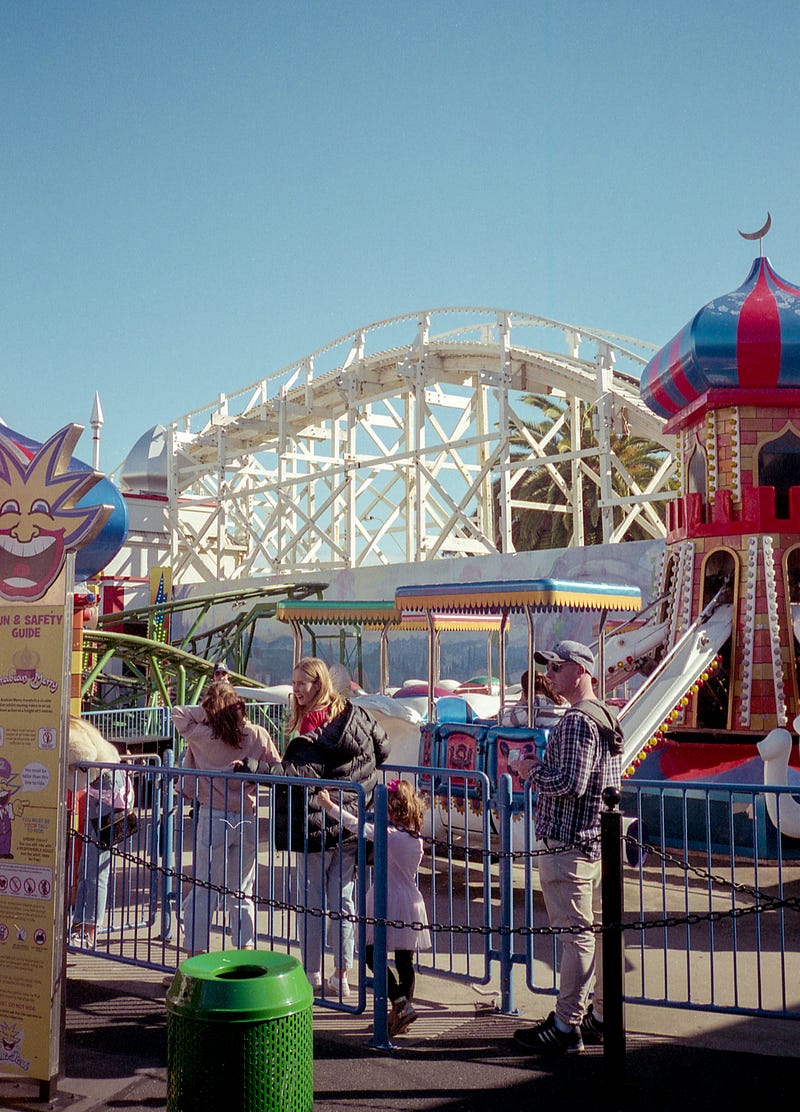
As he watched his wife walking a couple of steps ahead, James kept thinking about his essay and fought the impulse to take the papers with them into the park. Whenever he was involved in a project it normally became all-consuming and he was grateful that she had put up with his obsessions. With this project, he sensed that he was on the threshold of something truly extraordinary. After the children entered the park, it was difficult for James to keep up with them as they wanted to run from ride to ride. He watched his wife Yelena rushing indefatigably beside them, often holding both child’s hands at once. Angelica was the more strenuous runner, breaking free a couple of times and forcing her mother to chase her down. He imagined his daughter older, running in races, as he had done when he was in high school. He couldn’t remember the last time he had run. He spent his days sitting down at a desk and crunching numbers, and standing in a lecture hall reciting well-worn speeches on the fundamentals of physics. He would never speak about his private misgivings concerning the curriculum he was teaching.
They had been at the park about an hour and a half and James counted a dozen rides each had ridden, when Angelica approached him, looking both tired and satisfied. “Can you take me on a rollercoaster, Daddy, you promised?”
“I think these roller coasters would be too much for you.” What he was really saying was that it would be too much for him.
“The twisting serpent doesn’t look so scary,” she said while holding a copy of the park brochure.
“What a name for a ride,” he commented. “Go ask your mother.”
He was hoping his wife would be told to ride. But his daughter returned with a broad smile, a few moments after talking to her mother.
“Mommy said it’s okay if you ride with me.”
“Alright, honey, we’ll ride.”
They stood in line for nearly 15 minutes waiting for the ride. He timed the ride and it took three minutes and 17 seconds for every circuit around the metal tracks. He also estimated the height of the longest drop and began to calculate in his head, the velocity, acceleration and forces involved in the operation of the rollercoaster. He was surprised how fast the ride actually performed and what was ostensibly a children’s coaster. After he completed his calculations he was even more convinced of the imprudence of rollercoasters. Imagine the difficulties an engineer might have in building even longer and faster coasters without injuring or killing those subjects with the forces involved in riding the coasters.
When he and his daughter reached the front of the line and he attended Jester for them to board the small car, James wanted to sit in the rear car, in case something went wrong, But his daughter insisted on the front car. “Please daddy, it’s more exciting.”
“He wondered where she had learned the word “exciting.” He never spoke this way. He hated the idea of his daughter pursuing the path to more excitement. Perhaps because he had studied physics, she had become more risk-averse.
‘Exciting’ became a metaphor in his mind for “dangerous.” Everything around him seemed dangerous, far more dangerous than others seemed to realise.
They rode the rollercoaster together, with his daughter screaming at the top of her young lungs. It made him a little anxious that the old rollercoaster would fall apart, as it screeched and rocked through all its turns. When the ride came to an abrupt stop with a puff of air, he was happy it was over. His daughter’s first words were, “Can we do it again, please, please, Daddy. I want to do it again.”
He looked into his daughter’s expectant eyes and he looked at the even longer line of parents waiting with children.
“Alright, honey. We’ll ride again.” He could disappoint her.
The second time he rode the coaster was less anxious for him because he was not surprised by the sudden jolts and found his body instinctively responding to the obstacles before they arrived. His daughter seemed less excited the second time around.
“May I ride the rollercoaster another time, Daddy?” his daughter pleaded.
“I don’t think so, Honey. Can’t we ride the merry-go-round for a while?”
“You are tired, Daddy?”
“A little tired.”
“OK, Daddy. We can ride the merry-go-round.”
He took her hand and they began to walk towards the side of the park where the concessions were. When they arrived at the carousel, there was a long line of children with their mothers, and there was one young man whom he immediately recognised holding the hand of a six-year-old girl.
“Hello, Professor Clifton,” Taylor Morrisey greeted him. “What an odd coincidence! This is my little sister, Angelica.”
“She has the same name,” James’s daughter expressed.
“Yes, she has the same name.” Even his daughter thought this was unusual.
“Is this your first time at the amusement park, Professor? I’ve never seen you here before.”
“No, I come here often. Every couple of weeks if I can.”
A woman who was standing between them with two small boys gestured for James to move forward.
“Thank you,” he responded and moved ahead with the two Angelicas standing beside each other.
“How old are you?” James asked.
“I am 20 and my sister is six. I get it all the time. My parents had her later in life.” He paused a moment. “I come here at least every couple of weeks on Saturdays, an occasional Sunday.”
“I am surprised I’ve never seen you here,” James told him.
Taylor removed a small notebook from his pocket and began to read about the days he was at the park.
“So you’re one of these compulsives who keep track of these details. I try not to pay attention to random coincidences,” James acknowledged.
“You’re a physicist, Professor. You should pay attention to these details.”
Taylor had written down the last 20 visits in chronological order.
“Would you mind telling me when you were here, Professor? Twenty instances would be a good number.”
“I don’t think I can remember three.”
“Please try, consider this an experiment.”
James thought a few moments and his mind drew a blank.
“Three weeks ago on Saturday,” James finally answered.
“I wasn’t here. And before that?”
“Two weeks before that I think.”
“Again, I wasn’t here.”
“And before that?”
“I believe a week before.”
“I was here two weeks before,” Taylor spoke.
Taylor encouraged James to push further back in his memories until he compiled a long list of visits over the course of nearly 8 months. There were no visits where they were at the park at the same time until this current one.
“22 visits, professor and not a single coincidence until now when the two Angelicas finally meet. I find this phenomenon quite extraordinary. I could do a quick calculation of the problem is if you like, I’ve memorised the equations.”
“That’s not necessary. I know it’s highly unlikely.”
They finally reached the front of the ride and both girls with a little help climbed unto the merry-go-round.
“Horse or seat?” Taylor asked his sister.
“Horse,” she responded.
“I want to ride a horse too, Daddy.”
“Alright, just be careful.” They both helped the girls on the horses side-by-side, while James and Taylor stood beside the girls. Then the ride began to move.
“This is precisely why I don’t believe in the big bang theory,” Taylor proposed. “If everything in the universe were truly random, these kinds of patterns wouldn’t exist. There is organisation beneath the surface of things.”
“We’re on the same page about that,” James answered. “If the universe began with an explosion, it was a controlled demolition. I don’t think it was entirely random. Certain conditions had to exist for life to exist at all, for consciousness to exist. A truly random universe would have no coherency at all.”
“I like coming here,” Taylor told him. “I see physical principles everywhere I look.” He paused. “I also like the ice cream.”
“You are as strange as I am,” James observed.
“I’d say stranger,” Taylor responded. “Do you (He hesitated) keep track of how many hours you sleep at night and when you have dreams? Do you count all the mundane details of your life?”
“I can’t say that I do.”
“Well, I am especially prone to do these things.”
“How do you find the time?”
“The really crazy thing that I’ve come to experience, many times, is that I seem to have more time. I’m doing more now than I’ve ever done.”
“I hope you’re working on that paper about gravity.”
“I’m almost halfway through that paper,” Taylor answered. “I hope it will surprise you.”
The merry go round began to slow down then it came to a complete stop.
You know I have timed this right every time I’ve been on it,” Taylor explained. “Except for today. I have this watch with a stopwatch feature. Of course, the time varies. Aaron so depends on when you start the counting. I’ve always done it from the moment the ride begins to move, until the time it comes to a complete stop. The shortest time is three minutes 17 seconds, the longest time is four minutes 11 seconds. That day the operator of the ride fell asleep for almost a minute from parting to 3 in the morning after his high school graduation. I asked him.”
The two men began to walk off the ride each holding the hand of an Angelica. But they were so involved in the discussion, they didn’t realise that they had taken the wrong Angelica.
“The average length is three minutes 22 seconds, and that’s what it was the last time we rode it.” He paused. “I have noticed a pattern also, Professor. There are four different attendants who operate this ride. I’ve met them. Today the young lady operating the ride is Penelope, or as she likes to be called, Penny. She is the most consistent of the four.”
He pulled a small notebook from his pants pocket to look at a moment. He showed James the cover. “Merry-go-round” was written on it. “I know before you say anything, I’m out of my mind, completely out of my mind. But the way I figure it, everyone else seems to be sleepwalking, someone has to be paying attention to things. My grandfather used to tell me, that everything important is in the details.”
They both looked down and finally noticed they were holding the hands of the wrong girls. As they passed the girl’s hands to each other, they both looked around to see if anyone was watching and noticed what they had done. No one was paying attention.
“You say. No one and I mean no one, not even you and I, are paying attention.”
“Are you going to talk forever?” Taylor’s sister began to complain. “Can we ride another ride?”
“Of course,” Taylor answered.
The two Angelicas were talking to each other and laughing as if they were the best of friends, as though a life of friendship lay ahead of them and even Taylor and professor Clifton sensed there was something unusual about their coming together.
“It seems we’ve created a connection,” James commented. “Where to next?”
“Let’s go to the paddle boats,” Taylor proposed.
“I’m always a little concerned about Angelica falling in the water,” James acknowledged.
“Okay, then the antique cars?” Taylor proposed.
“What time is it?” James asked him.
“It’s 12 o’clock exactly according to my watch.”
“Okay, the cars, but then Angelica and I have to go to the tables for a picnic with my wife and son. You are more than welcome to join us.”
The two men began to walk toward the other side of the park, while the two girls walked beside them.
“Going back to my final point about the merry-go-round,” Taylor continued. “I think that my little experiment, in addition to being completely obsessive, has demonstrated something which brings the circular systems into equilibrium. If you think about it, there’s something in human nature that makes us secure experiences which manifest this equilibrium.”
James was not sure what Taylor was saying.
“I know I am not being completely clear.”
They took the girls to the antique car ride and stood behind a line of about a dozen people.
“How long do we have to wait, Taylor?” his sister asked him as he stood in line.
He counted the people and there were three families of three and three girls at the front.
“12 people, three-minute ride.”
He counted the cars and calculated the time to make a small circuit. He began to write down the numbers in the back of the notebook and returned a few minutes later with an answer.
“15 minutes, Angelica, give or take 30 seconds.”
“Do we have to wait?” She complained.
“Unfortunately, Angelica. We always have to wait,” Taylor told her. “It’s just the way the world works, but the good news is that after the wait, comes the ride and we all like the ride.”
The wait to get on the ride took exactly 15 minutes to the second and Taylor showed his stopwatch to demonstrate his powers the prediction.
“You are one of a kind, Taylor. I can’t see anyone else going to this much trouble,” James told them.“Believe me, Professor Clifton. I enjoy this. It’s no trouble for me at all.”
After they rode the cars around the small driving track, James and Taylor took the girls out of the cars and began to walk toward the picnic area where his wife Yelena and his son Teddy were preparing their feast. James was surprised at how much food Yelena had placed on the table. He could see that she had become friends with a young couple who were sitting at a table adjacent to hers. This couple seemed strangely familiar to him, but he could not recall where he had seen them, though he was certain they weren’t his students.
When the four of them arrived at the table, his wife Yelena was surprised. She introduced the couple, “This is Lillian Lancaster and Edward Matheson. They came to videotape the amusement park. We’ve had a very nice conversation.” James introduced Taylor and Angelica. They all thought it extraordinary that the girls had the same name.
Lillian explained, “We have been travelling across the country filming amusement parks. It was something that I always wanted to do. I thought I was dying, but my cancer was healed. Now I am trying to live every moment as though it may be my last. I’ve had such a great time talking to your wife Yelena. We’ve talked about so many things, about Russia, about your children, about you. Your wife even let me tape a short interview. We’ll have to leave soon. But it’s been wonderful.”
“She told me things about her wonderful journey,” Yelena explained.
“Thank you for showing such attention to my wife and son,” James spoke to them. “This whole day has been a blessing.”
“Best day ever, Daddy!” his young Angelica almost shouted.
“Thank you for opening your hearts to two strangers,” Lillian responded.
Then all six of them sat down and had a great feast, of piroshki and Russian sausage and borscht soup, along with fried chicken and potato salad. Time itself seemed to stand still and they ate together. They all felt excitement and tingling in their fingers.


