
The Hidden Meaning of Michelangelo's ‘Creation of Adam’
The symbolic iconography of the masterpiece
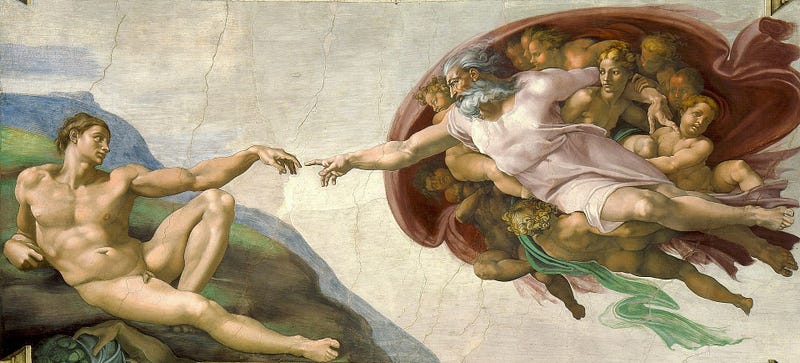
Michelangelo’s Creation of Adam is acknowledged as one of the world’s most famous art treasures. It is a fresco painting that forms part of the Sistine Chapel ceiling.
This painting reflects the incredible knowledge of Michelangelo in human anatomy. His experience in anatomical dissection is well documented by Renaissance artist Giorgio Vasari in Lives of the Artists.
Vasari says, “For the church of Santo Spirito in Florence, Michelangelo made a crucifix of wood which was placed above the lunette of the high altar where it still is. He made this to please the prior, who placed rooms at his disposal where Michelangelo very often used to flay dead bodies in order to discover the secrets of anatomy…”
Michelangelo's proficient anatomy skills aroused the interest of various art historians in the 21st century to analyze the hidden meaning behind the painting. The most common interpretation is the juxtaposition of God with the human brain. But some have argued it to be the portrayal of the birth process or Eve’s Rib.
The composition of Michelangelo’s Creation of Adam
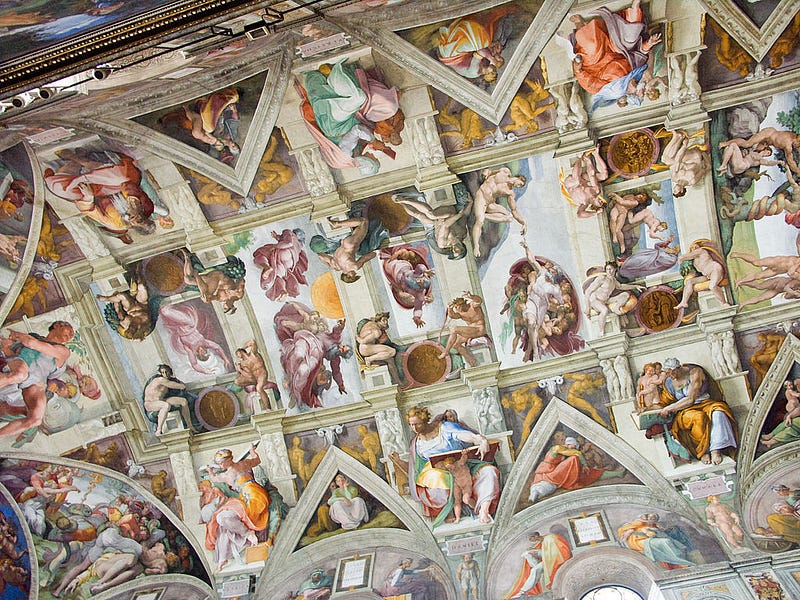
Pope Julius II commissioned Michelangelo to paint the Sistine Chapel and it took four years (c. 1508–1512) for him to create these magnificent paintings, each painting carrying an abstruse meaning with it.
One such is the Creation of Adam that illustrates the Biblical creation narrative from the Book of Genesis in which God gives life to Adam. This composition is chronologically the fourth in the series of intricate panels depicting the episodes of Genesis.
In this fresco, God is portrayed as an elderly white beard man enveloped in a white cloak while Adam is entirely naked positioned on the lower left. God is shown inside a floating nebulous and supported by angels without wings. The right arm of God is outstretched to touch the left arm of Adam extended in a pose mirroring God’s, reminding that man is created in the image and likeness of God.
God’s imminent touch to Adam would breathe life into him and ultimately will give life to all mankind. It is, therefore, the birth of the human race.
Art historians provided many interpretations regarding the identity of twelve figures around God. The most widely accepted interpretation is of English art critic Walter Pater who states that the person protected by God’s left arm is Eve. The feminine aura and the gaze towards Adam justify the analysis. And the other eleven figures depict the entire human race. This belief was challenged by the Catholic Church stating the pre-existence of souls is regarded as heretical in Christianity.
The symbolic iconography of the fresco painting
At the age of 17, Michelangelo began dissecting corpses from the Church graveyard. Thus formulation of several interpretations began based on Michelangelo's expertise in human anatomy.
The portrayal of the human brain
The most common interpretation in the painting is the figure of God juxtaposed on the human brain. In 1990, physician Frank Meshberger in Anderson, Indiana, pointed out that the shape portrayed behind the figure of God anatomically matches the human brain. The borders in the painting correlate with the frontal lobe, optic chiasm, brainstem, pituitary gland, and the major sulci of the cerebrum.
The portrayal of the human birth process
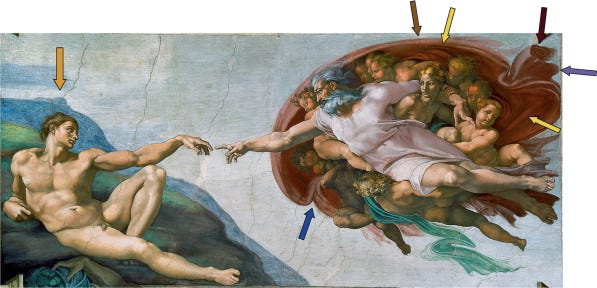
Another research published was by a group of Italian researchers who interpreted God situated in a postpartum uterus and Adam lying on a woman’s torso.
- The brown arrow represents God’s figure juxtaposing with the postpartum uterus.
- The yellow arrow resembles the folds of the mucosa of the uterus in the postpartum period. The folds seem to appear only after the delivery and retraction of the uterus muscle.
- The blue arrow represents the uterine cervix.
- Adam seems to be resting on a rock which in ancient iconography portrays generating mother. The orange arrow depicts the nipple of a female body.
- And, the green-colored scarf hanging out signifies the newly cut umbilical cord.
The portrayal of Eve’s Rib
The research done by the Clinical Anatomy journal represented the extra hidden rib on the left side of Adam’s torso as the rib of Eve. This again depicted the in-depth anatomy skills of Michelangelo and portrayed that Adam and Eve were created together. This interpretation was also against the Christian belief which states that Eve was created after Adam.
Conclusion
It is difficult to interpret historical work in a contemporary context but Michelangelo's knowledge of human anatomy convinced the art historians that everything in this painting has an explanation.
This art is a classic example of how Michelangelo encompassed the creation of the human race in one painting.
References
1. The “Delivery” of Adam. A Medical Interpretation of Michelangelo
2. An Interpretation Of Michelangelo’s Creation Of Adam Based On Neuroanatomy
3. A Reflection and Analysis on the ‘Creation of Adam’ Sistine Chapel Fresco
If you like this, you might like The Secret Behind Paintings With Dirty Feet.


.jpg)
