king-skyways-and-tunnels.html">blamed</a> for Downtown’s downfall.</p><div id="a4ba" class="link-block">
<a href="https://thisistexas.substack.com/p/the-texxas-jam">
<div>
<div>
<h2>Before Coachella, There Was The 'Texxas Jam'</h2>
<div><h3>By 1978, the tenor of the city was changing. The Cowboys had just come off their second Super Bowl win the year prior…</h3></div>
<div><p>thisistexas.substack.com</p></div>
</div>
<div>
<div style="background-image: url(https://miro.readmedium.com/v2/resize:fit:320/0*kSxm926kUpBHWYEw)"></div>
</div>
</div>
</a>
</div><p id="21fd"><b>Once upon a time, Dallas’ iconic skyline was no façade. </b>Buildings held major worldwide banking and financial institutions, corporate offices for airlines, and other major companies. As hard as it can be to believe, Downtown was bustling with activity.</p><p id="46cf">Until it wasn’t. The truth is, Downtown was already beginning its decline by the mid-70s, during the underground project. (As an aside, A friend mentioned to me how this struck him as odd, as Dallas in the national imagination seems firmly in the camp of being an eighties town more than a seventies one. Something to explore in future newsletters, I’m sure.) The city was expanding outward, with strip-malls and local shops so close to home that Downtown entertainment just wasn’t as important. This was true <a href="https://www.nytimes.com/2005/08/03/realestate/rethinking-skyways-and-tunnels.html">across the country</a>. The proposed solution certainly didn’t help the problem, and seemed to seal its fate.</p>
<figure id="40a5">
<div>
<div>
<img class="ratio" src="http://placehold.it/16x9">
<iframe class="" src="https://cdn.embedly.com/widgets/media.html?src=https%3A%2F%2Fwww.youtube.com%2Fembed%2FYlZ1M1Hh2QA%3Ffeature%3Doembed&display_name=YouTube&url=https%3A%2F%2Fwww.youtube.com%2Fwatch%3Fv%3DYlZ1M1Hh2QA&image=https%3A%2F%2Fi.ytimg.com%2Fvi%2FYlZ1M1Hh2QA%2Fhqdefault.jpg&key=a19fcc184b9711e1b4764040d3dc5c07&type=text%2Fhtml&schema=youtube" allowfullscreen="" frameborder="0" height="480" width="854">
</div>
</div>
</figure></iframe></div></div></figure><p id="c991"><b>But the justification made all the sense in the world — need to escape the heat during record-setting summers? Just go grab lunch underground! Maybe stop and get a haircut, or walk to a meeting across town. The idea seemed fool-proof.</b></p><p id="56ca">Designs from the era show a really unique and and forward-thinking construction. However, the Pedestrian Network never quite lived up to its full potential. While it was initially successful, it reduced additional street traffic by such an amount that downtown Dallas began to feel deserted.</p><p id="f3c6">Old photos of Downtown before the network are always shocking to people my age that never knew downtown Dallas as a place to hang out or shop. <i>SMUJonesFilm</i> <a href="https://www.youtube.com/watch?v=ow45qvHmyNw">preserves</a> <a href="https://youtu.be/qvDm_dMqaQs">and</a> <a href="https://youtu.be/YlZ1M1Hh2QA">uploads</a> old WFAA film reels, and a few wonderfully preserved old videos of the city show a busy street reminiscent of New York or Chicago.</p><p id="2412">From shoppers at the Neiman Marcus flagship to smartly-dressed businessmen, the streets were busy with foot-traffic. It was another world.</p><figure id="2796"><img src="https://cdn-images-1.readmedium.com/v2/resize:fit:800/1*NbtpRxCkZB7iNCs5ENycJg.jpeg"><figcaption>A 2009 <a href="https://en.wikipedia.org/wiki/Dallas_Pedestrian_Network#/media/File:DallasPedestrianNetwork.jpg">map</a> of the underground network.</figcaption></figure><p id="568b">So, instead of turning Dallas into a utopian urbanist story of the future, the network would reduce downtown to even more of a wasteland than it had become. By the early 2000s, mayor Laura Miller had some choice words for the project, <a href="https://www.nytimes.com/2005/08/03/realestate/rethinking-skyways-and-tunnels.html">telling</a> <i>The New York Times</i> that it was “the worst urban planning decision that Dallas has ever made” and suggesting she’d have liked to fill the tunnels in with cement.</p><p id="f835">It was never filled with cement. The network still stands today, and
Options
you can even see some of it for yourself. Some sections are privately owned. Certain larger portions of it, including an entrance in a Louvre-like triangular glass structure called <a href="https://www.narcity.com/dallas/crystal-court-is-a-glass-pyramid-in-downtown-dallas">Crystal Court</a>, are still open with a few restaurants and a Starbucks. However, to the casual observer, the tunnels themselves are invisible.</p><figure id="a15d"><img src="https://cdn-images-1.readmedium.com/v2/resize:fit:800/1*ETpBRMXX0u5J88qG8YfdxQ.png"><figcaption>One of the nicer portions of the tunnels, <a href="https://julielibersat.com/section/416604-Dallas-Pedestrian-Network.html">photographed</a> by Julie Libersat, 2015.</figcaption></figure><p id="1e9e">It’s more recently been labeled for “de-emphasis” by the city government (i.e., signs pointing to the network have been removed, website pages cut, and it is only open during business hours on the weekdays). Now, there’s only a few spots where you can still enter the tunnel, and ownership seems to be divided between buildings.</p><p id="7caa">Some have posted videos exploring the tunnels. It looks reminiscent of the popular “dead mall” trend — long, empty spaces, that can only be described as eerie and liminal, almost vapor-wave.</p><figure id="915f"><img src="https://cdn-images-1.readmedium.com/v2/resize:fit:800/1*RljGK_57Ci80OYW8eUXVPQ.jpeg"><figcaption>A busy Downtown Dallas in the 1950s, photographed by LIFE Magazine.</figcaption></figure><p id="948d"><b>The fact that the tunnels still exist, though, beg the question — could they be utilized again today? </b>The problem they tried to solve was noble, and if pulled off well, they could have been a success.</p><p id="09fe">Sweltering, hot summers in Dallas can become unbearable, and an underground network that’s better publicized today might actually bring more people downtown. <i>The</i> <i>Dallas Morning News</i> <a href="https://www.dallasnews.com/news/transportation/2016/07/28/want-to-make-downtown-dallas-walkable-use-the-tunnels-that-critics-hate/">ran a piece</a> in 2016 advocating use of the tunnels again for walkability.</p><p id="64e0">It has even attracted a cult-following of sorts, with an active <a href="https://www.facebook.com/DallasUndergroundCulture/">Facebook group</a> of 2,500 followers offering unofficial “tours” of the tunnels, and graphic designers using it as a basis for <a href="http://www.noahjeppson.com/map-of-the-dallas-pedestrian-network/">creative</a> <a href="https://www.behance.net/gallery/3307514/Map-of-the-Dallas-Pedestrian-Network">map-making</a>. YouTubers often go <a href="https://www.youtube.com/watch?v=WTeS-eXrxb4">underground to</a> <a href="https://www.youtube.com/watch?v=cRGWKgnUgmg&t=41s">explore it for</a> <a href="https://www.youtube.com/watch?v=7i-lKR1GtPc&t=769s">themselves</a>.</p><p id="723d">Above ground, new attractions like the <a href="https://discoverydistrict.att.com/about/">AT&T Discovery District</a> and exciting restaurants, hotels, and bars have made downtown more of a destination than it has been in years. Yet, the streets outside remain cramped with cars, the sidewalks are small, and it can be hard to escape the unpredictable weather.</p><p id="a3c4">Whether or not the network ever sees the light of day again, one only hopes that Dallas can still dream big. For now, the city seems keen on hiding one of the more interesting aspects of its history. Let’s just hope it’s not filled up with cement. ✭</p><p id="8de9"><i>Like this story? Check out more like this on my ‘<a href="https://thisistexas.substack.com">This Is Texas</a>’ blog, covering everything from culture and movies to history and other fun things below. If you feel so inclined, help support my creative writing by leaving a <a href="https://www.ko-fi.com/jakemerci">tip</a> here.</i></p><div id="ca6a" class="link-block">
<a href="https://thisistexas.substack.com/">
<div>
<div>
<h2>This Is Texas | Substack</h2>
<div><h3>My personal blog covers everything Texas - from culture and art to history and other things I find interesting. Click…</h3></div>
<div><p>thisistexas.substack.com</p></div>
</div>
<div>
<div style="background-image: url(https://miro.readmedium.com/v2/resize:fit:320/0*RZW2v-1qV-mbpmdM)"></div>
</div>
</div>
</a>
</div></article></body>
The Hidden City Under Dallas That Nobody Remembers
How a futuristic urban idea for an underground Pedestrian Network put the death knell in Downtown Dallas’ charm
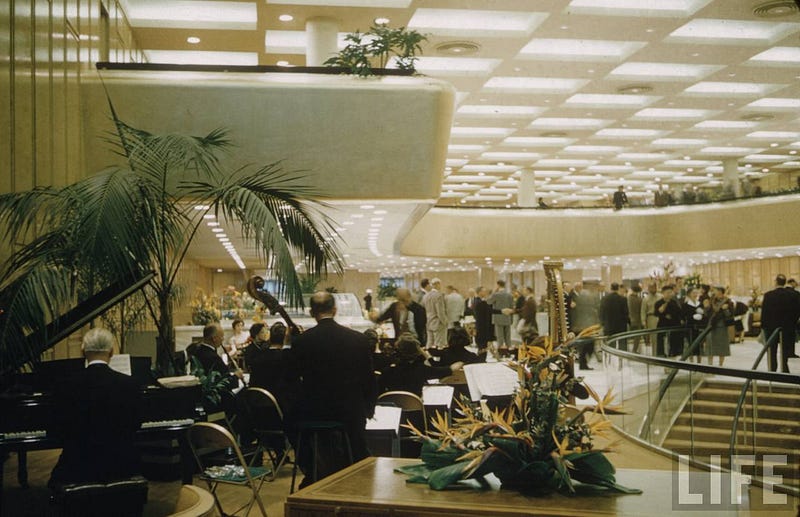
It’s an odd feeling to look at photos from the past and feel as if they’re from the future. In a world where we seem to innovate less and refine more, it’s become a common occurrence.
I am always shocked by the supersonic European Concorde and the American Space Shuttle captured in the same photo. There was something magical about the ingenuity and creativity of the 1970s on the heels of the moon landing.
Have we lost that completely? From pulp novels about fantastical space civilizations, to hypnotic musical and fashion inventions, to literally flying from New York to London in three hours, it seems we have.
A great example of this decline in creative thinking is the mysteriously well-hidden Dallas Pedestrian Network, constructed nearly 50 years ago. From newscasts of the time, everyone seemed optimistic (it was even billed as a “subterranean mall,” which, I’m sorry, sounds awesome).
The innovative passageway was built in record time, connected all of the major downtown buildings, and featured shops, restaurants, and even dance studios. It exists today as a series of half-abandoned three-mile-long tunnels and underground passages that almost nobody living in Dallas seems to remember.
It all started with one of those fantastical 1970s ideas. Famed urban planner from Canada Vincent Ponte, who was also the mind behind Montreal’s (successful!) “underground city,” had the idea to bring Dallas to new heights, figuratively speaking.
Expanding downtown urban life underground, or so they thought, would prove to be the best escape from the heat, offer an attractive entertainment space, and bring a new urbanist flair to a city that needed it. They even had a plan to add a subway system. But 30 years later, at a time when Downtown Dallas really needed saving, the pedestrian network was blamed for Downtown’s downfall.
Once upon a time, Dallas’ iconic skyline was no façade. Buildings held major worldwide banking and financial institutions, corporate offices for airlines, and other major companies. As hard as it can be to believe, Downtown was bustling with activity.
Until it wasn’t. The truth is, Downtown was already beginning its decline by the mid-70s, during the underground project. (As an aside, A friend mentioned to me how this struck him as odd, as Dallas in the national imagination seems firmly in the camp of being an eighties town more than a seventies one. Something to explore in future newsletters, I’m sure.) The city was expanding outward, with strip-malls and local shops so close to home that Downtown entertainment just wasn’t as important. This was true across the country. The proposed solution certainly didn’t help the problem, and seemed to seal its fate.
But the justification made all the sense in the world — need to escape the heat during record-setting summers? Just go grab lunch underground! Maybe stop and get a haircut, or walk to a meeting across town. The idea seemed fool-proof.
Designs from the era show a really unique and and forward-thinking construction. However, the Pedestrian Network never quite lived up to its full potential. While it was initially successful, it reduced additional street traffic by such an amount that downtown Dallas began to feel deserted.
Old photos of Downtown before the network are always shocking to people my age that never knew downtown Dallas as a place to hang out or shop. SMUJonesFilmpreservesanduploads old WFAA film reels, and a few wonderfully preserved old videos of the city show a busy street reminiscent of New York or Chicago.
From shoppers at the Neiman Marcus flagship to smartly-dressed businessmen, the streets were busy with foot-traffic. It was another world.
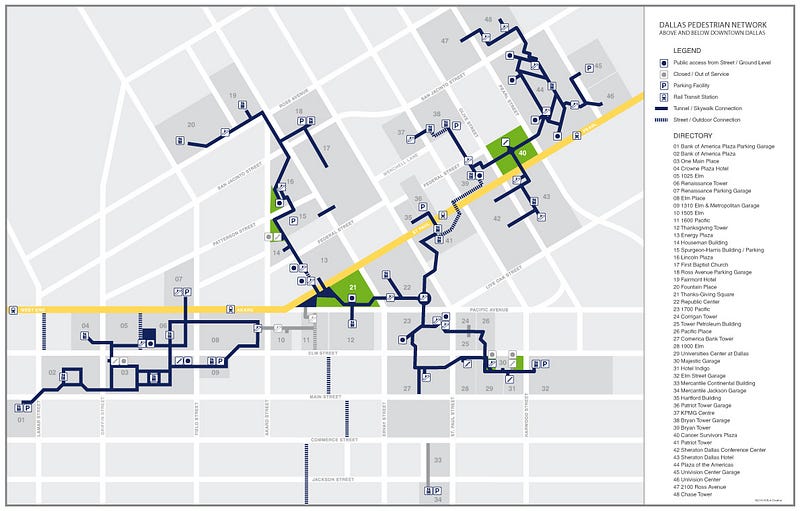
So, instead of turning Dallas into a utopian urbanist story of the future, the network would reduce downtown to even more of a wasteland than it had become. By the early 2000s, mayor Laura Miller had some choice words for the project, tellingThe New York Times that it was “the worst urban planning decision that Dallas has ever made” and suggesting she’d have liked to fill the tunnels in with cement.
It was never filled with cement. The network still stands today, and you can even see some of it for yourself. Some sections are privately owned. Certain larger portions of it, including an entrance in a Louvre-like triangular glass structure called Crystal Court, are still open with a few restaurants and a Starbucks. However, to the casual observer, the tunnels themselves are invisible.
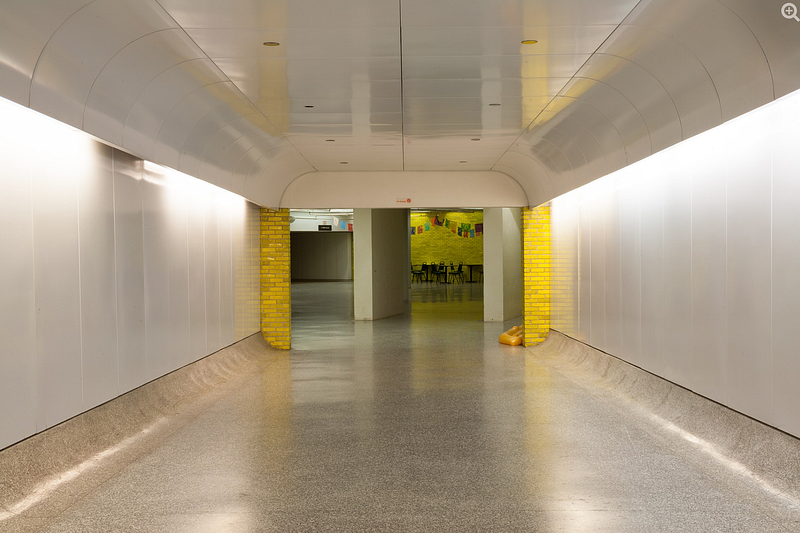
One of the nicer portions of the tunnels, photographed by Julie Libersat, 2015.
It’s more recently been labeled for “de-emphasis” by the city government (i.e., signs pointing to the network have been removed, website pages cut, and it is only open during business hours on the weekdays). Now, there’s only a few spots where you can still enter the tunnel, and ownership seems to be divided between buildings.
Some have posted videos exploring the tunnels. It looks reminiscent of the popular “dead mall” trend — long, empty spaces, that can only be described as eerie and liminal, almost vapor-wave.
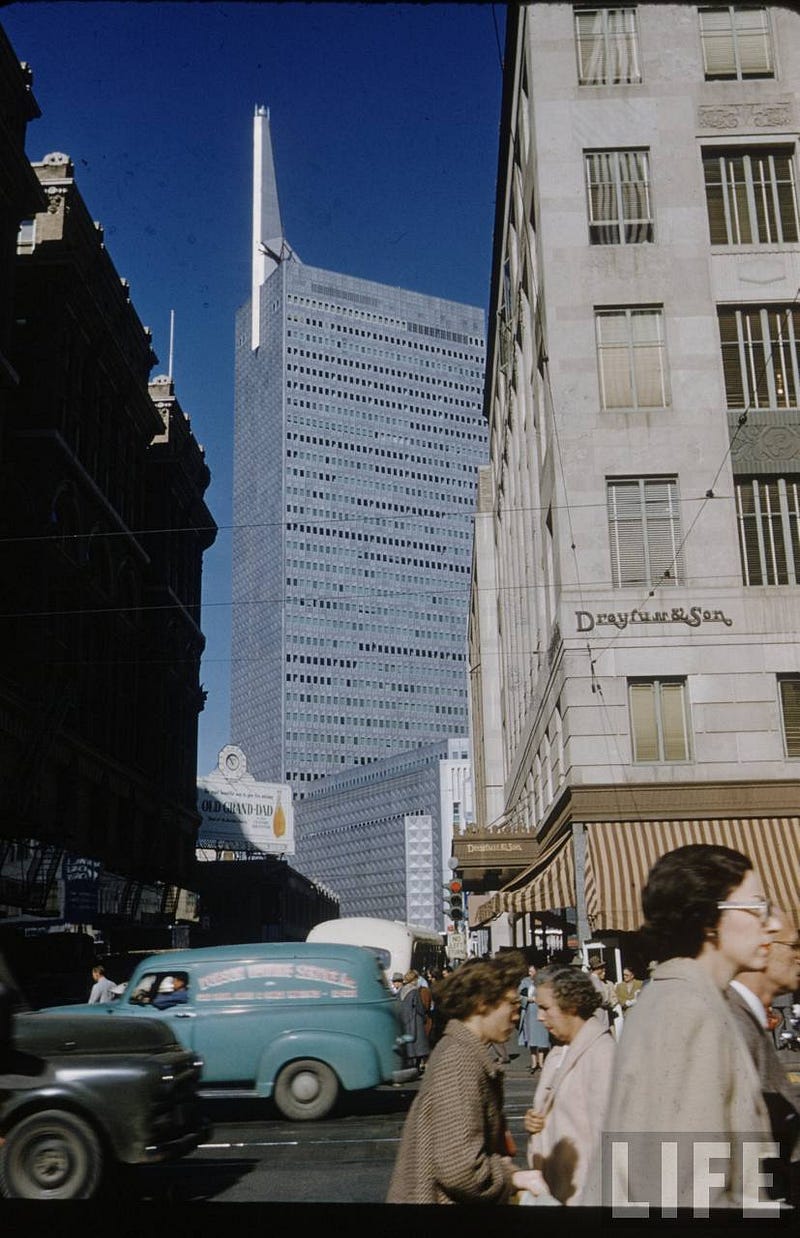
A busy Downtown Dallas in the 1950s, photographed by LIFE Magazine.
The fact that the tunnels still exist, though, beg the question — could they be utilized again today? The problem they tried to solve was noble, and if pulled off well, they could have been a success.
Sweltering, hot summers in Dallas can become unbearable, and an underground network that’s better publicized today might actually bring more people downtown. TheDallas Morning Newsran a piece in 2016 advocating use of the tunnels again for walkability.
Above ground, new attractions like the AT&T Discovery District and exciting restaurants, hotels, and bars have made downtown more of a destination than it has been in years. Yet, the streets outside remain cramped with cars, the sidewalks are small, and it can be hard to escape the unpredictable weather.
Whether or not the network ever sees the light of day again, one only hopes that Dallas can still dream big. For now, the city seems keen on hiding one of the more interesting aspects of its history. Let’s just hope it’s not filled up with cement. ✭
Like this story? Check out more like this on my ‘This Is Texas’ blog, covering everything from culture and movies to history and other fun things below. If you feel so inclined, help support my creative writing by leaving a tip here.