The Hero Behind Abolishing Slavery
The man who almost committed political suicide in his pursuit of equality.

In the late 1700s, many English traders raided the African coast on the Gulf of Guinea. They captured 35,000 to 50,000 Africans a year. They shipped the Africans across the Atlantic and sold them into slavery. Many powerful people depended on trafficking as it became a highly profitable business.
“The impossibility of doing without slaves in the West Indies will always prevent this traffic being dropped. The necessity, the absolute necessity, then, of carrying it on, must, since there is no other, be its excuse.” — A publicist from West Indies
During the time, the economics of slavery were so deep-seated that only a handful of people sought change. The same thought came across William Wilberforce.
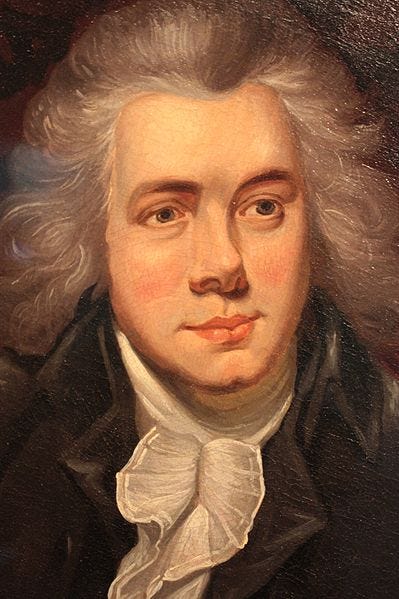
.JPG)
It would come across as a surprise to people who knew Wilberforce as a child. He was from a wealthy family. He grew up in an extravagant environment. He studied in St. John’s College at Cambridge. He wasn’t a very serious student, which he admits later. Yet Wilberforce had great political aspirations. He won an election to Parliament in 1780, with help from his connections. Shortly after that, he formed a lasting friendship with William Pitt, the future prime minister.
“The first years in Parliament I did nothing — nothing to any purpose. My own distinction was my darling object.” — William Wilberforce
He began to reflect deeply on his life. It led to a very depressing phase of his life. During the Easter of 1786, he reported a spiritual rebirth.
“amidst the general chorus with which all nature seems on such a morning to be swelling the song of praise and thanksgiving.” — William Wilberforce
Then, he abstained from alcohol, socializing with politicians, and endless conversations at dinner parties. He considered himself a ‘serious’ Christian. He saw his life’s purpose. Two causes caught Wilberforce’s attention.
Slavery
Under the influence of Thomas Clarkson, Wilberforce became absorbed with the issue of slavery. He came to hate the tradition of slavery and determined to never rest until its abolition.
Wilberforce was very naive and extremely optimistic. He did not doubt any chances of quick success. As early as 1789, he and Clarkson introduced 12 resolutions against slave trade. Some fine legal points outsmarted their resolutions. Internal politics, parliamentary chaos, different interests and international politics blocked the path to abolition. Wilberforce introduced other bills in 1791, 1792, 1793, 1797, 1799, 1804, and 1805.
Eventually some politicians realized Wilberforce wouldn’t let the issue die. It agitated his opposition, and they became ferocious. One of Wilberforce’s friend thought he would one day read the following about Wilberforce:
“Carbonated by Indian planters, barbecued by African merchants and eaten by Guinea captains.”
The pressure wasn’t just from the opposition. It was also from the international organizations.
Philanthropy
Slavery was not the only cause that excited Wilberforce. He fought for “reformation of manners” — morals. In 1787, he started a community to suppress immoral behavior. It came to be known as ‘Society for the suppression of the vice’.
The people dubbed Wilberforce — ‘the prime minister of a cabinet of philanthropists’ — at one time he actively supported 70 philanthropic causes. He gave a fourth of his income to the poor. He fought for single mothers, Sunday schools, orphans, and juvenile delinquents. He also found the Society for the better cause of the poor, the Antislavery society and a few other groups.
His fight against slavery finally bore fruits in 1807. The Parliament finally abolished slave trade in the British Empire. He also enforced the laws until they abolished slavery in Britain.
Wilberforce actively involved himself with the Christian community and the marginally oppressed. His ‘spiritual revival’ caused him to go so far in his pursuit for equality. Christianity heavily influenced his political beliefs. He eventually settled in Clapham sect — A group of devout Christians of influence in government and business.
Some historians argue that Thomas Clarkson and others were just as important in the antislavery fight. However, Wilberforce played a key role in abolishing slave trade not just across Britain, but to an extent in other countries which Britain traded with.
G. M. Trevelyan quotes it as “One of the turning events in the history of the world”.