

The heart of questions: an interview with Els Dragt, author of Dare to Ask
Centuries ago, Socrates suggested that questions lie at the heart of creativity and learning*. Later, Einstein said, “To raise new questions, regard old questions from a new angle, requires creative imagination and marks real advancements in science.” And more recently, research has shown that exceptional creativity does indeed relate to posing a good question, i.e., problem finding**.
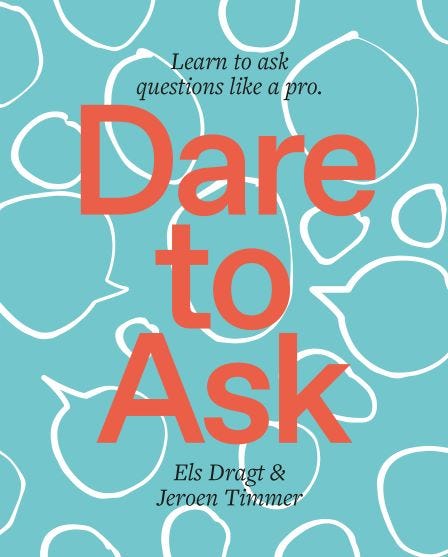
As the UXinsight 2020 writer, I sat down with Els Dragt for a conversation on questions and her new book Dare to Ask — Learn to ask questions like a pro, which she is writing with Jeroen Timmer. They will be speaking at UXinsight 2020, a user research conference, with the theme Creativity in Research.
About Els Dragt
Els is an independent consultant and a lecturer with 20 years of experience in the fields of market research and trend research. Dare to Ask is her latest book, expected March 31st.
Your new book Dare to Ask: what is it about, and who is it for?
We want readers to discover the power of asking questions. It is for anyone who finds it difficult to start a conversation. Or to keep a conversation going, no matter if you are a professional interviewer or someone who is looking for a casual conversation at the coffee machine. It’s a playful and easy-to-read book.
For the book, we looked for people who, because of their job, need to quickly make a connection with others. So, I interviewed a hairdresser, a policewoman, a psychotherapist, a clothing store sales employee, and a help-desk employee. I asked them how they talk to people and if they use any specific techniques.
Why this book? What inspired it?
When I talk to people at birthday parties or events, I notice some people don’t ask any questions. On the train, many people stare at their phones instead of starting a conversation. I wonder, what is holding them back? Are they not curious? Or do they find it difficult to start a conversation? On TV, I often see interviewers asking leading questions or biased questions. They use the questions to get to the answer they want. So, I decided to write a book that could help with this.
Of course, on TV, asking leading questions is an intentional technique, no?
Yes, unfortunately. [We laugh]
I like what Louis Theroux, a documentary maker advises, “It’s about asking a really simple question and then giving people the space to answer it.” . . . just pose a naked, bare, simple question.
Can you give us an example of different interviewing techniques you’ve learned?
Police agents use drilling down techniques during interrogations. They ask questions to reconstruct the whole event to as much detail as possible, for example, what were you wearing, was the light on or off, what were you doing. This makes it easier for people to recollect the relevant details. Also, the police officers adjust their way of asking questions depending on if they are talking to a suspect or the person who reported the crime.
From the hairdresser, I learned that they are trained on how to multitask, that is, how to engage the customer in a conversation while keeping on cutting hair, not ears.
What was the most surprising thing you learned while writing this book?
Two things that I come to mind: first, I discovered that we are at the peak of asking questions when we are around four years old. After that, it becomes more about knowing the right answer rather than asking the right question. I found that a little depressing and would love for us to go back to asking great questions.
We are at the peak of asking questions when we are around four years old. After that, it becomes more about knowing the right answer rather than asking the right question.
And second, there’s a Right Question Institute: they teach people how to ask better questions and to use questions to make decisions. They also do “question-storming” where they use questions to brainstorm.
Wow, an institute around questions sounds great, it’s like a user researcher’s dream. What advice do you have for us user researchers?
Start with a beginner’s mind during an interview or a conversation. Wipe your mind clean, look at the world with fresh eyes, and try to go back to the curiosity of your childhood.
Ask questions and then listen. As Lao Tse said, “Silence is a source of great strength.”
Thanks so much for your time, Els, and I look forward to your talk at UXinsight.
Curious to know more? Join us at UXinsight from April 6–8 in the Netherlands. Els and Jeroen will talk about their learnings. You can find the book at the BIS publishers website from March 31st onwards, and at the conference as well.
* Penick, J. E. (1996). In Science/technology/society as reform in science education. State University of New York Press.
**Sawyer, R. K. (2013). Explaining creativity: The science of human innovation. Oxford University Press.