
The Headspace App vs. One Trendy New York Meditation Studio
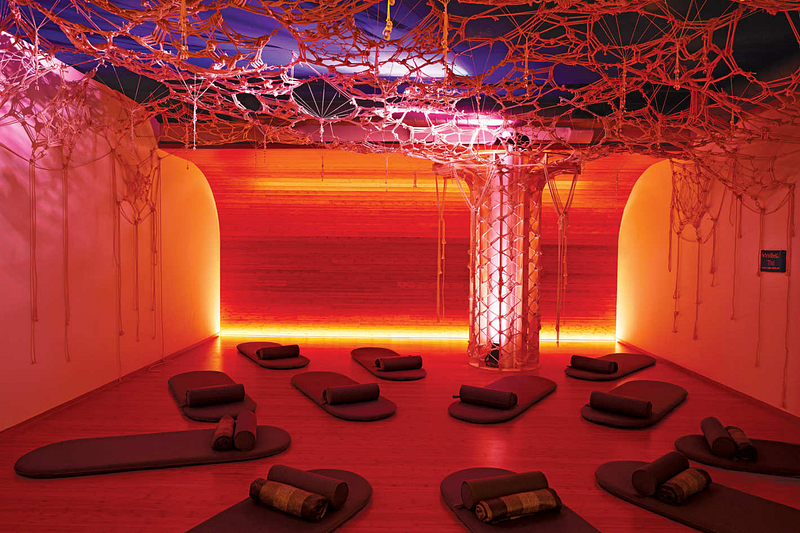
The other day, as a late-afternoon meeting was winding down, I let a yawn rip—a surefire signifier of my dwindling attention—and (awkwardly) blurted out, “Well, I could use a nap!” Instantly, one of my meeting mates — a bandana-and-gemstone-clad artist qua influencer — perked up, interjecting, “I used to nap, but now I just meditate.” Everyone nodded and “yeah’d” in agreement as the consensus settled in: Meditating is the new napping.
Later that evening, a friend texted me that, for her chronic headaches, her doctor had just “prescribed” meditation. The following day, I was e-troduced to someone who was described to me as a “guru’s guru,” and just this morning, I had breakfast with a medium + mindfulness adviser.
It’s sequences of events like these that stoke my skepticism when it comes to the whole mindfulness/wellness thing.
You see, I grew up on a sheep farm in Vermont, so I’ve always preferred to get my wellness (formerly known as fitness) game on via solitary bucolic activities like feeding animals, mucking stalls, scrubbing water buckets, mending fences, stacking bags of grain and bales of hay…and if there’s time, after all them chores, I also love a good ol’ fashioned hike, trail run, horseback ride, ski, or quick dip in an ice-cold creek.
But somehow I ended up living in New York City, spending lots of time in front of multiple screens, building an app for wordplay, copywriting for brands, working on a startup out of a museum-led tech + art incubator, writing a column about tech + culture at Vogue, and helping dress celebrities for red carpets and press junkets, because that’s the world we live in — the age of the polymath, where variety and the art of being schizophrenically busy is key.
So, after reading about the meditation app Headspace for the first time, circa 2012, I was stoked to try it out. Yet, for years on end, I’ve struggled to develop a conclusion about my Headspace experience — and to really develop a consistent meditation practice.
Sure, it’s convenient to have an on-demand guru in your pocket, but there’s something about meditating via an app on your phone that feels, I dunno, distracting?
After reading about Inscape, a new New York–based meditation center (with ambitions to go nationwide) that NYMag hailed the “SoulCycle of Meditation,” I was also eager to give it a go and compare how going into a physical space with an instructor compared to the DIY app-based meditation options, like Headspace.
The Inscape Experience
As it turns out, the first lesson I learned is that I might just be one of those people who could really benefit from some consistent meditation, because I’m evidently so distracted by technology that I completely missed the fact that, due deference to NYMag’s analogy, Inscape isn’t really like SoulCycle at all.
There are no insta-famous instructors akin to “Akin” — the name of one of SoulCycle’s most famed teachers slash models (pronounced Ah-ken — as avid New York SoulCyclers love to point out, discuss, and debate). Consequently, there isn’t that rush to sign up before classes book up — I booked my Inscape session using the Mindbody app, and a friend who came with me just walked in and signed up.
You see, Inscape has no instructors, no gurus. Inscape has “facilitators” — entirely lovely, soft-spoken, Zen characters who press play on a recording.
Walking through the oversized doors, you are greeted by a tastefully merchandized open-floor boutique with wellness lifestyle accoutrements, such as matcha kits, incense, bath salts, and dietary supplements promising you everything from genius status to sex goddess.
Past the boutique sits a front desk with an iPad check-in and a scattering of employees who appear to dress in a uniform-esque mix of white T-shirts, denim, and khaki. As I observed their outfits, I thought to myself, “Gosh, they look like glowing Gap employees.” That thought sparked the realization that the founder of Inscape, Khajak Keledjian, is also the founder of Intermix, which is now owned by the Gap. [Insert fashion conspiracy theory here.]
Past the check-in is a “personal reflection” waiting area filled with high-end bean bag chairs and a dark mural, which I also read in the NYMag article was done by Arianna Huffington’s daughter. Past that, there’s a little open locker area followed by some bathrooms.
To nitpick for one moment, there’s no “occupied” signage that comes on when the bathroom door locks, which I find really upsetting, because, at least for me, one of the most unmindful experiences in life is accidentally rattling the door to a bathroom in use and then having to look the person whose private time you disrupted straight in the face. It’s just a terrible feeling, especially pre-meditation.
Anyway, after taking a bathroom break and putting your phone in a locker, if you’re like me, you feel instantly better. I think that’s probably the greatest luxury of Inscape — the ability to dump your phone in a locker and be truly phone-free for 30 minutes to an hour — the general length of their classes.
As you enter one of the two meditation rooms — “The Dome,” where most of the mindfulness, mantra, and visualization meditations are held, or “The Alcove,” where more of the relaxation-focused meditations are hosted — a facilitator gives a calmly scripted speech, introducing themselves and explaining how they’ll be there in the room with you to answer any questions that may arise and to “gently tap” the shoulders of the occasional meditator who’s drifted off into a snoring slumber, so as not to distract the rest of the group, while dabbing oil (for sale in the gift shop, no doubt) on your wrist.
The rooms smell glorious. The air is filled with some sort of oil-diffuser mist (also likely available for purchase in the gift shop) and furnished with exposed wood, artfully designed Zen-motif ceilings, and ultra-comfy reclining mats and bean bag chairs. (It feels like those nap mats from kindergarten got the luxury treatment.)
These spaces are genuinely blissful, but as you settle in and begin to get ready for that “serenity now” feeling, it’s hard not to look around the room and try to guess who might break into a snore à la Jack Nicholson in The Witches of Eastwick or wonder to yourself if you might be the snoring Jack (Ass).
The facilitator then walks up to a piece of technology inlaid in the wall and presses play, and a recording of a very robotic Australian woman begins.
She doesn’t introduce herself, which I find to be, in the parlance of our times, #RUDE.
Some post-meditation internet reading revealed that Inscape, which also has an app, takes the position regarding recorded guru vs. real guru that, when it comes to meditation, consistency is key. Therefore, having the same meditations led by Sky (the Australian woman’s name) available in the studio and on the go via the app trumps the inconsistency of say, a human. There’s definitely a Skynet joke to be made here.
In one of the classes I attended, there was a classic robot vs. human fail where the facilitator realized the wrong recording was playing for the class, stopped it, started a new one, and then realized that it was in fact the correct initial recording after all. This class was comped.
Speaking of cost, Inscape does run a nice $50 unlimited weeklong first-timer’s deal, and then a variety of packages, but generally an individual class will run you $18 to $29.
Dear NYMag, I think Inscape is less like SoulCycle and more like going to a Deadmau5 concert — you’re in a big dome where you feel defrauded that someone’s “just hitting play” but then end up kind of enjoying yourself anyway.
The Headspace Experience
I’ve been a laissez-faire Headspacer for approximately the past five years.
My favorite thing about the app might be the same reason I struggle with consistently using it — the ability to meditate on a whim.
I always go for the yearly subscription, which costs just under $100 and unlocks a boatload of meditations—and no, the irony would not be lost on me if there’s a meditation on commitment to meditation issues that I’ve yet to unlock.
The app is smartly designed, featuring very startup-y meets Disney’s Inside Out animations illustrating what might be your thoughts, and uses gamification tactics via a “stats” page calculating how many meditations you’ve done to date. There’s also a fun feature that shows you how many people are also currently meditating using the app.
But it’s neither the gamification nor the cartoons that keep me coming back — it’s the sweet, sweet sound of Headspace co-founder and trained Tibetan Buddhist monk Andy Puddicombe’s voice.
I wish Andy could narrate my life. It feels like pure serenity as he guides you into a mind-like-puddi(combe) state, scanning the body, feeling the ways “it’s all connected.”
When you first download the app, Andy gives you a really lovely introduction where he explains his path in life and how he ended up in your ear — a successful attempt at humanizing the digital experience—something I think Inscape’s Sky could take a cue from.
Then, you have the options of going through some introductory “basic” meditations (great for meditation ultra-neophytes), a quick “singles” meditation, or one of the more specific packages categorized under health, bravery, happiness, work and performance, and sports. There’s also a category called Headspace Pro, which I’ve been intrigued yet frightened by, much like a bunny-sloper peeking over the edge of a double black diamond.
As far as where I use Headspace, usually, if it’s a warmer season, I try to sit on my roof for a session — sometimes alone, sometimes with my partner, sometimes in lotus position.
If it’s winter, I’ll usually find myself sitting at my kitchen table having some sort of a work-related moment of stress and thinking, “I should, like, really meditate or something.”
Regardless of the season, my first pre-app-meditation thought is always, “You should really turn all your phone notifications off,” but I usually don’t.
I’ve also experimented with the in-the-taxi and on-the-subway meditation, which has actually calmed my unpredictable onsets of motion sickness and calmed my pacing heart before a big meeting.
Despite my love of Andy’s voice, I don’t have the respect for the app that I imagine I’d have for an in-real-life guru (something I was hoping to get at Inscape).
I don’t think I’d walk out on a real person mid-meditation, but with Headspace, if something distracts me, like a push notification or a sound, or a horrifying realization that I actually have a call in five minutes, I’m totally fine with pulling Andy’s lifeline and x’ing out of the app with no definitive plans on when I’ll be back.
I’m mauled by the thought that Andy and I may be in an emotionally abusive relationship.
And like many complicated relationships, I’ll never really be “over” Andy and his Headspace, but I think I need something more.
Conclusion: I’m Waiting for the Man
It’s fair to say that after comparing Headspace and Inscape, my personal mindfulness pendulum has swung away from technology and back over to the human side of the meditation equation.
The truth is, I like humans. I like their diversity. I like their inconstancy. I like their ability, for better or for worse, to respond to my human energy.
So, while I’m not completely writing off app-lightenment, I’m beginning to believe that technology’s role at the moment may be best served in assisting the discovery of and connection with human instructors, like this resource for finding an in-person meditation spot near you.