
The Harsh Truth No One Tells You About Living on This Bitter Earth
I used to wonder what the point of life was. Older, I can finally answer that.
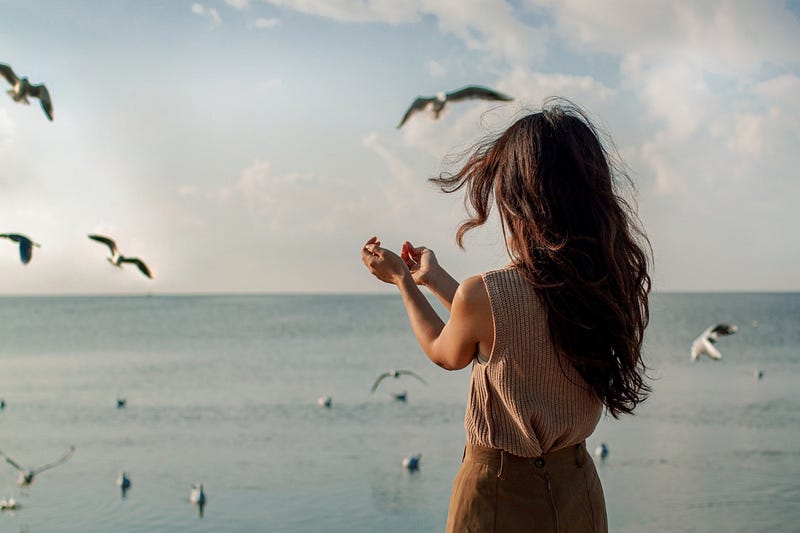
We were just walking on the beach when I saw her.
She’d dug a hole in the sand. Not so much a hole as a bowl. A shallow little bowl, scrabbled out in the sand by tiny birdy footprints.
There she sat, in her little bowl. A nest?
Behind me, I hear my child.
Mom, it’s bleeding
I turn and our eyes meet. I move to the same vantage point and see it too. Bright crimson seeping and creeping up the snowy white of her feathers. Oh no, I whisper. Slowly, I kneel in the sand beside her.
She doesn’t move but sits, utterly still. Who knew a seagull’s eyes were so beautiful? Like onyx or black opal. Glittering little gems watching me.
I’m sorry your life ends like this, I whisper. Injured, bleeding and alone. I hope you had many glorious days with the sunshine warm on your back and the wind beneath your wings.
She watches me silently, tiny chest rising and falling.
She is a being, not so different than me, with a heart that beats not unlike mine and we crouch in the sand, me and my child, unlikely companions to the sad and random ending of another being.
I don’t know how long we sit like that. Forever, it seems, and yet not nearly long enough as the sun moves slowly across the sky and the shadows on the sand grow longer and leaner.
Finally, the little bird sighs, chest rising. She shudders, feathers ruffling.
Then she turns her head and looks away.
We are dismissed.
Slowly, we stand. Walk away silently. I stop and look over my shoulder and see our footprints leading from the place she sits, alone again. I keep looking back until I can’t see her anymore.
We’re driving down the street when we happen upon a magpie funeral. There they stood, in a circle around a fallen friend, laying still in the street and we stop, watching. They are unimpressed at our intrusion.
It’s a little eerie to stumble across on a random Saturday afternoon.
A professor at the University of Colorado who was studying funeral rituals of magpies and corvids once watched a group of magpies carry clumps of grass in their little beaks to make a wreath around a fallen friend.
When I read that, I couldn’t help but remember all of us standing around my dad’s grave on a sunny summer day, gently tossing handfuls of dirt and flowers into his gravesite as birds soared in the sky above.
Did they watch, I wonder, understanding more of us than we do of them?
This isn’t about death, in case you thought it was.
I watched a haunting video of the Dalai Lama pondering on humanity while random clips of people just living their lives played and in the background Dinah Washington crooned This Bitter Earth.
Oh, this bitter earth, can be so cold. Now you’re young. Too soon you’re old.
He said ants cooperate better than humans do and we must do better. I’m not sure they do, though. Ants cooperate in small groups but brutally kill outsiders. Red and black ants will kill each other on sight.
It’s not just ants. Wasps throw the workers out of the nest to starve when their work is done and male chimpanzees are aggressive and violent to female chimpanzees to establish dominance. And birds mourn.
We are all creatures of this earth, not so different than each other.
David Herbert Lawrence said there’s one difference between us and the other creatures of the earth.
He wrote scandalous novels like “Lady Chatterley’s Lover” and oddly poignant poems about the beauty of nature. Here’s what he said;
I never saw a wild thing sorry for itself.
A small bird will drop frozen dead from a bough without ever having felt sorry for itself he wrote, and then dropped dead at forty four himself.
I want to ask him how he could know if the little bird felt sorry for itself but alas, there’s only one way conversation to be had in a graveyard.
The next time we go to the beach, nothing remains to say she was there.
I stare at the sand where the little bowl once was, before we walked away, before the sun went down, before the tide gently carried her home.
And then we see it. Oh, I say. Look!
A plant, growing in the sand mere feet from where she laid. Sturdy green stems and a riot of glorious purple flowers. And there, at the base of that little plant, a handful of downy white feathers.
Every time I see purple flowers, I think of that line in The Color Purple where Shug says she thinks it pisses God off if we walk by the color purple in a field somewhere and don’t stop to notice.
I kneel in the sand and pick up a white downy feather. It flutters and curls around my fingers as the wind tries to tear it from my grasp.
Here’s the truth no one tells you about living on this bitter earth.
You and me?
We are that little bird. No more, no less.
Tiny specks of life in a universe that is so big and so vast we simply cannot help be anything except miniscule by comparison.
We live. We breathe. And for a brief droplet in the bucket that is time, if we are brave or lucky or maybe both, we feel the wind beneath our wings, whatever that means to us. And then we are gone.
Oh, this bitter earth, can be so cold. Now you’re young. Too soon you’re old.
I used to ponder the meaning of life when I was younger. Why are we here? What is the point of my life, I wondered. Older, I can finally answer.
That it ends. That’s all.
That it ends.
Slowly, I open my fingers and let the wind take the feather. I watch as it flutters higher and higher on the wind until I can’t see it anymore.
Then I go home and do the only thing I can. I write.
“I have a right to be this way. I can’t apologize for that, nor can I change it, nor do I want to. We will never have to be other than who we are.” — Alice Walker, The Color Purple