
The growing threat of China’s sinister regime
A review of ‘China, the Super Predator: a Challenge for the Planet’ by Pierre-Antoine Donnet (Changemaker Books, February, 2024)
I have already written about this timely and enlightening book and its French author in two recent articles, but the importance of the work in today’s precarious and disturbing geopolitical climate also demands a stand-alone review, I feel.
Veteran journalist Pierre-Antoine Donnet is a former Beijing correspondent for Agence France-Presse (AFP) who speaks Mandarin and has studied China for more than forty years. His new book, first published in French in 2021, has been updated for its English edition — the translation is by Richard Lein — and has an afterword by Donnet.
A laudatory foreword, described by Donnet as ‘an act of courage in these times’, is provided by the French sinologist Jean-Pierre Cabestan who specialises in the law and institutions of contemporary China and Taiwan and is a professor and head of the Department of Political Science at Hong Kong Baptist University.
‘The regime in Beijing, and especially the one honed and perfected by President Xi Jinping since 2012, is more toxic than ever to freedom.’ Cabestan writes.
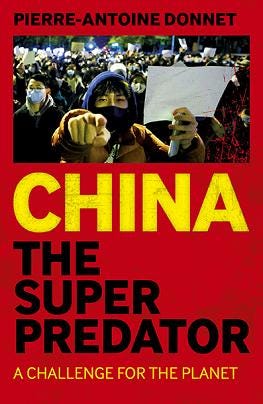
China, the Super Predator is essential reading for anyone concerned about the way the world is going — and that must be very many of us. Comprehensive in scope and engagingly written, the book gives a most valuable in-depth insight into how the Chinese Communist Party’s ruthless bid for world domination has escalated in recent decades, making China, with Russia, the main threat to Western democracy.
But also, crucially, it’s about how China faces huge economic, environmental, social and political challenges which could thwart its sinister global aspirations. And in this latter regard, it’s especially interesting to read why Donnet believes that we’re probably witnessing the beginning of the demise of a system that has run its course, China already being the last great communist country in the world.
Today’s threat from China is not entirely lost on the West, of course. Donnet quotes John Ratcliffe, US Director of National Intelligence, who, writing in the Wall Street Journal in December 2020, said that ‘the People’s Republic of China poses the greatest threat to America today, and the greatest threat to democracy and freedom worldwide since World War Two’.
We know, as Donnet points out, that in China there is no multi-party political system, no universal suffrage, no plurality of debate, no independent justice and no free press.
Controversial global ambitions
And yet China’s steady infiltration of UN affairs, and, in particular, those of the World Health Organisation which has its own controversial global ambitions, is one of many worrying developments revealed by Donnet. It seems to me that the Chinese communist system is not altogether unattractive to certain ‘elites’ in the Western world — think, for example, of the World Economic Forum and its sought-after ‘Great Reset’, or of the authoritarian cadres in various Western governments intent on curbing free speech.
In the confrontation between the USA and China, two models of society are facing off, but the problem goes far beyond the rivalry between the two super-powers, says Donnet. It’s a head-on clash between a society which embraces universal values widely accepted by humankind, and another that categorically rejects them: democracy versus totalitarianism.
At the heart of it lies democratic Taiwan, maybe yet a model for the Chinese nation. And, more than ever before, the US, Japan, South Korea, Australia, India and other states, are willing to defend Taiwan against China which regards the island as its own territory.
Donnet remains optimistic: ‘Despite several lights flashing on the dashboard of democracy, I remain firmly convinced that debate and intellectual ferment will help it prevail over one-track thinking, the disappearance of free will, and censorship.’
Elsewhere, he states, inspirationally: ‘In the end, truth will triumph over lies, and light over darkness. Nothing and no one will stop the power of the written word and the image.’
The first seventy pages of China: the Super Predator are spent describing Chinese repression and the Communist Party’s propaganda machine: Donnet details China’s human rights abuses against the Uyghurs, Tibetans and Mongols, its silencing of all forms of dissent, and its takeover of Hong Kong.
He then turns to the environment, with scepticism that China can achieve carbon neutrality by 2060, discussion of the pollution, deforestation and soil depletion ravaging the country, and China’s position as the world’s top consumer and importer of raw materials.
How China has shifted from being the world’s workshop to being its laboratory is charted, with its high-tech ambitions, space programme, the battle for semiconductor supremacy, its cyberwarfare and disinformation — and the industrial espionage which has allowed China to advance so fast technologically in recent decades.
Indoctrination of the masses
Donnet investigates ‘Uncle Xi’, President Xi Jinping and his dictatorship which involves constant indoctrination of the masses (‘Big Brother is watching you’), the rewriting of history, and the ‘stubborn reality’ of labour and ‘re-education’ camps.
Next, and equally significantly, Donnet explores China’s ‘New Silk Roads’, or ‘Belt and Road’, initiative under which, to date, 155 of the world’s 195 countries have signed up for infrastructure projects which seek to increase China’s role in international affairs; indeed, to pursue a global empire which the US must try to counter. According to Wikipedia, these 155 countries account for nearly 75 per cent of the world’s population and more than half of the world’s gross domestic product (GDP).
But countries have been caught in what has been described as ‘debt-trap diplomacy’ — being snared in debts which, when they cannot be repaid, are translated into support for China’s geostrategic interests.
China now has an overwhelming presence in South-East Asia, and the South China Sea, where China has been making a series of territorial claims, has become a potential flashpoint for military aggression.
Finally, Donnet considers the ‘long march’ towards the truth about the origin of covid-19, and how Beijing’s credibility has been undermined yet further by its culture of silence and concealment. The opinion that the virus escaped from the Wuhan Institute of Virology, perhaps by an accidental leak, ‘carries weight’, says Donnet.
Pierre-Antoine Donnet, a prize-winning author of twenty books, worked as a reporter for 37 years at Agence France-Presse (AFP). His main postings: Beijing (1984–1989), Tokyo (1993–1999), Warsaw (1999–2001), Bureau Chief, Nicosia (2001–2005), as the AFP regional chief editor for the Middle East, Paris (2005–2006), Global News chief editor, New York (2010–2012), and AFP correspondent at the United Nations Headquarters. He now lives in Meudon, France.
* See also my interview with Pierre-Antoine Donnet, ‘How China has been seizing control at the UN and WHO’, and my previous article ‘Call for Ireland’s UN team to reject WHO’s ‘pandemic treaty’’.