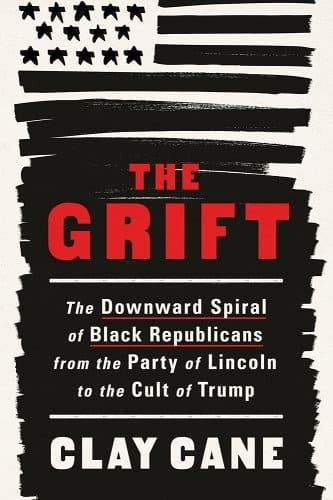
‘The Grift’ Started Long Before Trump
Clay Cane‘s book on ‘Black Republicans from the Party of Lincoln to the Cult of Trump’

Clay Cane has hosted a SiriusXM radio show since the first year of Trump’s presidency. His book The Grift: The Downward Spiral of Black Republicans from the Party of Lincoln to the Cult of Trump is available for preorder. It’s a thorough examination of a complex topic, connecting Black American history since the mid-19th-century to today’s Trumpism. Whether you’re learning this history for the first time or you want a refresher, you’ll take away something from The Grift.
‘Grifting Is a Betrayal’
“Today, a pernicious strain of Black Republicans,” Cane says, “has seized influence by disregarding the interests of Black voters for their advancement.”
“Grifting is a betrayal,” he says; it means lying “to sell one’s soul” and “to dishonor your community.” This is his assessment.
He points to many examples of those who, in his judgment, are grifters.
One is Booker T. Washington (1856–1915), who, “by insisting that Black people stay poor, uneducated, and docile,” became “a wealthy man, pointedly disregarding his own advice.” He emboldened white supremacists, as they could then point to a Black man who was making their points for them. Cane adds that “if there were Fox News in 1901,” Washington would have had his own show.
Another is Edward William Brooke III, a Republican who was elected senator from Massachusetts in 1966. A Time Magazine profile “glorified” him a month after he took office “for not being like the other Blacks.” But while Brooke tended not to explicitly align himself with Black movements, nonetheless he was “unafraid of calling out the GOP’s racism”—and today, the GOP avoids mentioning him.
Yet another is Winsome Sears, a Republican who in 2021 ran a successful campaign for lieutenant governor of Virginia. During her campaign, she complained that kids are being taught to assume that all white people are racist, and — “without regard for the broader impact on public school education and teachers’ safety,” Cane laments —she flaunted an AR-15 style rifle in an ad.
There’s a Lot of History Behind This
Abraham Lincoln once wrote that his goal was “to save the Union…not either to save or to destroy slavery.” This Republican president wanted to find more soldiers for the Union during wartime, and for this purpose he issued the Emancipation Proclamation, which freed about 2 percent of the millions of then-enslaved people, as it applied only to the rebel states and had effect in “small pockets of the South, like parts of South Carolina.” He freed people so they could go to war. While Lincoln had jurisdiction over “border states, like Missouri, Kentucky, Delaware, and Maryland,” he did nothing to free people there.
In the so-called Compromise of 1877, the Republican Party agreed to allow federal troops to withdraw from the South — giving local control there to Democrats as it had been before the Civil War, ending the period of Reconstruction — in exchange for allowing the Republican Rutherford B. Hayes to be declared victor of the 1876 election. This abandoned Black Americans, who needed the ongoing federal intervention in the South more than they needed a four-year Hayes presidency.
At first, “Douglass Republicans,” Cane writes, strived for “self-sufficient Black communities while still keenly aware of white fragility.” But then came the grifters. Their behavior made it harder for others to seriously maintain progressive values while remaining Republicans.
Blanche Bruce, a wealthy Black man, was a Republican senator from Mississippi from 1875–1881. While he did demand remedies for election violence, funding of Black colleges, and nondiscrimination for Chinese immigrants and Native Americans, he was mostly unsuccessful. Also, Cane says, “he voted to seat a former Confederate and defense attorney for Klansmen, Lucius Quintus Cincinnatus Lamar, as a Mississippi senator.”
After Representative George H. White, a Republican from North Carolina, left office in 1901, it was another “twenty-eight years for the next Black man to be in Congress.”
Black Americans began shifting to the Democratic party in the 1930s after Franklin D. Roosevelt, a Democrat, gained the presidency. Though FDR tried to exclude Black Americans from his New Deal, “some programs inadvertently helped Black communities, particularly strengthening labor unions.” And so Black people began to vote Democrat for this reason.
Then, in the 1960s, many of the remaining Black Republicans were “pushed out of the GOP.” Though President Lyndon B. Johnson (a Democrat) was personally racist, activists compelled him to sign the Civil Rights Act of 1964, ending segregation. Within a couple weeks of the signing, his Republican rival, Barry Goldwater, was onstage defending white supremacy; Goldwater would get only 6 percent of the Black vote.
During Reagan’s eight years in the presidency, Black unemployment dismally fluctuated between 11–21 percent. This period introduced a new “grifting lane” for Black Republicans. Samuel Riley Pierce Jr., as secretary of housing and urban development, was subjected to a five-year criminal investigation for allegedly diverting funds to Republican consultants.
Then there’s Clarence Thomas, whose 1980 speech at the Reagan-sponsored Black Alternatives Conference was its own “watershed moment in the Black Republican grift,” as Cane puts it. Though “no one on the American Bar Association committee found Thomas ‘well qualified’ for the Supreme Court,” Thomas was appointed to the court in 1991, where he voted in 1995 to limit affirmative action. He married a woman who became a Trump administration insider.
Senator Tim Scott, a Black Republican, similarly pointed to his own election as justification for why the nation doesn’t need voting rights legislation. That’s a non sequitur; 92 percent of Black voters in South Carolina had asked for someone else. Throughout this book, Cane makes the case that Black politicians can get elected without necessarily having Black support, as long as those politicians support white interests. White voters electing a Black candidate doesn’t prove that Black people were able to exercise their right to vote.
Michael Steele, a previous chair of the RNC, has been a Republican for four decades “because I know it pisses them off,” so he has asserted. He told Cane that Republicans “love the idea of Blacks in the party, as long as they sound and act white. I don’t mean that in the sense of white people; I just mean in terms of how the white power structure wants to talk about these issues.”
Don’t Use Racial Slurs to Talk About This
While it’s common to describe Black conservatives as “Uncle Toms,” Cane argues against doing so.
First of all, insofar as only Black people are ever called this — Uncle Tom was an enslaved Black man in an 1852 American novel — it’s an epithet that ties someone’s virtue to their race. That makes it a racial slur, and slurs are unproductive, especially if the person using them isn’t a member of the group they’re lampooning.
Secondly, examples from slavery (real or fictional) don’t make for very good points of comparison with modern-day behaviors. The fictional character of Uncle Tom was unfree, and any choices he made, good or bad, were under that constraint. Neither is Uncle Tom specifically a good fictional illustration of wrongdoing, since, even if his sympathies were often directed toward his white enslavers, he is generally perceived as brave and self-sacrificing. By contrast, today’s Black grifters, Cane argues, have more freedom than Uncle Tom did—and yet they choose evil.
Thirdly, using a term like “Uncle Tom” prompts Black Republicans to mirror the “slave mentality” insult and project it onto Democrats by telling them to stop complaining about racism. This projection does not make sense, because a Black person’s acknowledgment that racism exists is not what causes racism to exist.
Lastly, Black Republicans simply are Black: “Being a Republican does not erase one’s Black identity. Denying their Blackness dismisses and simplifies the threat.” Choices don’t make someone “less Black,” Cane says, but they can make someone “a grifter.”
What Dialogue Do These ‘Grifters’ Want, and Why?
The origins of Cane’s book seem to lie in his questions about whether certain people are truly interested in meaningful, co-creative discussion and, if not, what is motivating them to run their mouths.
Cane invited a Black Republican to be the first guest on his radio show. He learned from this experience, as his guest turned into “a fact-averse border wall” without “nuance or logic.” The guest’s behavior was getting him personal attention from Trump and he was profiting from it.
Cane went on to have a Black gay man on the show. This man later asked to return to the show to “come out” as a conservative. He justified his new beliefs as “from a consumer’s perspective it’s far more interesting,” i.e., he believed that a radio audience would be more excited to tune in to hear someone billed as a Black gay conservative who was arguing with a liberal. Cane declined, advising the man to be ideologically genuine.
This is a question we could ask of Trumpist grifters of all races. Their universal answer seems to have to do with their desire to be on TV, to be a friend of Trump, and to line their pockets. This book helps make that argument.
There Is More
The Grift is a 400-page book with a couple hundred years of USAmerican history. The later chapters focus on our present political moment. If you want more on this topic, pick it up.
It doesn’t give a follow-the-money trail. Instead, it focuses on concepts and attitudes that have remained roughly constant, such as: If I‘m rich and successful, everyone else can be too, regardless of whatever policy is currently on the table that might impede wealth or success. Cane is talking specifically about Black people, but again, hopefully needless to say, this human frailty can affect people of any race. Readers can think about how we manifest this attitude in our own lives.
Political grifting in the US didn’t begin with Trump and it won’t end with Trump.
You can buy The Grift on Bookshop or Amazon (my affiliate links). It will be published by Sourcebooks on January 30, 2024. I received a free advance copy from NetGalley.