
The Greatest Oppression That’s Ever Existed
Why the animal rights movement is the greatest struggle that’s ever been fought
It’s been called “the greatest struggle that’s ever been fought, against the greatest oppression that’s ever existed.”
I’m talking, of course, about the animal rights movement, the struggle for animal liberation, the fight against speciesism.
I’m not denying that racism is still a big problem. Or sexism. Or homophobia. These forms of discrimination still make millions of lives a misery. People still die in racist and sexist and homophobic attacks.
But, on the whole, most modern societies around the world recognise collectively that discriminating against someone based on nothing more than the fact that they’re a different race, or sex, or sexual orientation to yourself is wrong and unjust.
Not so with speciesism.
The vast majority of people in modern society still believe that discriminating against someone because they are a different species to yourself is not only justified, but is so normal as to not even warrant question.
Never mind that the animals in question might be more intelligent than a five-year old human child.
Never mind that they might be at least as sensitive to pain and suffering as we are, if not more so.
Never mind that they want to live every bit as much as we do, or that they fear death just as we do.
Never mind that they have lives and families, wants and desires which are every bit as important to them as ours are to us.
In most people’s minds, the fact that they’re not human gives us all the justification we need to imprison them, enslave them, kill them and exploit them in pretty much any way we choose.
We objectify other animals to such an extent that they’re not even seen as having personhood.
They’re viewed as commodities, as resources whose only reason for being is to serve us as humans.
How sick is that?
And we exploit them in their billions. We kill these other people, these non-human Earthlings with whom we share the planet, at a rate of millions every single second.
These kinds of figures just aren’t tangible. We cannot really grasp what it means to kill 150 billion land animals every year, or 1.2 trillion sea animals.
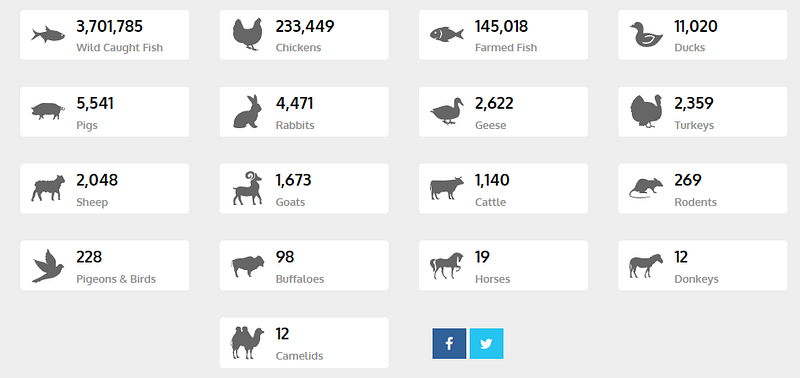
In the two minutes since you started reading this article, more than 5,500 pigs have been slaughtered, many of them while fully conscious, struggling, screaming and fighting for their lives.
More than 1,000 bovines have been killed, many of them calves only a few days old, killed by the dairy industry simply because they had the misfortune of being born male, and therefore deemed useless to the industry.
Over 233,000 chickens have been slaughtered in the past two minutes. Again, many will have been fully conscious when they passed the automated blades designed to cut their throats. In their panic and desperation, they often lift their heads, being deeply and painfully cut instead on their breasts or wings. Many enter the scalding tanks — designed to loosen the feathers of dead birds — still alive and fully conscious and drown in scalding water while bleeding out from their wounds.
How many times do we think of them whilst eating a handful of chicken nuggets?
And since you started reading this article, over 4 million wild caught fish have died, often suffocating under the vast weight of thousands of others, dragged out of the deep sea in giant nets and left to thrash around in the unimaginable agony of a slow death.
If this isn’t the greatest oppression that’s ever existed, I don’t know what is.
Every single one of these victims was an individual. No matter how different they may appear to us, every single one of them wanted to live, and suffered as they died.
Yet, it’s difficult for many of us to appreciate these animals as individuals. In the western world, the USA, Europe, Australia, for example, many of us have no such difficulties seeing our beloved dogs as individuals. We know they are people. We know they have personalities, desires, fears, lives that have meaning for them.
Yet is a dog’s experience of life and death that much different from a pig’s or a cow’s?
Or a human’s?
Every minute around the world, 25 dogs are killed for the meat industry. Speciesism is a cultural thing.
Sometimes the enormity of the figures make the scale of the problem hard to grasp. Sometimes it’s easier to think of each individual. So think of your dog. Think of the horror, both yours and theirs, as they are strung up on a production line by their back legs, watching their friends murdered before them; watching the slaughterman approach, knife in hand; watching as their own life blood drains onto the floor while they struggle for their last breath, struggle to understand why anyone would do this to them.
Why? Because we can? Because they’re different to us? Because they’re not human? Because they’re just commodities, resources?
Despite the enormity of the figures I’ve given above (and you can see a live version of the image here) to every one of those individuals, their life matters. And to every one of us as individuals, our actions matter. We can make a difference.
We can choose whether we support this atrocity by funding these deaths directly with our hard-earned cash, or whether we take a stand against it by refusing to pay for such wanton slaughter.
Going vegan is a good place to start. We don’t need to eat flesh or animal products to thrive and be healthy. We don’t need to be part of the killing machine. That machine is driven by profit. Where we put our money matters. The choices we make matter.
Yet, as profound as our choices are, they don’t have to be difficult. Joining the greatest struggle that’s ever been fought, against the greatest oppression that’s ever existed can be as simple as changing what you eat. Millions of people are living healthy, vibrant lifestyles as vegans.
The question we have to ask ourselves is this: are we going to continue being one of the oppressors, or are we going to join the resistance?
