
The Greatest Experience in the World — Japanese Onsen Bath
Everything you need to know for a life-changing visit to an onsen
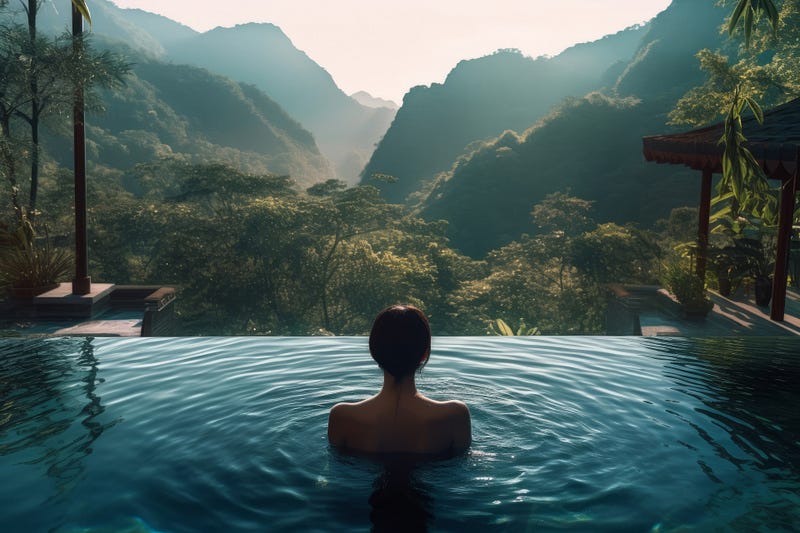
The greatest experience in the world, one everyone should enjoy at least once in their life, is a trip to an onsen — the hot spring resorts that dot Japan.
You might think, what’s the big deal? You’ve been to the baths in Switzerland, taken in the waters in Budapest, you’ve partied in the Blue Lagoon in Reykjavik, and you’ve soaked in a mud bath in Napa Valley.
All nice, no doubt, but until you’ve been to a Japanese onsen, you’ve yet to climb the towering heights of luxury and relaxation.
With the incomparable beauty of the cherry blossoms about to wash over the country in a wave of pink, now is the time to hop on a plane to Japan and head straight out of Tokyo to an onsen resort.
What exactly is an onsen?
The word onsen (温泉) in Japanese simply means “hot spring.” The upside to being in a volcanic, earthquake-prone country is there are around 25,000 hot springs up and down the land.
For centuries, the hot springs have been the place where the Japanese love of bathing and health was combined with the country’s appreciation for nature and great food.
The onsen is more than just hot water bubbling forth from deep underground. It’s a resort where you go to relax and eat, and take in the scenery.
The baths are usually inside a ryokan — a traditional Japanese resort hotel. Each onsen town will have a number of ryokan where you bathe, eat, and sleep.
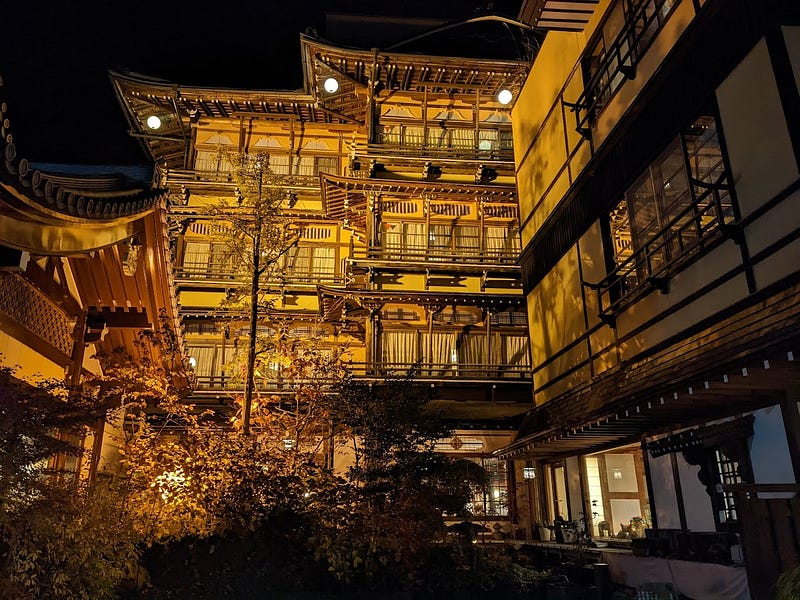
Some big onsen towns also feature public baths in the town center. You can stroll from your ryokan along the cobblestone streets wearing the hotel-provided yukata robe and the wooden geta sandals.
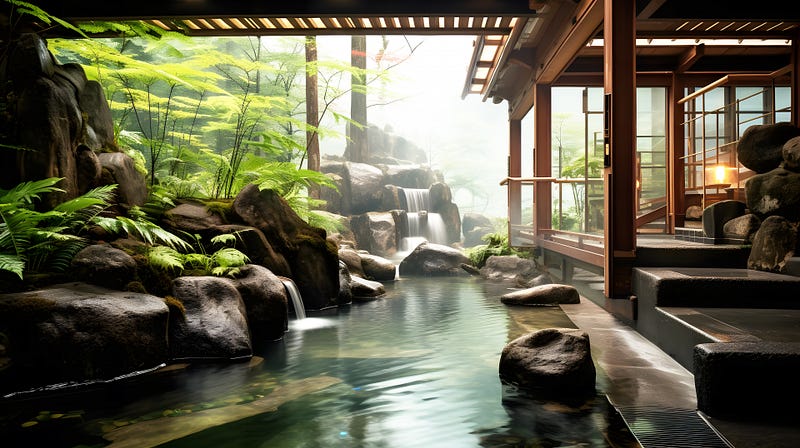
Most ryokan feature both a big outdoor bath called a rotenburo, and smaller indoor baths. The outdoor bath is the main draw, putting you right in the middle of the scenery, but if it’s raining heavily or just too cold outside, you have the option to stay inside and stare at the beauty through the wall of windows.
Each onsen has different minerals dissolved in the spring water. Calcium, sulfur, sodium, magnesium, and iron were long believed to offer cures for arthritis, digestive disorders, muscle pain, skin conditions, and many other infirmities.
While you may want to stick to modern medicines for serious medical conditions, there’s no doubt that soaking in a hot, relaxing mineral bath while staring at beautiful scenery leads to a state of relaxation that can’t be bad for your blood pressure and certainly leads to a deep, comfortable sleep. And after stepping out of a hot spring rich in silica, your skin will be noticeably soft and smooth.
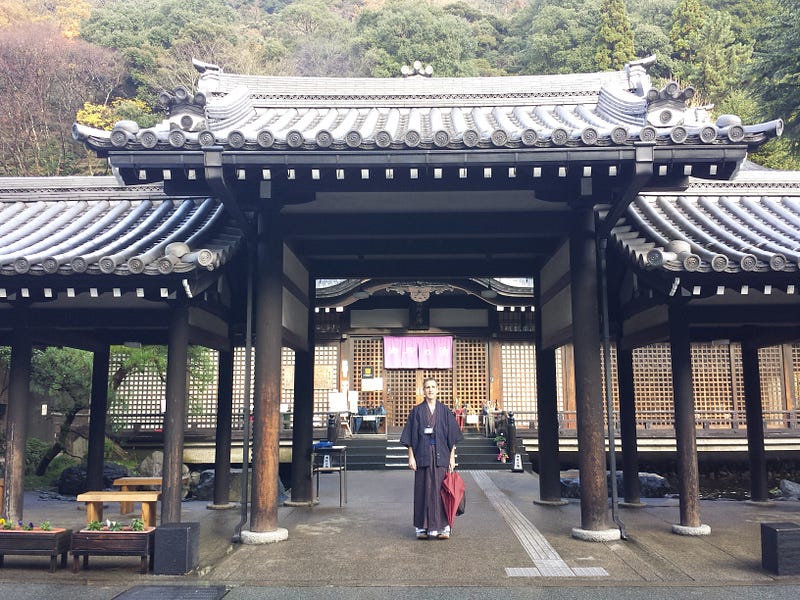
Mastering complex bathing etiquette
Whether you’re bathing at the ryokan or a town onsen, you’ll be soaking in a big communal bath for which there is a strict etiquette that can seem daunting until you understand the logic.
Nowadays, almost all onsen have separate facilities for men and women, though historically that wasn’t the case. The entrance for women is usually through a red noren curtain marked with the 女 character (onna, woman) while the entrance for men is through a blue curtain marked 男 (otoko, man). Even if you can’t read the characters, look for the curtain color or the appropriate simple character or complicated character, or just ask someone to point you in the right direction.
The baths are open in the morning and the evening. Many places swap the men’s and women’s baths between those two times so you get to experience both baths which offer different views of the scenery.
So, the first rule at the onsen is to make sure you’re entering the correct bath. It might not be the same place you went last time.
When you step through the noren curtain into the bathing room, take off your slippers and step up onto the mat floor. Most places you can leave your slippers at the entrance, but if you’re wearing shoes, you’ll put those into the shoe box beside the door and take the numbered key with you.
Inside the curtain is the locker room. Take all your clothes off and slip them into a locker, along with all your belongings. (You can come in street clothes and bring the supplied yukata robe from your room to wear when you leave, but it’s easier to change in your room beforehand and come down to the bath already wearing the yukata.) Take only your washcloth with you. The locker key is on a band that you slip around your wrist or ankle.
The point of the bath is to soak in mineral water. Chlorine would ruin the experience. So the water is straight from the underground source. The bath is not for washing. Before getting in, you have to scrub your body clean.
From the locker room there will be a sliding door to enter the steamy room with the baths. Against the wall inside, you’ll find a row of showers. That is where you start.
Use the washcloth to soap up and scrub every inch of your body. Make sure to rinse thoroughly, getting rid of the soap residue. Anything you track into the bath will be shared with everyone else.
Now that you’re clean, you’re ready for the baths. Take your washcloth with you. Either fold it into a neat square to place on top of your head or set it on the ground outside the bath beside you.
The water will be HOT HOT HOT! 41C is typical, though some places may be even hotter. In a few minutes, you’ll be boiled like a lobster. You’ll also be incredibly relaxed.
When you’re done, you can enjoy the sauna, cold bath, jet bath, and other bathing amenities, or just head back to the locker room.
Dry yourself with the bath towel and get dressed in your yukata robe. The facility will supply razors, hair dryers, toothbrushes, and a variety of hair products, skin creams, perfumes and colognes for your use.
Do I Have to Get Naked?!?
Yes. No bathing suits in the bath. Don’t worry, though, because nobody cares. Nobody is looking at you. They’re all naked, too.
If that makes you uncomfortable, well…get over it. The first time might feel a little awkward, but I promise you’ll quickly get used to it.
If you really, really have to, some ryokan will offer small onsen baths in their more expensive rooms. You get to experience the baths without having to be in public. But…you’ll miss the full experience of the big bath outside amidst beautiful scenery.
How Much Does the Ryokan Cost?
Like any hotel, there’s a wide range of prices from inexpensive to insane. Fortunately, with the current weak yen, the costs are very favorable to foreign tourists.
Typical prices are around 20,000 yen ($134) per person per night. Note that prices are per person rather than per room. The price includes the lodging and bath, plus dinner and breakfast. And it’s the dinner where wonderful turns into incredible.
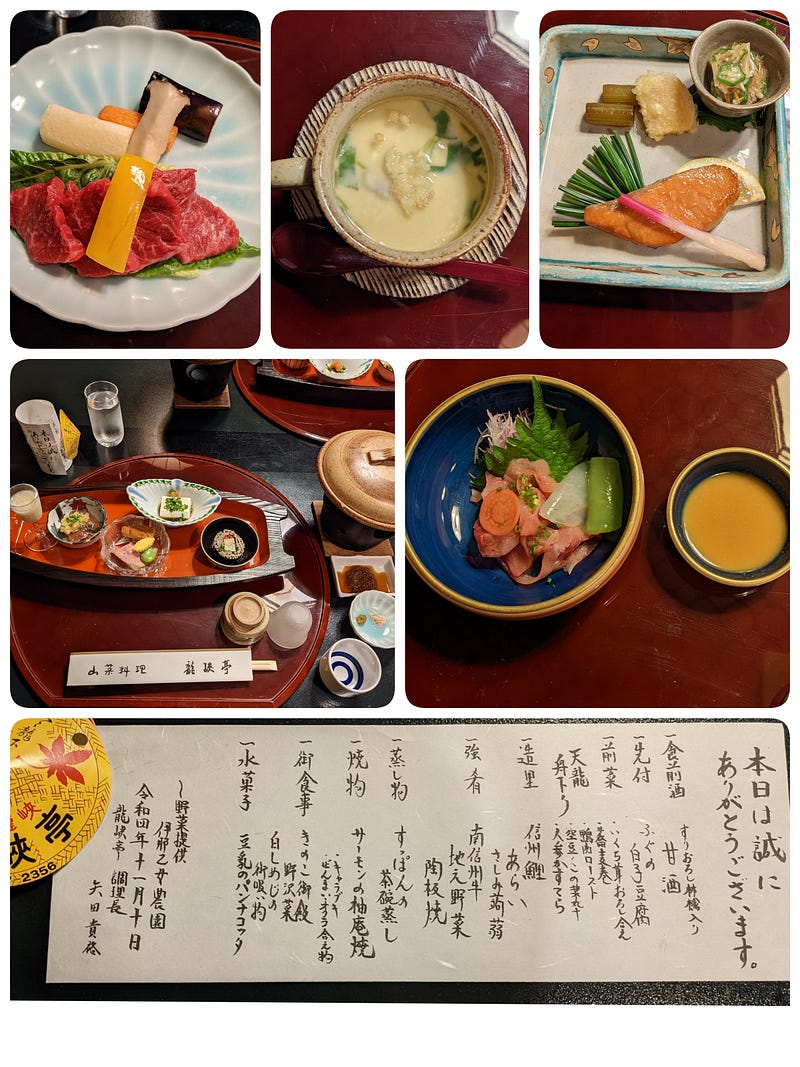
The Dinner
The meal will consist of many small courses of local and seasonal foods that change daily.
Dinner will start with a few small dishes, and continue through many courses with some seafood, some meat, miso soup, rice and pickled vegetables, and a small dessert.
Pay attention to the presentation of each course in special pottery or lacquerware selected to highlight the food while matching an overall theme.
The menu is always a set course, though you may have options when you make the reservation for how elaborate (and expensive) a dinner you want. All people in the party will have the same meal. There are no substitutions, but most places will make accommodations for food allergies if you let them know when you check in.
If you’re a vegetarian, well…Japan can be a challenging place to visit. But it is getting easier. Don’t expect most ryokan to offer a vegetarian menu, but search out the places that specifically cater to vegetarians.
Breakfast is a lower key affair, though still insta worthy. Some places will offer a huge buffet with an amazing variety of choices while others will have a course menu for breakfast, too, usually grilled fish, rice, miso, and pickled vegetables.
If you depend on coffee to wake up in the morning like I do, some very traditional ryokan only serve green tea. I always bring extra single-serve coffee packets with me for caffeine emergencies. There will be a thermos of hot water in the room. There are usually vending machines to buy a variety of canned drinks including hot or cold coffee.
What if I Have a Tattoo?
Okay, so this is a problem. Most onsen have a “no tattoos” rule, and rules in Japan are enforced without exception.
The reason for the prohibition on tattoos is that yakuza mobsters also enjoy onsen, occasionally getting drunk and rowdy and threatening anyone who complains.
There’s no way to say “no yakuza allowed”, but with the yakuza famous for their intricate full-body tattoos, most ryokan adopt a simple rule that says no tattoos in the bath. Except for yakuza members, tattoos remain rare in Japan.
However, that rule has caused complications for the increasingly tattooed Westerners visiting the country. While a woman with a small tattoo of a butterfly on her wrist is clearly not a threat, the ryokans fear that if they don’t enforce a blanket ban on tattoos, it will be difficult to keep the yakuza out.
If you have a small tattoo that you can cover with a bandage, most places won’t ask. But that’s not guaranteed. And if you have a large tattoo or one in a place that’s difficult to cover, you’ll be politely but firmly informed that you’re not allowed in the bath.
So if you have a tattoo, be sure to check the policy before you go to avoid what ought to be the experience of a lifetime turning into disaster.
Famous Onsen to Enjoy
Here’s a few of the most famous onsen that are easy to reach from the major cities.
- Atami — an hour from Tokyo overlooking the sea
- Hakone — two hours from Tokyo in the foothills of Mt. Fuji
- Kinugawa — two hours from Tokyo in the mountains near Nikko
- Arima — an hour from Osaka in the mountains above Kobe
- Kinosaki — two hours from Kyoto on the Japan Sea coast
When you visit Japan, enjoy the cherry blossoms, the views of Mt. Fuji, the anime and cup noodle museums, but most of all, make sure not to miss the most incredible experience of your lifetime at an onsen hot spring.
If you enjoy Japanese culture and mysteries, don’t miss my novel, To Kill a Unicorn, set in Silicon Valley’s Japantown.


