
The Greatest (and Worst) Thing About Japan — 1 Yen!
Welcome to the kitchiri country where everything is done right
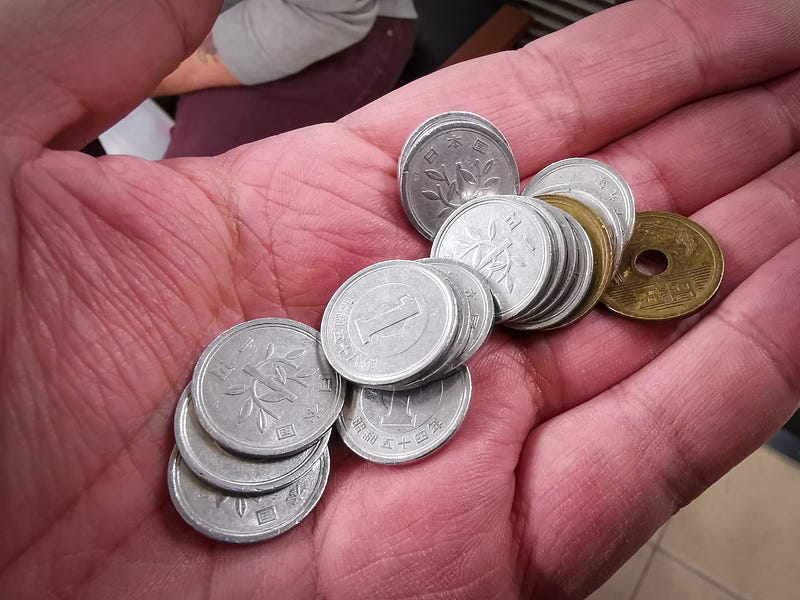
On my first day of work in Japan many years ago, a colleague took me into a convenience store to grab a bento for lunch.
The price for my items came to ¥1001. These were the days before Icoca/Suica cards and pay by phone when everything had to be paid with slips of paper. In my wallet, I had one ¥1000 bill, and a bunch of ¥10,000 bills.
I held up the crisp ¥1000 hoping the casher would take it. My Japanese colleague laughed at the clueless gaijin as he pointed at the ¥10,000 bills.
In the US, there would be a little plate of change where I could take a penny and make up the required ¥1001, or the cashier would shrug, take the ¥1000 bill, and say “close enough.” The cashier would be as little interested in counting out 8999 yen in change as I was with being weighed down with 999 yen of coins jangling in my pocket.
When I tell this story to my Japanese friends, they look at me cockeyed. If the cost is ¥1001, why would I expect to be able to pay only ¥1000?
My arguments that accepting ¥1000 would make the transaction faster, saving at least ¥10 of the cashier’s time held no sway. The total was ¥1001; why would I pay anything else?
Fortunately, those days of carrying around change for the conbini, for the vending machines, for the trains, subways, and buses are long gone. But the same attitude towards precision and perfection is deeply embedded into the Japanese spirit in a million other ways every day.
I was even more amazed when I was invited to our first group meeting that afternoon. The meeting was scheduled to start at 2 PM. Everyone showed up 3 minutes before 2 PM and the meeting started exactly on time. And ended on time, too. Wow!
In decades of meetings in the US, I’ve yet to see one start on time. If the scheduled time is 2 PM, members begin showing up around 2:05. We get started around 2:10, and the stragglers straggle in whenever they’ve returned from Starbucks, so the discussion has to be repeated a few times. Oh well.
I couldn’t believe my eyes when my welcome party scheduled from 6–8 pm started at exactly 6 pm. And ended at 8 pm. Amazing! A party in the US starts whenever people show up, if they show up, and ends whenever they leave.
A workman who says he’ll be at our house to fix the refrigerator between 10–12 will likely show up around 1:30. Or maybe he’ll call at 4 PM and say he’ll try to make it tomorrow if he can.
Everything in Japan runs like clockwork. Including almost all the clocks in the world, which may be designed in Italy or Switzerland, but use Japanese movements inside because they are the most precise.
Japan is an amazingly kitchiri place, a word so Japanese it’s hard to translate. Everything is done precisely, accurately, and without fail.
The trains and subways famously run on time. In a trick of physics I still don’t understand, even the buses run according to the posted time schedule. Every single day. Of course, there are the rare delays due to unpreventable circumstances, but even those are measured to the second and analyzed. (https://www.mlit.go.jp/common/001215328.pdf) Precision, indeed.
As a mechanical engineer myself, Japan is a wonder. Japanese products have the highest quality because Japanese factories have the highest precision. If the specification calls for a clearance of 1001μm, no 1000μm isn’t close enough.
Japanese craftsmanship creates works of beauty because the craftsmen take the time to get the details right. If it isn’t perfect, it goes in the trash. Sorry, not good enough. I once visited a pottery kiln with a pile of broken pottery up to the ceiling. They weren’t perfect so the potter smashed them rather than selling an inferior good at a lower price. Hard for Americans to imagine.
The beauty of the tea ceremony has little to do with tea. It’s the precision of every movement, from the angle to hold your hand when purifying the bowl, to the way the door is opened to create the perfect sliding sound, practiced a thousand times over until it becomes second nature.
If Japan is the epitome of kitchiri where everything is done perfectly, America is Exhibit A for tekitō — meaning sloppy or careless, but also good enough or appropriate.
Kitchiri is great if you’re building a car with 30,000 parts that have to fit together perfectly to avoid falling apart on the street. For software, maybe perfection is too much. A bug or two isn’t always the end of the world.
The productivity in Japan is $42.56/working hour. In the US, it’s $73.70. Workers in US produce close to double the output by value as Japan. Or as my Japanese friends would say, 73.01% higher, using 2 decimals of precision despite being based on data that’s accurate to at best a few percent.
There’s a lot of reasons for this difference, including the mix of products and the number of people who have to attend each useless meeting, but a big reason for the low productivity in Japan is the demand for perfection.
Sometimes perfection is perfect. But sometimes perfection is the enemy of good. Sometimes good enough is actually good enough. Sometimes it’s okay if there’s a few bugs in the software if it gets new features out quicker. Sometimes it’s okay if the American hot water heater springs a leak after 10 years if it costs a quarter of the price of the Japanese one.
And in the office, while it annoyed me when people were late to meetings, in the end we got the work done well enough with the people who bothered to show up.
As a perfectionist myself, I find it easier to live in Japan. The tekitō-ness all around me in the US drives me crazy. And sends my wife into conniptions of hara-ga-tatsu-ness at least once every hour.
But when I have ¥1000 in my pocket, I really don’t want ¥8999 change from a ¥10,000 bill. Fortunately, now I have an Icoca card in my wallet, too, and don’t have to carry any change at all.
Welcome to world of Ted Tatsu Hara, a hacker in Silicon Valley whose mother is a tea ceremony teacher, in my mystery novel, To Kill a Unicorn. He uses tea ceremonies and ramen to find out what happened to his missing friend.


