
The Great Transition: Moving Beyond Negative/Zero Sum Games to Positive Sum, and Even, Infinite Games
This article synthesises the 4 part series “Being Game B”, and provides an overview of my 42 articles here on Medium and 8 books about living a Game B life in a Game A world — and how to make the transition to a regenerative, inclusive, collaborative, multicapital world.
Being a leader of change and transformation is a seriously tough job. Stress levels and personal sacrifices have never been higher. We’re here to help resolve some of those difficulties to ensure you can master those challenges and feel energized, fresh, and ready for action, through a free online mini-course.
Every Monday in the Global Change Agent club, we gather to explore topics related to making the transition from Game A to Game B more effectively, smoothly, and elegantly — including 15 November 2021- join us if you can.
Life’s a game. Or is it? In the mists of time, way back when an upright hominid species was evolving into what would become homo sapiens (you and I), our early ancestors started playing games. New research shows how deeply embedded game-playing is in apes. Primatologists at the University of Michigan-Dearborn recently published a study in which they pitted four adult chimps against twelve human children ranging from 3 to 12 years old, and four adult humans.
The chimpanzees tended to do about as well as the kids between 3 and 6 years old, completing the maze in a similar amount of time. The scientists were also recording “travel efficiency,” or how much distance the gamers covered before beating the game. That’s where Panzee the chimp shined: on the most difficult maze, she took a significantly shorter route to the prize than the kids — and even the adults.
Playing games for fun is only one example of the different kinds of games that can be and are played. Some of the most profound games are not played for fun, but for real. Most people are unaware they are playing an evolutionary game, but then evolution is probably one of the least understood yet most important phenomena that have shaped human nature and continue to shape our evolution, and our future. It is in our nature to play games.
In 1964 psychiatrist Eric Berne published the bestselling book Games People Play: The Psychology of Human Relationships which has sold more than five million copies. The book describes both functional and dysfunctional social interactions.
In the game entitled “Now I’ve Got You, You Son of a Bitch,” one who discovers that another has made a minor mistake in a matter involving them both holds the entire matter hostage to the minor mistake. The example explains a situation where a plumber makes a mistake on a quoted $300 job by underestimating the price of a $3 part as $1, so the plumber sends a bill for $302, the correct price.
This is despite the customer making it clear at the beginning of the transaction that the $300 quote was to be adhered to. The customer won’t pay the entire original $300 unless and until the plumber absorbs the $2 error instead of just paying the (undisputed part of the) bill of $300. In this example of NIGYSOB (Berne often abbreviates his names for games by using their acronyms), the ‘white’ (the customer) receives a gain in the form of a justification for his rage and can avoid confronting his own deficiencies. The plumber also receives a gain from his clear refusal to adhere to the terms of the agreement, although in the book’s example, he eventually gives in — an example of the game “Why does this always happen to me? (WAHM)?”.
Hundreds of games have been documented by researchers, driven by the incredibly diverse range of dynamics in human interactions. Not all interactions or transactions are part of a game. Specifically, if both parties in a one-on-one conversation remain in an Adult-to-Adult ego-state, it is less likely that a game is being played.
Berne describes three roles or ego states, known as the Parent, the Adult, and the Child, and postulates that many negative behaviors can be traced to switching or confusion of these roles. He discusses procedures, rituals, and pastimes in social behavior. For example, a boss who talks to her or his staff as a controlling ‘parent’ will often engender self-abased obedience, tantrums, or other childlike responses from her or his employees.
Emotionally intense memories from childhood are ever-present in adults. Their influence can be understood by carefully analyzing the verbal and non-verbal interchanges (‘transactions’) between people, hence Berne’s name for his model: Transactional Analysis.
In another bestselling book, I’m OK, You’re OK, psychiatrist Thomas Anthony Harris saw great merit in the ability of Transactional Analysis to define basic units through which human behavior can be analyzed — the ‘strokes’ that are given and received in a ‘transaction’ between two or more people — and a standardized language for describing those strokes. Think “Likes” on Facebook, pats on the shoulder, hugs, kisses, sex, compliments, awards, and much more.
Games are played for fun, for profit, competitively, co-opetitively, and collaboratively, mirroring the dynamics of different parts of our minds, our social relations and position, and our level of psychological development. There are negative sum games (wars for example) where everyone loses. There are zero-sum games, where only one or a few players can win while the others lose- chess, sports, most board games, foreign exchange trading are but a few examples.
There are positive sum games, where all players gain something- for example, “win-win”, where two or more players/partners generate synergistic outcomes that make all players better off in an organization or business. And then there are “win-win-win” games where not just the players, but people and planet also win- even if they are not “playing the game”, they still benefit.
Interpersonal games are but one level at which games are played. Games scale, from our own interpersonal relationships to teams, to organizations, to nations and planets. Let’s examine a planetary game played with great fervor during the latter half of the 20th century, and still ongoing, called “Mutually Assured Destruction”, perhaps one of the deadliest and most negative sum games ever played.
The Mutually Assured Destruction (”MAD”) Game
The role of scenarios in evolution may perhaps, one day, come to be viewed as one of those breakthrough moments in the history of our species. Although it is difficult to say when the discipline of scenario thinking began, it is certain that Pleistocene man needed to be able to plan for the unexpected in order to survive.
By having to ask questions such as: “What if it snows, and all our crops are destroyed/our prey unavailable/ we all die of cold”, homo sapiens has had to do some form of primitive scenario planning simply to survive. We can also see that this particular form of foresight acted as a stimulus for stores of food to be accumulated (“what if we have a bad harvest next year”), infrastructure to be built (“what if the wolf comes”), and helped many artifacts of civilization to emerge.
Many scholars agree that many other species need to deal with contingencies and behave “as if” they are asking the question “what if”, even though they demonstrate little or no reflective consciousness. Thus, most species that build infrastructures and store food have evolved phenotypes and/or instinctive behaviors including social systems which protect them from all manner of unpredictable contingencies, from having to deal with the flooding of a termite's mound to the need to build nests invisible to or away from predators.
It appears that formal scenario planning emerged originally in a military context, and became documented during and post World War 2. Given the increasing sophistication of warfare and the ability of combatants to deceive each other as to their intentions, it became necessary to prepare several sets of possible plans, depending upon the strategy eventually deployed by the other side/s.
Although rehearsal for a number of contingencies has always been a key element of military training and organization, this in itself is not a form of scenario planning. What is required in scenario planning is the concept of not only multiple possible moves by another player but the further concept of multiple possible future worlds.
What if There is a Third World War?
The US Air Force appears to have been conducting “War Game” exercises for at least seven decades. Since the advent of nuclear weapons, advanced simulations on some of the world’s fastest supercomputers have focused on the following question: “What if a thermonuclear device is detonated or thermonuclear war is started?” The “space race” that began with Sputnik in 1957 was a thinly veiled response to this question and ended up bankrupting the Soviet Union along with their misadventures in Afghanistan.
As most of the documentary evidence of what the Soviet Union and the USAF were doing in their respective computerized wargames is still classified information, it is only possible to speculate here about what happened. Nonetheless, it may have gone something like this:
The USA/USSR Dialogue: “Behind the Scenes”
USSR 1975: “Comrades, we keep on running these third world war scenarios, and can’t seem to avoid an outcome in which a minimum of 250,000,000 people die if nuclear weapons are used. Do we all want to live in Siberia to stay alive?”
USA 1978: “Well, General, you are going to have to tell the President that our simulations indicate that a pre-emptive strike could still result in US casualties of at least 50,000,000, even we can take their key installations out first. That is not a real vote-winner down in Peoria”
US President 1985: “Gee, I guess we’ll just have to go for that Star Wars thing to avoid having to nuke those Ruskies. It’s kind of funny, but I sort of like that Gorbie guy, even if he is from the Evil Empire. Pass the jelly beans”
CIA 1986: “The KGB have got such a tight grip on the Soviet Union that no matter what we do, the Communist Party will always stay in control. We must convince them that a third world war is unwinnable, as the US budget deficit makes the cost of our nuclear warhead program prohibitive”
USSR 1988: “Comrades- that Star Wars program is frightening. Our intelligence reports say that the Yankees will blast our warheads out of the sky even before they reach the USA, and we will get fall-out over mother Russia from our own weapons. Anyway, we are running out of money for our new weapons programs. Gorbachev and Abagenyan are telling us we must give the people consumer goods, otherwise, our economy will fall apart and make the USSR unsustainable”
We know what happened next: building on the SALT and START talks begun by Nixon, Reagan, and Gorbachev presided over the largest peace-time destruction of nuclear weapons in history. And we are still here to tell the tale. What would have happened if both the computer had taken another ten years to emerge, and scenario planning had not been possible in such detail? One shudders to think- mutually assured destruction was a very real possibility.
We still have Kim-Jong-Un, Iran, Israel, Pakistan, India, and China playing with different variants of MAD along with Russia and the USA, of course, so MAD is not yet, nor may it ever, be truly over. In the world today, nine major countries currently possess nuclear weapons:
- Russia, 6,375 nuclear warheads
- United States of America, 5,800 nuclear warheads
- France, 290 nuclear warheads
- China, 320 nuclear warheads (planning to add another 150)
- United Kingdom, 215 nuclear warheads
- Pakistan, 160 nuclear warheads
- India, 135 nuclear warheads
- Israel, 90 nuclear warheads
- North Korea, 30–40 nuclear warheads
The Game Changers
As a teenager in the early 1970's, I remember writing a long and angst-ridden essay in response to the question: “Is Civilization Just a Thin Veneer?”. Having lived in Canada where our neighbors built nuclear bomb-proof shelters as JFK was navigating the Bay of Pigs crisis and Russian nuclear submarines off the coast of Cuba were ready to fire on several American cities, this was not a fanciful creative writing exercise.
Perhaps it was not surprising that “Make Love, Not War”, became a leitmotif of my baby-boomer generation. Perhaps we had learned something after all from two World Wars and the 45 years long Cold War. The idea of dying for one’s country had become distinctly unfashionable, helping end the Vietnam War.
Sadly, many countries continued military conscription for young men (and women, in Israel). After qualifying as an Advocate of the Supreme Court, I spent two challenging years as a lieutenant and legal officer in the midst of the S African civil war and the battle against the ”communists” in Mocambique, Angola, and Zimbabwe, aided by their Russian and Cuban advisors. Ironically, I’ve been very happily married to a Russian for the past 18 years- how pleasantly surprising and unpredictable life can be.
Humanity’s origins have bequeathed us with both ego-centric and ethnocentric dynamics. These two dynamics explain both human selfishness and rational self-interest, as well as altruism. We generally collaborate with our “tribe”, pursuing our self-interest in the process. When these get out of alignment, conflict arises. Conflict and cooperation between tribes have also been a perennial feature of human and hominid evolution.
In the 19th and 20th centuries, transport and communications technologies shrank the world, and distance was no longer a major obstacle to developing a more complete understanding of our planet and each other. The post-war, baby boomer generation developed world-centric consciousness with the aid of newspapers, radio, TV, travel, and now the internet. We discovered that all human beings have much in common, despite our ethnic and cultural differences, especially our shared “Out of Africa” origins some hundred thousand years or so ago.
Humanity is now, in some senses, a global “tribe”, and thanks to the six interconnected and escalating global crises we face together, along with the possibility of our own extinction and that of 90% of life on earth, we now find global cooperation at its highest level ever. Even if COP26 may not result in limiting global overheating to 1.5C, all of earth’s peoples and nations have been part of the negotiations, whatever their final outcome. We’ve seen the enemy, and it is us. It’s a start.
Game A and the Giant Con Job
At the beginning of 2021, I wrote an article in response to the failed coup and invasion of Capitol Hill on 6 January, called “The Giant Con Job- 24 Hours that Changed the World”. In it, I explained how what we now call “Game A”, is something of a giant con job.
VERB- cons, conning, conned: Persuade (someone) to do or believe something by lying to them.
NOUN — An instance of deceiving or tricking someone.
Confidence tricks exploit typical human characteristics such as greed, dishonesty, vanity, opportunism, lust, compassion, credulity, irresponsibility, desperation, and naivety. Cons succeed by inducing judgment errors — chiefly, errors arising from imperfect information, and cognitive biases. In popular culture and among professional con men, the human vulnerabilities that cons exploit are depicted as ‘dishonesty,’ ‘greed,’ and ‘gullibility’ of the marks.
Dishonesty, often represented by the expression ‘you can’t cheat an honest man,’ refers to the willingness of marks to participate in unlawful acts, such as rigged gambling and embezzlement. Greed, the desire to ‘get something for nothing,’ is a shorthand expression of marks’ beliefs that too-good-to-be-true gains are realistic. Gullibility reflects beliefs that marks are ‘suckers’ and ‘fools’ for entering into costly voluntary exchanges.
Accomplices, also known as shills, help manipulate the mark into accepting the perpetrator’s plan. In a traditional confidence trick, the mark is led to believe that he will be able to win money or some other prize by doing some task. The accomplices may pretend to be strangers who have benefited from performing the task in the past.
How has nearly half of the population of the USA, the UK, and much of the rest of the world become susceptible to con jobs, conspiracy theories, fake news, and giant lies told by charlatans and con artists called populist politicians, funded by greedy elites?
A second major element of the giant con job has been trickle-down economics, or “trickle-down theory,” which states that tax breaks and benefits for corporations and the wealthy will trickle down to everyone else. It argues for income and capital gains tax breaks or other financial benefits to large businesses, investors, and entrepreneurs to stimulate economic growth.
The reality is that wealth does not trickle down from the rich to the poor. That’s the latest conclusion of new research from the International Monetary Fund. In fact, researchers found that when the top earners in society make more money, it actually slows down economic growth. On the other hand, when poorer people earn more, society as a whole benefits.
The researchers calculated that when the richest 20% of society increase their income by one percentage point, the annual rate of growth shrinks by nearly 0.1% within five years. This shows that “the benefits do not trickle down,” the researchers wrote in their report, which analyzed over 150 countries. By contrast, when the lowest 20% of earners see their income grow by one percentage point, the rate of growth increases by nearly 0.4% over the same period.
This playbook is as old as the human race itself, and we saw it repeated many times over in the 20th century alone in Hitler blaming the Jews and Blacks for Germany’s ills, Stalin blaming capitalism and the corrupt west, Mao blaming the “imperialist running dog” capitalists and “rightists”, Pol Pot blaming the urban elites and intellectuals in Cambodia, and much more.
But the 21st-century version is much more subtle, relatively speaking. We may not yet have managed to trigger World War Three, as elites in their private jets, dozens of mansions and yachts would run out of champagne and caviar, and that wonderful sense of entitlement and smugness that makes them feel so superior to the little people and “essential workers” i.e. you and me. We have, however, pushed our entire biosphere to the edge of collapse and endangered our very own survival as homo sapiens in the next century.
The fossil fuel, mining, and chemical industries, along with other major contributors to runaway global warming such as cement, construction, and the fossil fuel-powered vehicle industry, have invested in the Republican Party for 40 years. They got a major payback with the election of Trump, and continue to block legislation that could help turn the tide against global warming as President Biden struggles to win the votes he needs to make that a reality five years later.
The Long Game is to reward rich political donors with tax cuts, a free hand to drill, exploit and pollute, and much more. The greedy elites can hide behind populist politicians to feather their ever-expanding nests, conning the most gullible, least-educated, often rural populations to vote for abstract, jingoistic concepts such as “Freedom” and “Greatness”, in the case of Republicans, and “Sovereignty” and “Taking back Control of our Country” in the case of Boris Johnson and Brexit. The dog whistle message underlying most of this is, of course, an appeal to white supremacy and anti-immigration rhetoric- basically, blame the outsiders and foreigners.
We can characterise Game A as follows: it is largely degenerative, exclusive, hierarchical and mono-capitalistic. Let’s take each of these in turn:
Degenerative — even if all the commitments made at COP26 were met, we would still be on target for 1.8C global overheating, not the 1.5C needed to ensure we do not trigger runaway global overheating and a death sentence for most of humanity and 90% of life on earth. The sixth mass extinction is also well underway, as we eliminate natural habitats and replace them with industrial agriculture and cattle/pig/sheep farming, which is how Covid-19 made its debut. Game A is essentially the longest suicide note in history.
Mass consumerism also plays its part. In 2019 a United Nations panel reported that sometime around the turn of the millennium, consumption surpassed global population growth as the greatest driver of our environmental crises. When it comes to climate change, species extinction, toxic pollution, water conservation, and other challenges, how much each one of us consumes matters more than how many of us there are.
For many consumers, shopping has become mixed with guilt and a sense of responsibility as it increasingly depends on credit card debt and the labour of poorly paid and precarious workers — and it has a heavy environmental toll. Buying something today is also an experience drained of fun: it often entails making sure you are in when the package arrives, unpacking it and realising that it isn’t what you wanted.
Nothing we have done to “green” this consumer appetite has been able to keep up with how quickly it is growing. Here and there we ban plastic bags or plastic straws; meanwhile, plastic production overall is set to expand by 40% in the next decade. “Sustainable fashion” is trending, but in the past 20 years, the number of garments purchased per person increased by 60%, while the life span of those clothes was cut nearly in half. The fraction of goods in circular systems — in which discarded products are cycled into new ones — is actually shrinking. The amount of raw materials pouring into the world economy is higher than ever.
The average American alone consumes so much that if everybody in the world lived the way they do, it would take five Earths to maintain such a global standard of living.
Exclusive — The world’s richest 1% have more than twice as much wealth as 6.9 billion people. Almost half of humanity is living on less than $5.50 a day. Billionaires have now more wealth than the 4.6 billion people who make up 60 percent of the planet’s population, and emit 70 times the greenhouse gases. The rules of Game A favor greedy elites at the expense of the rest of us. The world’s richest people spent $234 billion a year on luxury goods in 2020 — including yachts, private jets, wine, jewellery, art, cars and clothes.
Global economic output is $80 trillion, of which roughly half represents energy, food, water, housing and the basics of life. Covid-19 has cost us $14 trillion so far. Global overheating, the sixth mass extinction, the loss of critical ecosystems and severe droughts, fires, flooding and storms are already costing us $5–10 trillion a year depending on what you include as “damage”.
Who is picking up the bill? You and I, not the elites- no they’re fully insured and mobile so they can stay in whichever of their dozen homes around the world is currently habitable.
The “American Dream”, has now gone global as the “Global Materialist Consumerist Dream”, even in state capitalist totalitarian nations such as China. Not only does this dream happen mainly while people are sleeping, it is also utterly unsustainable and degrading for the bulk of humankind, the “have-nots”.
Several billion “have-nots” are suffering and struggling to live better lives, in the shadow of a global media which spews outlandish untruths about “western” lifestyles, where 20-somethings live in giant loft apartments and average American families live in McMansions. Everyone is told that they “deserve it”, to sell more stuff, get people into debt, and introduce more misery into the world, so that we can all keep up with the Joneses. Cue fashion, Instagram, and every other trivial pursuit of celebrity, riches, narcissism, while the wealthy earn money with money from this sad parade.
Greta Thunberg, with 13 million Instagram followers, may be the conscience of her generation, but that icon of conspicuous consumption and bling, Kylie Jenner, with 270 million Instagram followers, is sadly more representative of many members of Gen Y and Z.
Hierarchical — half of humanity live in dictatorships ruled by tyrants. As a lethal pandemic, economic and physical insecurity, and violent conflict ravaged the world in 2020, democracy’s defenders sustained heavy new losses in their struggle against authoritarian foes, shifting the international balance in favor of tyranny. Incumbent leaders increasingly used force to crush opponents and settle scores, sometimes in the name of public health, while beleaguered activists — lacking effective international support — faced heavy jail sentences, torture, or murder in many settings. Power largely comes in the form of money and/or the barrel of a gun in such places, assisted by advanced surveillance technologies, large armies, intelligence agencies and police forces.
Socially well-adjusted psychopaths, known as sociopaths, tend to rise to the top in Game A. Interestingly enough, such hypercompetitive people gave been known as “Type A” by psychologists for half a century. The core personality features associated with psychopathy are callous and unemotional personality traits, which include a lack of empathy or remorse, weak social bonds, an uncaring nature, and shallow emotional responses.
Unsurprisingly, it turns out that Game A is bad for our hearts. Feeling stressed all the time raises your risk of heart attack and stroke, according to a recent study published in the Lancet. Constant stress has been linked to higher activity in an area of the brain linked to processing emotions, and an increased likelihood of developing heart and circulatory disease.
Most large organizations are also structured along hierarchical lines, whether business, government or civil society, so that they can benefit from the cost-saving efficiencies of siloes of knowledge and capabilities solving simple and complicated problems, thereby increasing profit and the manageability of their constituents and donors, while paying lip service to impact.
Spoiler Alert- the six interconnected, escalating mega-crises we face today are complex, wicked problems that hierarchies are ill-equipped to deal with.
Mono-capitalistic — only money really matters when it comes to how Game A measures its success. There are 2 755 billionaires and 56 million millionaires in the world today, with a total net worth of $191.6 trillion. Greater China topped the list with a billionaire population of 1,058 people, despite being “communist”. Since the start of the pandemic, central banks in the U.S., Europe and Japan have been on a $9 trillion spending spree. That binge has turned the U.S. Federal Reserve, the European Central Bank and the Bank of Japan into the ultimate market whales, swelling their combined assets to $24 trillion. Who benefits? Mainly banks, stock market and real estate investors, though this “Quantitative Easing” has kept global economies afloat during the great covid recession. Essentially, though, this is simply funding Game A, not “building back better” or “levelling up”.
In 2021 we are living in the exit turbulence of late-stage capitalism, where our attempts to drive never-ending economic growth and materialism on a planet with finite resources have become the new definition of insanity. The idea of “success” that costs the earth is a performative contradiction. Yet as a species we seem to be sleepwalking toward that particular cliff edge despite 60 years of environmentalism, protests, and the rise of Generation Z global school strikers where millions of teenagers called us out for destroying their future.
How can we inspire billions of consumers and citizens in the developed world to change the failing habits and mindsets of a lifetime that are leading us to ruin? To enable them to see through one of the biggest con jobs of all time?
Is Game B Real or Just a Utopian Fantasy?
What is happening is that the world is, far too slowly, transitioning from a set of Game A rules that favor the 1% of greedy elites, to a set of rules where a more equal distribution of wealth prevails, workers earn thriving wages instead of poverty or “living” wages, and people and planet matter more than profit, meaning we operate in a multi-capital world, not a mono-capital only money matters world.
Is there really an alternative to Game A, what does it look like, and how is it different from Game A? And how can we transition toward it fast enough?
To answer the first question: Yes, there is an alternative way of life, which looks very different to Game A, which is also often the exact opposite of Game A. Let’s call it Game B.
Game B is regenerative instead of degenerative. It is inclusive rather than exclusive. It is collaborative rather than hierarchical, and values people and planet above profit, meaning it is “multi-capital”. Let’s unpack each of those carefully.
Regenerative — In Game B we regenerate our natural and human capitals by synergising our knowledge and relationship capitals, so that we rebuild our social capital, the source of the trust and security upon which civilizations are built. To prioritise people and planet above profit, we need to vote for leaders that share our values at all levels of government, buy from companies that are reducing their negative footprint, and support initiatives in civil society that are game-changing rather than band-aiding.
Regeneration means we stop deforestation and regenerate forests of all kinds, especially rainforests and mangrove swamps; it means we regenerate coral reefs and the nurseries of ocean life; it means we regenerate agricultural land destroyed by industrial farming and fertilisers to capture carbon in the soil; it means we stop burning fossil fuels to limit global overheating to 1.5C and replace them completely with renewable forms of energy; it means we change our materialistic consumerist lifestyles and focus on quality, not quantity, moving toward a “buy less, buy better” economy in which we buy fewer things but ones that last longer.
To get there, we could encourage consumers to pay a premium price for quality, though that hasn’t worked well in the past. A better bet is taking concrete steps to help durable goods compete with disposable ones. We could make companies pay more of the health and environmental costs of pollution, including climate pollution, produced in their products’ manufacture — costs that are currently borne by society at large.
We could pass laws mandating that goods be easily repairable, or require life-span labels that tell us how long the things we buy will last. Interestingly, some companies — having witnessed the clear environmental benefits of the COVID-19 consumer slowdown — were inspired to move toward a business model in which customers buy fewer new things- Levi Strauss, for example, which encourages us to “Buy better. Wear longer” and to buy more of its products secondhand.
Game B is a future built more around quality than quantity when it comes to our stuff, services, and experiences, pointing to some of the good that we glimpsed in the pandemic — cleaner air and water, less materialistic values, a better relationship with nature, better conversations and connections with each other.
Inclusive — The answer to a world run by greedy elites, is simple: make them pay for the social cost of carbon, and the damage they are doing to the environment through their conspicuous consumption. The social cost of carbon is an estimate of the economic costs, or damages, of emitting one additional ton of carbon dioxide into the atmosphere, and thus the benefits of reducing emissions. The estimate informs billions of dollars of policy and investment decisions in the United States and abroad. At the moment, the figure used for the social cost of carbon is $57/tonne, though latest estimates indicate it should be well north of $100/tonne.
Research also suggests that larger gaps between rich and poor aggravate consumerism by magnifying status differences, which cause us to spend more in pursuit of a dignified place in society, and by increasing feelings of insecurity, which tend to make us focus more on income and possessions. Income inequality is something concrete we can change. We know there are ways to spread wealth more evenly- taxing the ultra rich is the simplest way, while ensuring the funds raised actually go to those suffering the most harm from the social cost of carbon, including some form of universal basic income, a proven way to level-up societies.
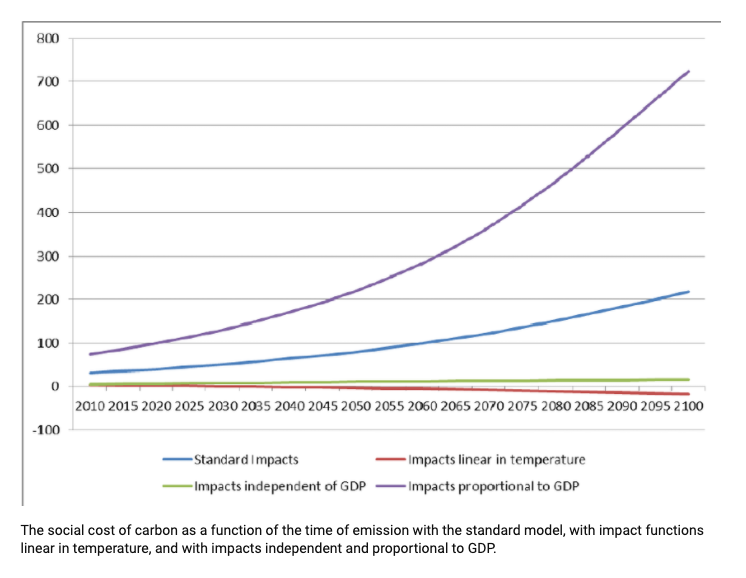
In addition, anyone with net assets of over $30M and corporations should pay a minimum tax of 20% on net income, while income tax should be zero for those earning less than $100 000 per year, encouraging those who work hard and actually make the economy and the world function. Earning money on money adds little or no value to society. In fact, it has become at its worst, a form of predation on the poor with extortionate, near mafia level interest rates, charges, penalties and the like.
Collaborative — Hierarchies, under the right circumstances, can perform useful functions, if the problems they are designed to solve are obvious or complicated- for example, designing a car. When things become complex or chaotic, however, then hierarchies are too slow and unable to handle the complexity of the situation. Brittle hierarchies eventually break, whether it is the USSR in 1990, S Africa’s apartheid regime, or IBM’s old mainframe business which nearly bankrupted it. But they can and do last a long time and cause a great deal of damage.
Most business organizations have flattened their hierarchies from more than twelve to somewhere around seven levels of management between the board and the front-line workers in the past 40 years. Even the military has adopted collaborative team-based problem solving approaches for combat, within it’s still very present, traditional hierarchical. command and control structure.
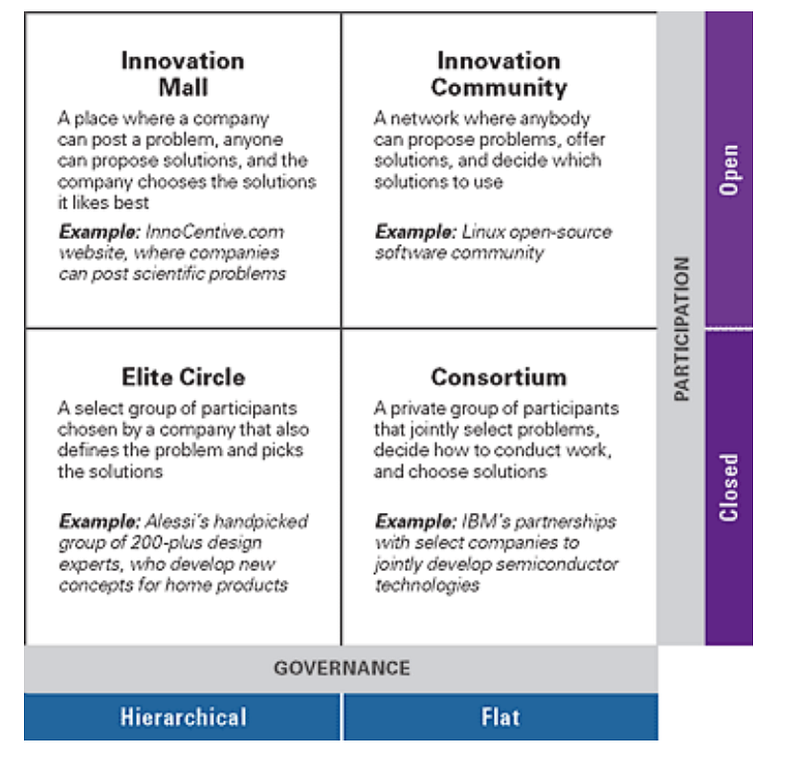
Open innovation and open source have become popular for solving specific kind of problems. The many benefits of a collaborative team and organization include: better problem-solving; people learning from each other; productivity rates go up; team collaboration increases an organization’s potential for change; remote teams are more efficient; wellness and engagement improve; a positive workplace atmosphere is created; and collaboration helps organizations attract top talent. The new leaders in innovation will be those who can understand how to design collaboration networks and how to tap their potential.
Design and innovation are both crucial to creating thriveable and desirable futures, yet if they occur in contexts that are too narrow (or “siloed” i.e. in narrow silos of activity or disciplines), they run the risk of being difficult or impossible to implement in the face of highly complex, interconnected challenges, also known as “wicked problems”.
Most of the big problems we face as a species are now wicked, given the success we have had in solving simple and complicated problems of meeting our basic, biophysical needs. This “success” has also now resulted in planetary overshoot driven by greedy elites and huge middle-classes wanting more all around the world.
So the really difficult challenge is: how can we transcend silos and encourage systemic, integrated thinking and actions in human systems at different scales so that we have a chance of arriving at a desirable, thriveable future for all stakeholders? And do this in ways that encourage natural emergence rather than pre-given prescriptions of exactly what “should” happen. We are working, after all, in the realm of complex, messy human systems and not designing merely complicated bridges or nuclear submarines.
Complex social problems and opportunities take collaboration to a different level. For organizations, collaborative advantage is the ability to form effective and rewarding partnerships with other organizations, for mutual benefit. Being a good partner is a key corporate asset, or capability, for any business, civil society or governmental organization. The only sustainable, collaborative edge in the future will come from accelerated capability building — creating the conditions to enable people to learn faster by working together, building communities of practice and coalitions to drive learning and performance improvement. Deep personal relationships are a key to driving capability building.
If we are to transition from Game A to Game B without a life and death struggle, we have to deepen the understanding of ourselves and each other and build the trust that enables us to learn and enjoy each other’s presence in safe spaces. This is at the core of the concept and lived experience of thriveability, which I coined in a speech I gave over a decade ago:
“Thriveability — In conscious living systems such as human beings, thriveability includes the sense of the flourishing of oneself and all life, together with the ability to engage purposefully in life and work through meaningful relationships, along with a sense of accomplishment for one’s positive contributions to the world.”
Each of us can thrive when we are part of a larger whole that is flourishing. When we are in a nurturing place that helps us realize our full potential, we can also make a much greater contribution to the health of the whole system we are a part of. As it is in the nature of living systems to evolve and transform, healing ourselves and the wholes we are a part of is a synergistic process that can positively transform how our world works for all life. For this, we need to practice relational amplification, not just “connecting” or “reaching out”.
The “Future Glue” that integrates the six core biophysical and psychocultural capitals/flows into social and business models that lead to a regenerative, distributive world-system, comprises Relationship and Intellectual/Knowledge Capitals. Through the trust we build through our networks of relationships, and the ideas and initiatives we co-generate, we make good happen and shift our world and ourselves into a more thriveable future through synergistic innovations.
Coalitions of businesses, civil society and governments (from local to national/regional) are also essential to resolve the wicked problems we face in the exit turbulence of Game A. If we are to arrive at outcomes that work for 100% of humanity, we need to bridge the gaps between different forms of governance. Our friends at Unstitution are doing great work in this area, and it is a privilege for the Balancer to be partnering with them. As they put it on their Linked-In page:
“Unstitution’s mission is both global and local, to build binding coalitions across civil society, business and government sectors, helping to shape the robust interdependent relationships needed to gain traction tackling complex societal problems that are falling between the cracks.
Many of our systems at local, regional and global levels are broken and there is a need for change that can scale across multiple locations, through learning and adaptation, using the co-creative power of binding coalitions.
We are well underway building a distributed global WorkNet of capable values-based practitioners, content experts, institutional partners and emissaries equipped to help activate our Evolutionary Navigation System anywhere in the world, wherever the need and readiness to proceed, is greatest.
We have a core set of modular and adaptable methodologies to build coherent agency in ways that are practical and accessible for multi-stakeholders, whereby people get unstuck and work together in coalitions toward targeted social, environmental and economic mission-critical deliverables.
Although our foundation has its roots in decades of experience, we are consciously choosing to build out Unstitution in some unstitutional ways. We are discovering as our WorkNet grows, that there are many unstitutionalists out there seeking to be the change they want to see in the world. Our approach makes space for #MessyHumanness and #DancingWithMonsters; we use some metaphors and plain language to cut through, make concepts understandable and level the playing field.”
Coalitions have loose-tight, antifragile properties if put together and operated in the spirit of Game Be. They’re antifragile because they evolve and grow from disorder, and thrive on complexity and change. They’re loose-tight because they’re tightly aligned on Game Be values and visions and loose on structures and processes. This creates semi-permeable membranes between organizations and individuals that lets mission critical information flow freely, while ensuring that the autonomy and privacy of individuals and organizations is respected.
In Game B, we learn to embody and integrate the heart-centered “Uplink” principle, along with the head-centric “Upthink” principle and the hands-centric “Transactivate” principle, as outlined in Part 1 of this series.
Multi-capital — The “Thriveable Transformation Journey” is an operating system for transformation. There are three key ingredients in this model. The first ingredient is a map, a very comprehensive map, of everything that’s currently being done to move from Game A to Game B in communities, healthcare, education, employment, food, homes, cities, logistics, design, strategy, and more, much more.
But unfortunately, we’re often putting a band-aid on the deep wounds that we’ve created and we’re treating symptoms, not causes. We have to focus on each of those pathways and the desirable outcomes, which involve a stream of interrelated decisions that have an impact on one and generally many more aspects of our lives and work.
These areas of impact are called “Capitals.” And today, the leaders of the world and the leaders of the banks, insurance companies, corporations, and governments are framing their impact around the metrics that these “capitals” measure.
But isn’t capitalism the problem!? No, the fundamental problem is not capitalism itself. The fundamental problem is the way in which we’ve distorted that system, a system that should be for the benefit of all and not the benefit of a few. There are six “Pathways of Thriveable Transformation” to ensure the survival of our species and our future thriving.

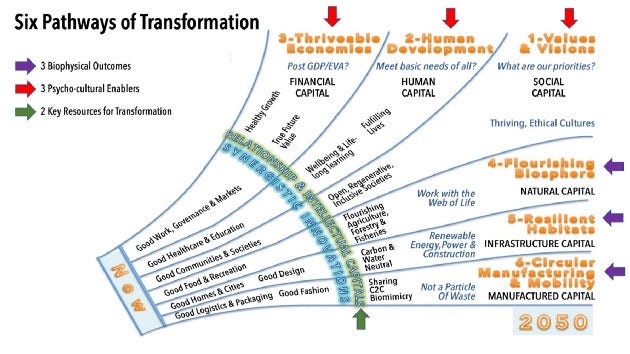
The first three pathways are critical “bio-physical outcomes,” and we have to simultaneously work on the three “psycho-cultural enablers” that will accelerate the good work that’s already being done in those areas.
The bio-physical pathways involve “Natural Capital,” “Infrastructure Capital,” and “Manufactured Capital.” And the outcomes we absolutely have to have in place soon, start with Natural Capital. We need a flourishing biosphere. We need to work with the web of life for flourishing agriculture, forestry, and fishing, and for good food and recreation.
In turn, we need resilient habitats. And our habitats have built infrastructure that requires renewable energy, power, and construction that is carbon and water neutral. So that we can have regenerative homes and cities and regenerative design.
The third key biophysical outcome that’s needed for the survival and thrival of our species is “Circular Manufacturing and Mobility”. Manufacturing literally produces all the stuff that goes into our resilient habitats, made of “Manufactured Capital.” And the key thing is we need to accelerate the trends of the sharing economy, cradle to cradle, biomimicry so that there’s not a particle of waste in the next few decades when we make things- and that good logistics, packaging, and good kinds of fashion that are recyclable, become the norm. Along with shared, electric and hydrogen powered mobility and transport, so that all vehicles, airplanes, and anything that gets us from “A” to “B” can become a shared form of low-carbon mobility.
Now those are very real and very important goals. There are pathways to all of those goals. So the question is what’s blocking us psycho-culturally, behaviorally, from realizing this transformation?
In order to generate those three critical “bio-physical outcomes,” we have to simultaneously work on the three “psycho-cultural enablers” that will accelerate the good work that’s already being done in those areas.
First of all, we need to re-order our priorities. We need to begin to work on developing thriving, ethical cultures that generate open, regenerative, inclusive societies. Which means that we can all live in healthy communities.
That in turn, enables us to focus on human development as a top priority of political and economic strategy. And human development today means meeting the basic needs of all people and helping everyone realize their full potential, their “Human Capital.” And that involves at the very first good health care and education.
That then enables wellbeing and lifelong learning for fulfilling lives for all of us. Sounds like a dream, but it’s already happening in many countries in the world. The key enabler is a thriveable economic system that doesn’t just measure gross domestic product.
And so “Financial Capital” has to be steered towards regenerative outcomes so that we have healthy growth. And that we have regenerative work, governance, and markets. Now, the future glue that holds all of this together is the synergy between relationship and intellectual or “Knowledge Capital.”
To synergize social capital, we need to appreciate how it is formed through a mixture of all the other capitals that it is made up of: human, relationship, intellectual, infrastructure, manufactured, natural and financial. And also appreciate how this melange creates different kinds of value for different kinds of people.
To make good happen in a Game B world, we must design our organizations, products, networks, and social institutions as autocatalytic, self-sustaining interactions between these eight key capitals, in regenerative, distributive ways. We can use the six pathways to 2050 as a map to help position where we are and the next steps we must take on our respective journeys toward good.
That might sound overly complicated, but on a day to day basis, we are already intuitively equipped to do exactly that- we know how important our relationships with our friends, family, and colleagues are; we also know that our reputation and that of those we associate with is key for our continued success personally and professionally; and we are also well aware that we can use money, technology, infrastructure and knowledge to make our lives work better.
The Great Transition from Game A to Game B
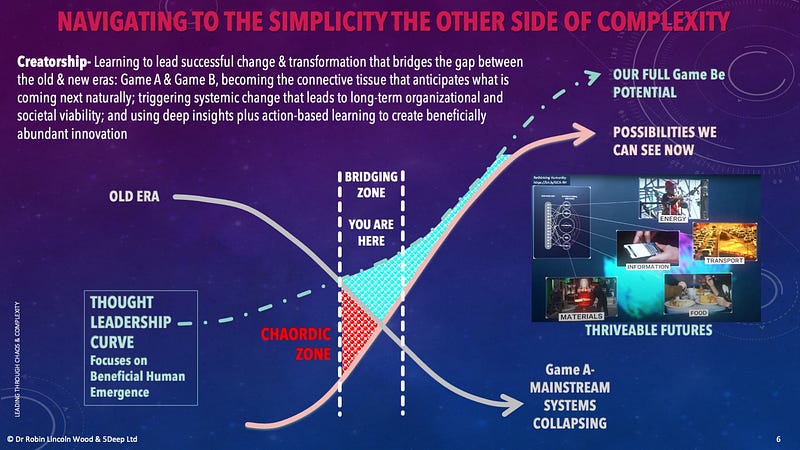
Transitions always involve periods of social chaos and heightened violence due to disorientation and the breakdown of the old system. Corruption, moral decline, and inefficiency appear to be signal features of a system's final stages.
The growing importance of technology in shaping the evolutionary logic of power/action and love/care has led to history accelerating, where each transition happens faster than the last. The chaordic zone in the exit turbulence of modernism is a crucible in which hundreds of millions are making a momentous leap into worldcentric and kosmocentric levels of mindsets, paradigms, and consciousness.
Being a leader of change and transformation is a seriously tough job. Stress levels and personal sacrifices have never been higher. We’re here to help resolve some of those difficulties to ensure you can master those challenges and feel energized, fresh, and ready for action, through a free online mini-course.
Right now, right around our planet, people are developing worldcentric, systemic perspectives and capabilities that can not only resolve most of the challenges we currently face — they will also transform our species and what it means to be human.
Imagine a world powered by renewable energy, where all human beings thrive in resilient habitats; where businesses operate in a circular economy that regenerates natural capital, without a particle of waste, led by enlightened leaders whose goal is to maximize the thriving of all stakeholders; where each individual is empowered to pursue their passion and make a living in service to others; where governance systems are transparent, effective and wise in the ways in which they deliver their services to their communities and populations; and where intercultural appreciation and insight enriches the exchanges between the diverse worldviews and cultures embraced by humankind.
Does that sound like an impossible dream? Every single one of these “pockets of the future” is currently observable in the present, right here and right now, somewhere in the world.
This series of articles offers a guide for those who wish to understand and take part in this global transformation, showing us how to connect and align with the pockets of the future in the present that will become a mainstream reality for most of us by 2030. You will also discover the roots of the rapidly growing regenerative, distributive economy, along with the emerging social and political systems that can ensure a thriving future for us all, and a flourishing biosphere for all life on earth.
Coda- Thanks for reading this far. If you’ve enjoyed this article, please clap as many times as you like and share widely. Every Monday in the Global Change Agent club, we gather to explore topics related to making the transition from Game A to Game B more effectively, smoothly, and elegantly — including 15 November 2021- join us if you can.
Being a leader of change and transformation is a seriously tough job. Stress levels and personal sacrifices have never been higher. We’re here to help resolve some of those difficulties to ensure you can master those challenges and feel energized, fresh, and ready for action, through a free online mini-course.
This article synthesises the 4 part series “Being Game B”, and provides an overview of my 42 articles here on Medium and 8 books about living a Game B life in a Game A world — and how to make the transition to a regenerative, inclusive, collaborative, multicapital world.