
The Great Disappointment

Preparing boys for the inevitable disappointments in life is one of my main objectives in writing ‘The Hero in You.’
It seems surprisingly preordained that concurrent with this work, I myself am preparing for the possibility that the book will never get published. This would be the fourth one that ends up in the trash heap of obscurity.
How will I deal with this blow?
My reaction will either make my advice a grand hypocrisy, or one of the most valuable lessons I can teach boys. So, either I walk the talk, or join the ranks of the impostors and charlatans.
Disappointment is the displeasure we feel when our hopes or expectations are not fulfilled, like not getting that desired promotion or raise, never marrying the ‘woman of our dreams,’ our kids never making honor roll or achieving much in life, never getting to travel to exotic destinations, or never becoming rich or famous.
The logical inference would then suggest that absent hope or expectations we would never feel the sting of disappointment.
But can we live without them? What if we separated the two?
Does it make sense, say, for me to hope that my book gets published but not expect it will? In other words, “hope for the best but expect the worse?”
Might the pleasure I derive from writing the book in the present and the feeling of elation I actually feel when imagining it in the hands of millions of boys, offset the displeasure I alternately experience when imagining its failure?
This ability to imagine future scenarios and actually feel the emotions we project we will feel if those scenarios materialize is an evolutionary adaptation exclusive to humans. Our capacity for foresight makes us both prudent and optimistic.
But in this exercise, we often exaggerate and bowdlerize. If we imagine ourselves poor, for example, we picture ourselves sleeping under a bridge in the dead of winter and never once consider the calm and serenity an unencumbered, simple life might afford us. We fantasize driving a red Ferrari down the French Riviera, but edit-out the cost, not only in coin, but in the stress and toil inherent in its acquisition. Or we bask in the imagined glamor of our hoped-for fame and celebrity status but ignore the fact that we will never be able to enjoy another undisturbed moment in solitude.
We also ignore that the person feeling the elation of future rewards or the dread of unwelcome events will not be the same person when the future arrives. What you desire or fear right now will most likely not be the same, ten, or twenty years from now. You’ll change. That is, unless you never evolve as a human being. Isn’t it deliciously ironic how many people spend a third of their lives accumulating stuff, another third worrying about their stuff, and the last third trying to get rid of it?
These thoughts bring two aphorisms to mind:
“There are only two tragedies in life: one is not getting what one wants, and the other is getting it.” — Oscar Wilde
and this Chinese curse:
“May you find what you are looking for.”
I’m also reminded of this poem, by Rumi:
Who makes these changes? I shoot an arrow right. It lands left. I ride after a deer and find myself chased by a hog. I plot to get what I want and end up in prison. I dig pits to trap others and fall in.
I should be suspicious of what I want.
What exactly is the sting I feel when I imagine my book never seeing the light of day?
A diminished sense of self-worth. The sense that all will be lost… that if I don’t become a published author there will be nothing left for me to do. That I’ll be judged a failure…
I’ve been there before.
Twenty years ago I lost everything I worked hard to build. Not only was my sense of self-worth diminished, it crumbled altogether. It was inevitable because it was built on the quicksand of status, wealth, and external approbation — weak foundations against the whimsical nature of fortune. A defective condom, if you will.
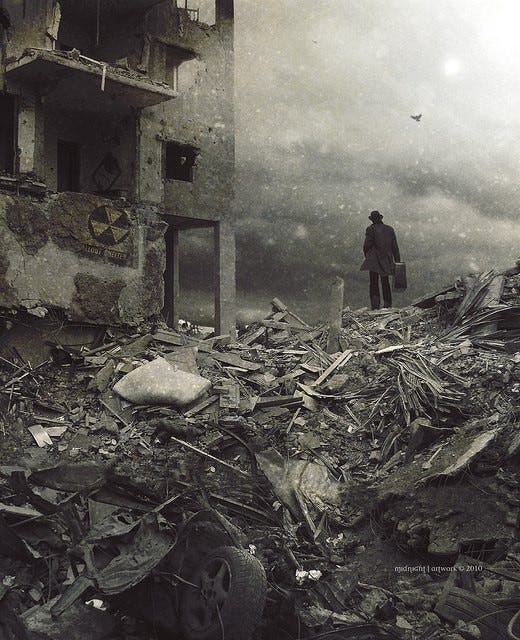
Man builds on the ruins of his former selves. When we are reduced to nothingness, we come alive again. — Henry Miller
In Greek mythology, the Goddess Fortuna represented life’s capriciousness, often depicted holding a ship’s rudder on one hand and a horn of plenty in the other. One day she lavishes great rewards upon you and the next she upends your life and steers it in a totally different direction. Those who lost most of their wealth in the 2008 market crash know this well. I’m afraid it’s only a matter of time until it happens again.
No man, said Roman philosopher Seneca, has been shattered by the blows of Fortune unless he was first deceived by her favors. A day without food for a person in the industrialized West feels like a calamity, while for millions in poor countries it’s just an ordinary day. Might it be true that the truly poor are those who fear poverty?
Seneca never trusted Fortune, even when she seemed to offer him peace. All the gifts she bestowed on him — money, status, influence — Seneca relegated to a place whence she could claim them back without bothering him. “I kept a wide gap between them and me,” he said, so that when she took them away it did not feel crushing.
Wealth, status, and influence never defined Seneca as they did me. I did not keep a wide gap between them and my identity. Once gone, I was hollowed out, empty of meaning… adrift and disoriented.
I did not know then that changing the script from a tragedy to an adventure was simply a matter of how I oriented myself to the moment, i.e. my reaction, or narrative. “The difference between despair and hope,” says philosopher Alain de Botton, “is just a different way of telling stories from the same set of facts.”
When Zeno, the founder of the Stoic school of philosophy, lost all his possessions in a shipwreck, he shrugged it off saying fortune was bidding him to be a less encumbered philosopher. What he meant was that he hadn’t lost wealth, but distractions. He focused on what he gained, not on what he lost.
Ignoring this simple trick, I wallowed in tragedy for many years and missed the gifts Fortune was offering me by moving the tiller of my life. It was only much later that I realized that she was giving me exactly what I needed, not what I wanted.
I realized that the feeling of being a loser was caused by having adopted someone else’s measure of success.
That I had defined myself narrowly by what I did, or had, rather than by who I was.
That I had bought-into the precepts of meritocracy, fully owning my successes as well as my failures, and never once allowing for the role of fate, accident, or misfortune to temper the crushing sense of defeat and ensuing shame. Since then, I’ve learned to not use the word “loser” but “unfortunate”.
I discovered that most of my decisions were driven by envy which is why even my victories had a weird taste of failure.
That the feverish pursuit of material rewards were masking deep emotional needs which can never be met by more stuff.
That being busy is not the same as being fully alive.
Now I know.
While I still hope the book will get published, it is a hope tied not to material rewards but to the difference I know it can make in the lives of millions of troubled boys. I am serving a cause greater than myself.
Its failure will surely ruffle my feathers but won’t leave me denuded. I will not allow the anxiety of its probable fate to sully the enthusiasm I have felt while writing it. I have dared, and dared greatly, which is more than most people can say. My defeat will have a wonderful taste of victory and I will have a wonderful tale of adventure to tell my grandchildren.
My identity will remain intact, because I don’t define myself as an “author” but as a “storyteller” who is simply trying to make a tiny part of the universe a little better and make people enjoy life a little more. This flexibility will allow me to adapt to whatever fortune has in store for me. “After all, one doesn’t sing because one hopes to appear one day in the opera,” said Henry Miller, “one sings because one’s lungs are full of joy.”
I won’t consider myself a bad storyteller if things don’t work out because I know the role luck, chance, or timing play in our lives.
My identity is now securely anchored on intrinsic ground. My very own, not someone else’s. I have defined my own standards of what it means to be successful so no longer follow external guideposts, which, by the way, keep shifting all the time. I’ve become, so to speak, my own, unwavering lode star.
My journey has no particular endpoint. I chart my course on the basis of what I like, not what I want, knowing full well that my wants and desires will change over time.
I will sail through storms and calm waters with equanimity, neither hoping for one or the other, knowing that both victory and defeat are what make the human adventure so exhilarating.
Our universe is like one ginormous, never-ending fireworks display. An enchanted story of beauty and creativity as well as extreme violence and destruction. That’s what makes it such a good story. A fairy tale without thunder and lightning, or without epic battles or fiery dragons, would not be a good story no matter how pretty the princess is. Life without struggle would be as boring as playing Monopoly or watching paint dry. — From Chapter 1 of ‘The Hero in You.’
At the end, I want to echo what Hunter Thompson once said, that “life should not be a journey to the grave with the intention of arriving safely in a pretty and well preserved body, but rather to skid-in broadside in a cloud of smoke, thoroughly used up, totally worn out, and loudly proclaiming “Wow! What a Ride!”
One can only hope.
Join my mailing list to receive updates of my journey.

Thanks for reading the Real Life Resilience publication
For more resilience-related content listen to the Real Life Resilience podcast on iTunes, Stitcher, Google Play, or directly from the website. We also have fabulous short videos on the Real Life Resilience YouTube channel.

If you enjoyed this story, please recommend 👏 and share to help others find it!