
The Great Balancing Act of Climate Advocacy
Addressing both individual actions and the systems that perpetuate climate change
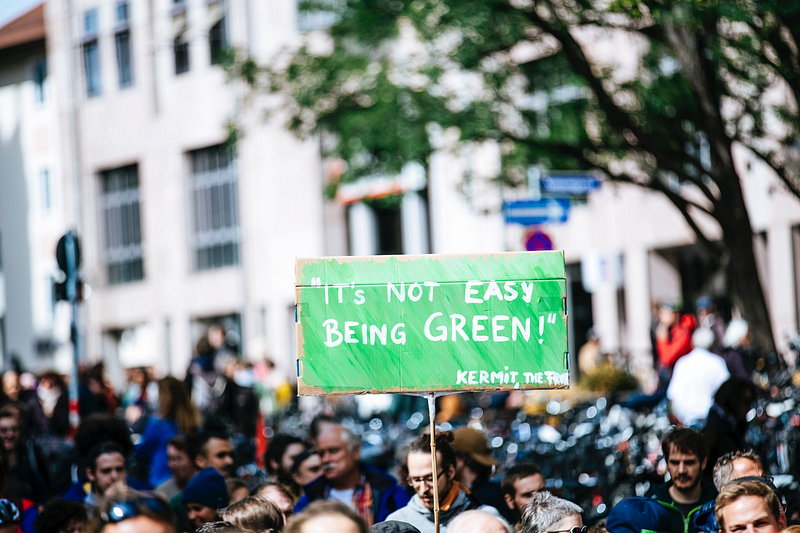
To those of you who feel the urgency of climate change yet see those earnest sentiments so often dismissed, you are not alone. To those of you who are overwhelmed by the sight of ever-increasing buckets full of trash being dumped out onto the planet for every gum wrapper you pick up, you are not alone. And to those of you who have tried to make lifestyle changes yet feel ashamed by the smallness of what is actually feasible within your regional and economic constraints, you are not alone. It’s not easy bein’ green.
The sad irony is that our efforts to be more sustainable are themselves unsustainable as long as entire socioeconomic systems are built on models that generate the greatest amounts of short-term profit and gain. Unfortunately, these fossil fuel powered systems that benefit, above all, the wealthy and powerful are not going to sustain us for long.
Our individual actions towards climate mitigation are important. But we also need to recognize that there are constraints to how much each of us can do within our current social structures. In The Great Derangement: Climate Change and the Unthinkable by Amitav Gnosh, the author writes about the dangers in framing climate change as a “moral issue.” He writes:
For if the crisis of climate change is to be principally seen in terms of the questions it poses to the individual conscience, then sincerity and political positions will be judged. This in turn will enable “deniers” to accuse activists of personal hypocrisy by pointing to their individual lifestyle choices. When framed in this way, authenticity and sacrifice become central to the issue, which then comes to rest on matters like the number of lightbulbs in Al Gore’s home and the forms of transport that demonstrators use to get to a march (p. 133).
Falling prey to the neoliberal trends of individualism is counterproductive when it comes to something as large-scale as climate change. Tackling climate change takes the collective effort of everyone. It will require dramatic societal transformation, which will in turn create a new, sustainable norm to which people have no choice but to adapt. And here’s the good news. People are incredibly good at adapting, especially when their lives and their children’s lives depend on it.
In a New York Times article titled, “How to Stop Freaking Out and Tackle Climate Change,” columnist Emma Marris writes, “As long as we are competing for the title of ‘greener than thou,’ or are paralyzed by shame, we aren’t fighting the powerful companies and governments that are the real problem. And that’s exactly the way they like it.”
This is all a very important reminder that transformation towards a brighter future must take place at a systemic level. We need to focus on the systems that envelop us, not simply on individually becoming “perfect” environmentalists. But — and this might sound like I’m contradicting myself — this large-scale transformation often starts with a lone individual acting and speaking truth amidst a current of opposing opinions. Greta Thunberg is an example of someone whose small actions have led to something greater, eventually inspiring an environmental movement that has mobilized millions of people worldwide.
Individual action and systemic action go hand in hand. We need to find ways to balance the two.
In a recent TED Talk, Chris Anderson and Christiana Figueres introduced a new global climate campaign called TED Countdown. During the Q&A session, an attendee asked: “Are individual efforts, like ditching plastic straws or going vegan, making a difference, or are they just tokenistic drops in the ocean?”
Figueres gave the following answer:
They are totally important. Absolutely important. Because it’s not just about the one straw that I use. It’s about me not using that straw, going to a restaurant and telling the waitress, “Excuse me, I don’t want a plastic straw, because — ” and giving her a little lesson, then she goes up to the manager, the manager comes to the table and says, “Excuse me, could you explain that to me?” Then you go through the lesson. And sooner than you think, you have that restaurant, plus the other ones. Actually, information is contagious. And wanting to do the right thing is also contagious. So don’t look at it as just simply, you know, “What is a straw? Am I using the straw or am I not using plastic bags, I have my plant-based bags to go shopping,” etc., etc. All of that counts. It counts for you, first of all, because it is a personal reminder of who you are and what you stand for. But it is also a very important tool to educate everyone around you.
The little actions matter, too, because they inspire others and remind us of our values and priorities as we advocate for larger, societal change. It’s not easy bein’ green. But in the process of it all, let’s not shame ourselves (or others!) for “not doing enough.” And let’s not lose heart over the seeming smallness of our actions. Individual actions are necessary for systemic change that can, in turn, shape individual and corporate activities worldwide. Every victory we experience in caring for our homes on this planet, whether big or small, is worth celebrating.