The Great (and weirdest) Escape
The modern dinosaur is not the greatest flyer. Ours have always preferred to spend their time on terra firma, expending their energies on seeking out food and bullying comrades lower down the pecking order. But they have wings and they can fly.
Not Natural Escapees
Now and again one of our dinos will bounce out over the fence to explore the garden — it’s more of a bounce than a flight; they’re not natural aviators.
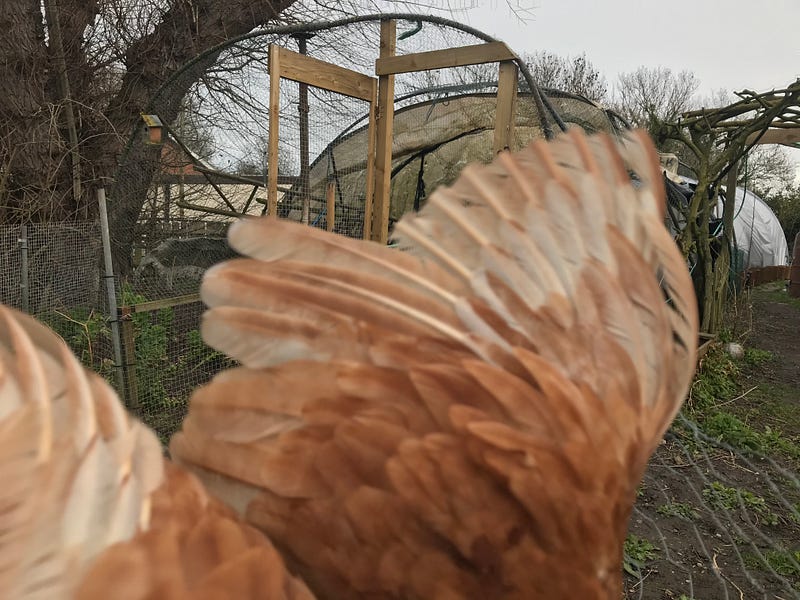
Ex-battery hens are not natural escapees. One rattle of a bucket and the escapee will race back clamouring to be let in. That is, she will crowd the fence, making ineffectual dashes back and forth, squawking in protest that the rest of the flock might get goodies that are out of her range, and that no, she can’t possibly find her way to the now-open gate, all the while apparently forgetting that she has a working flight-suit attached to her back.
Ex-Battery Hens Act Differently
The ex-battery hens we’ve had over the years behave differently from the Orpingtons and bantams who have joined the flock from time to time. These arrive usually as pets whose owners can no longer look after them, and we provide a forever home. If the non-battery birds decide to roam, they hop back and forth over the fence, and if they decide to hide, no amount of bucket rattling or cajoling will get them in.
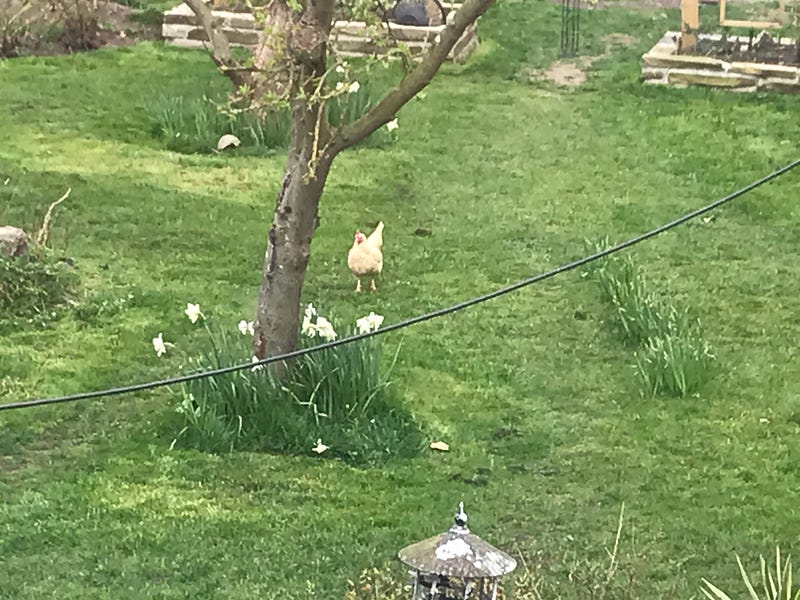
These hens, in our experience, know how to hide. If one of them decides to build a nest, she can become as invisible as though she has stepped through a sci-fi portal to another world. We’ve had several over the years who have nested in hidden corners (or maybe in another dimension) and only emerged once they had a bundle of fluffy balls crowding along behind them.
In the days we had a cockerel running with the flock, we provided safe nesting areas, but they seem to take the view that they’ve been around for millions of years longer than we have, so what would we know? And I guess they have a point.
Strategies For Predators
I’ve yet to see a mother dino at a loss for what to do if a potential predator comes close. If caught out in the open with her family, she employs one of two main strategies; the first is to call the chicks beneath her, sit tight, and invite the predator to get within range of the pickaxe she keeps attached to her head; the second is to instruct the chicks to scatter while she proactively makes use of her pickaxe to drive the predator away.
None of this applies to the rescue dinos who have always made up the bulk of our flocks. Ex-battery birds rarely sit on eggs, and the few times they do, they lose interest long before anything can hatch. I have heard of other people’s ex-battery hens hatching eggs, but it’s never happened to us.
Their attitude to predators is different too. Years ago, I saw an unexpected meeting between a German Shepherd and a flock of ex-battery hens. They were all racing for the same set of scraps. The dog was taken aback at the temerity of the flock that simply piled in, showing no sign of respect for this fierce predator, and it backed off. I’m not even sure the hens noticed it.
A Mass Breakout
Back to the escape; the ex-battery hen is no aviator. It prefers to walk through a gate rather than fly over the top, and to climb a ladder to its night-time roost, but it doesn’t lack ingenuity.
One of the reasons we don’t give our hens free range around the whole garden is that they use their feet as mini rakes and can clear the topsoil from a newly planted bed or upend a box and empty it out in no time at all, but it is always good to see ex-battery hens raking the ground. Many of our early rescues arrived with no idea how to do that.
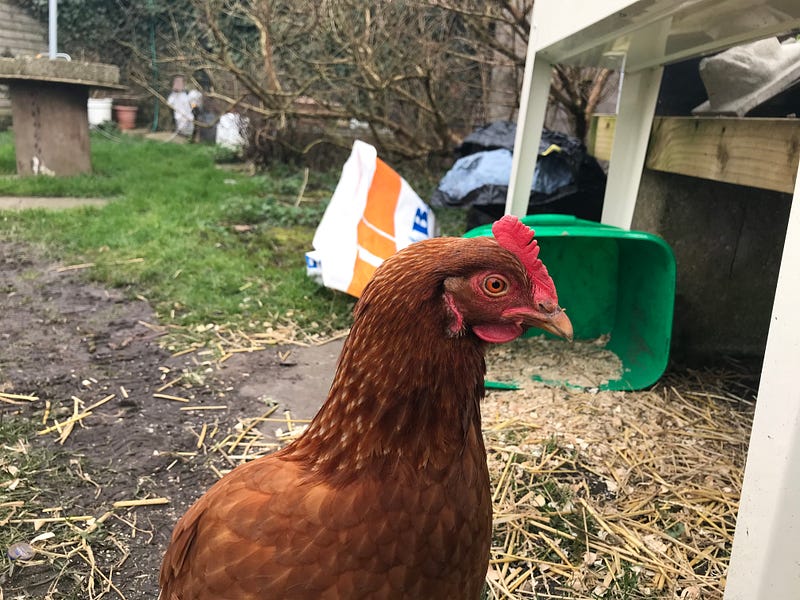
Our latest lot, having come from an organic free range farm, had no trouble using their rakes and have been redistributing material all around their run from day one, but a couple of weeks ago we started to see a group of them concentrating on an area of ground by the fence. We wondered what the attraction was of this particular stretch but could see nothing to account for the dedication with which the small group set about their work every day.
Then one morning, I took advantage of unexpectedly sunny weather, made myself a cup of tea and took it out to enjoy in the garden.
I was faced with a mass break out. Sixteen mini-dinosaurs were hard at work in the seed beds by the apple tree. They’d raked out soil and seeds, spread everything across the lawn and were settling in to eat their fill.
The odd one getting out, I’m used to, but sixteen at once was new. It didn’t take long to recapture the escapees. I opened the gate of the run, rattled a bucket and walked up and down the fence showing each of them in turn that flapping and squawking did no good, no matter how histrionically done, and that the open gate was the way in.
‘What made you all fly out?’ I asked, as I hadn’t immediately got it.
One of them obliged by racing to the stretch of fence where they’d been raking assiduously for days, and ducked underneath.
I picked it up, dropped it back over the fence, and jammed a plank of wood across the hole, before returning rather crossly to my now cold cup of tea.
An Unlikely Escape Committee
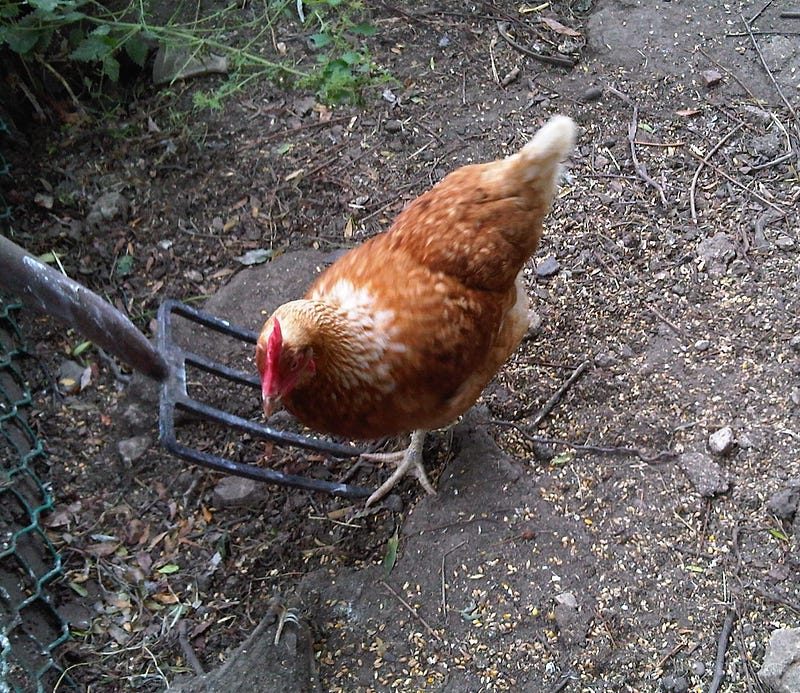
These creatures have wings — operational wings. They haven’t been clipped. They’re never going to migrate over vast distances or roost in trees, but for short hops (say, over a low fence) their wings are tailor-made for the job. Yet they formed an escape committee and spent several days tunnelling out!
This is the weirdest set of rescue dinos we’ve ever had.


