avatarAki Järvinen

Free AI web copilot to create summaries, insights and extended knowledge, download it at here

3558

Abstract

55058_The_virtual_reality_hardware_acceptance_model_VR-HAM_Extending_and_individuating_the_technology_acceptance_model_TAM_for_virtual_reality_hardware">paper by Kerry Manis and Danny Choi</a>, the authors aim to extend and focus the TAM model into VR hardware adoption. They introduce ”Curiosity” and ”Perceived enjoyment” as constructs specific to the case of VR, among other more common ones:</p><figure id="bd73"><img src="https://cdn-images-1.readmedium.com/v2/resize:fit:800/1*RamRqdB5n_MZWRJ8hC8F8Q.png"><figcaption><a href="https://www.researchgate.net/publication/328255058_The_virtual_reality_hardware_acceptance_model_VR-HAM_Extending_and_individuating_the_technology_acceptance_model_TAM_for_virtual_reality_hardware">Source</a></figcaption></figure><p id="eb5f">Manis and Choi collected close to 300 responses to a survey that mapped ”beliefs, attitudes and intentions associated with VR hardware”. They found a strong relationship between usefulness and ease of use and consequently perceived ease of use as a positive predictor of usefulness.</p><p id="8638">On the other hand, as we mention in the podcast, ”usefulness” comes across in the paper as almost neo-libertarian take on increased productivity and efficiency rather than a construct that also covers less quantifiable intentions and motivations, such as seeking something novel or entertaining.</p><p id="562d">If we relate usefulness back to the Steam graph and assume that the spike is largely a result of Valve’s announcement of the <a href="https://store.steampowered.com/app/546560/HalfLife_Alyx/">Half-Life: Alyx</a> game, we see that usefulness equals “promise of highest production value game entertainment, based familiar franchise”.</p><h2 id="01fd">Seven constructs of VR as “emerging technology”</h2><p id="4586">In <a href="https://www.worldscientific.com/doi/10.1142/S0219649219500205">another recent paper, Mohanad Halaweh</a> from AL Falah University in Dubai writes about ”META”, i.e. ”Model of Emerging Technology Adoption” and uses VR as a case study. The author argues that TAM and IDT models are not able to capture how people adopt so-called ET i.e. ”Emerging technologies”, such as VR.</p><p id="5523">Halaweh also refers to arguments according to which the models were created in an age (1980s and 90s) when innovations – before social media and Silicon Valley as we know them – largely came from large corporations who were able to control how their innovations communicated to the public, etc. Crowd-sourced VR hardware productions were not possible then.</p><p id="f41d">Halaweh’s emerging technology characteristics include uncertainty, unobvious impact, and non-conclusive research – all elements we can agree still apply to VR. For the META model, Halaweh goes on to identify seven factors that influence VR adoption:</p><blockquote id="fe5e"><p>Network effects</p></blockquote><blockquote id="f0b0"><p>Clarity of impact</p></blockquote><blockquote id="daeb"><p>Uncertainty</p></blockquote><blockquote id="c6c7"><p>Cost</p></blockquote><blockquote id="4201"><p>Maturity</p></blockquote><blockquote id="6ae7"><p>Timing</p></blockquote><blockquote id="b48d"><p>Availability</p></blockquote><p id="107f">This set is intuitive, however, it does not address perceived usefulness or intentions of use. Halaweh explains this in the conclusions: ”META can be used to explain and predict the influencing factors on the decision to adopt ET rather than using the ET itself.”</p><p id="a130">To us, this is a bit of a chicken and egg dilemma; it basically implies

Options

that technology itself would be enough to trigger adoption – without a sense of what it is useful for. We feel that approaches like this end up being highly theoretical propositions. They break the phenomenon down into parts, which helps in discussing the problem, but then what?</p><h2 id="3871">More constructs: Hedonic motivation and social influence</h2><p id="643f">Finally, in the podcast, we briefly touch on a paper that is not about VR adoption but worth mentioning for more context to where the above papers are coming from. <a href="https://www.semanticscholar.org/paper/Consumer-Acceptance-and-Use-of-Information-the-of-Venkatesh-Thong/512dd3c7e1b55786e6f918bd0411ff744bb4cf62">Venkatesh, Thong, and Xu</a> in 2013 argue for ”Extending the unified theory of acceptance and use of technology” and introduce more nuanced constructs, including hedonic motivation and social conditions:</p><figure id="0528"><img src="https://cdn-images-1.readmedium.com/v2/resize:fit:800/1*lXYTT6ryMt1xF9Djaacy6Q.png"><figcaption><a href="https://www.semanticscholar.org/paper/Consumer-Acceptance-and-Use-of-Information-the-of-Venkatesh-Thong/512dd3c7e1b55786e6f918bd0411ff744bb4cf62/figure/0">https://www.semanticscholar.org/paper/Consumer-Acceptance-and-Use-of-Information-the-of-Venkatesh-Thong/512dd3c7e1b55786e6f918bd0411ff744bb4cf62/figure/0</a></figcaption></figure><p id="c917">Nevertheless, we feel that none of the models discussed here quite find a balance between adoption, the notion of ”usefulness”, and a user-centred approach sensitive to a broad spectrum of intentions and motivations. Manis and Choi echo this in their conclusions:</p><blockquote id="ea0c"><p>While VR hardware can be improved for functionality, the VR industry must also simultaneously refine and develop more relative content to increase the usefulness of VR in general and VR hardware in particular.</p></blockquote><p id="d52d">However, they use the word ”content” to imply that VR is just another platform to channel content, rather than the next computing platform - one that would not need a ”killer app” because the medium in itself is the killer app.</p><p id="3872">Perhaps it is when a technology implies such a paradigm-shifting promise, its potential is especially difficult to capture into a set of predictive constructs, to a satisfying result.</p><h2 id="a0da">Takeaway: Take off the headset, step back, and reflect</h2><p id="1f46">Whether the spike in VR gaming is triggered by the increase in perceived usefulness, decreased cost, network efforts via social media, or a single game announcement, it still seems likely to be a blip within a homogenous niche of gamers and early adopters in the west.</p><figure id="70ca"><img src="https://cdn-images-1.readmedium.com/v2/resize:fit:800/1*sS4TGbLs1ob-nbVhw8H4cw.jpeg"><figcaption>See also <a href="https://twitter.com/skarredghost/status/1216461345601851394?s=21">https://twitter.com/skarredghost/status/1216461345601851394?s=21</a></figcaption></figure><p id="5b5e">It is because of this we suggest a general takeaway: technology acceptance studies, while not perfect, do provide a lens through which VR enthusiasts and practitioners can take a step back and reflect on why other consumers are not ”getting it”, and what the timeframe for any major shift in their intentions and attitudes might be.</p><h2 id="6296">If you enjoyed the post, please give a clap or even a few!</h2><h2 id="d50a">LIsten the podcast on Soundcloud, Spotify, or Apple Podcasts.</h2><h2 id="9dac">Follow us on Twitter</h2></article></body>

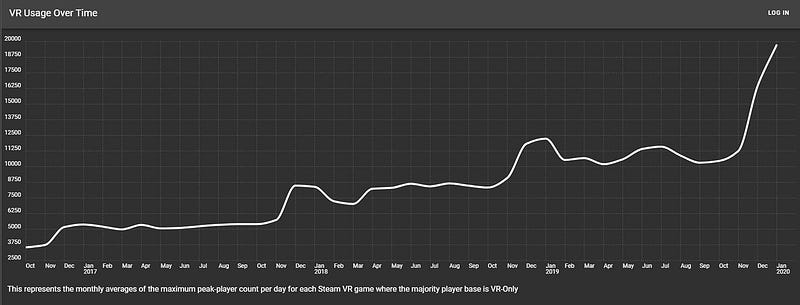
The graph says Virtual Reality usage has doubled over a few months but instead of tea leaves let’s look at technology acceptance models for answers.
https://www.reddit.com/r/virtualreality/comments/ekdavk/guyz_vr_is_dead/

The spike in the graph above indicates that something is going on in regards to intentions and attitudes towards VR and games on Steam, the major digital gaming platform. How seriously should we take this?

To understand the bigger picture, let’s zoom back to how academics, technologists, and analysts have tried to grasp technology adoption. They have modeled adoption rates and innovation diffusions into research instruments, such as TAM (Technology acceptance model) or IDT (Innovation diffusion theory).

In our latest podcast episode, we ask: Can such models explain where we are in VR’s adoption curve?

From TAM basics to three takes on VR acceptance

We tackle the question by discussing three academic papers on the topic. In each, the authors’ set out to define a number of ”constructs” that influence individuals’ adoption of a specific technology. ”Perceived usefulness”, ”Complexity”, ”Relative advantage” to other innovations, and ”Trialability” are among the constructs across the various TAM and IDT case studies.

The models can be applied to look at directions of influence between the constructs, and the strength of these influences. Influence can be positive or negative. For example, age, gender, and experience as constructs might influence ”perceived usefulness” of a technology or its ”perceived ease of use”. In empirical case studies, researchers have studied whether hypotheses about the relationships of the constructs hold true, and how strong or weak their influence might be.

Historically these models have been quite simplistic in the sense that in the original TAM from 1986, F.D. Davis did not take any aesthetic aspects or emotional dispositions into account. The core of Davis’ model has since been expanded to a more human-centered direction, and researchers have also produced models that consider technologies used for other purposes than the pure utility. In the podcast, we discuss how our own motivations and attitudes have influenced our particular uses of VR hardware and software.

Ease of use contributes to perceived usefulness

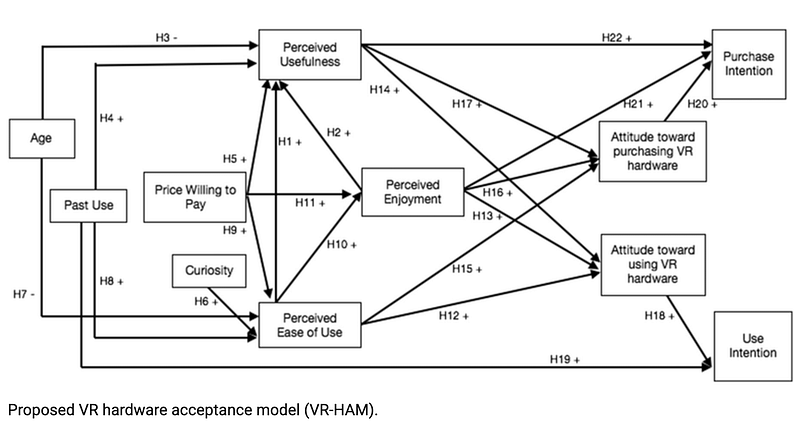
In a 2019 paper by Kerry Manis and Danny Choi, the authors aim to extend and focus the TAM model into VR hardware adoption. They introduce ”Curiosity” and ”Perceived enjoyment” as constructs specific to the case of VR, among other more common ones:
Source

Manis and Choi collected close to 300 responses to a survey that mapped ”beliefs, attitudes and intentions associated with VR hardware”. They found a strong relationship between usefulness and ease of use and consequently perceived ease of use as a positive predictor of usefulness.

On the other hand, as we mention in the podcast, ”usefulness” comes across in the paper as almost neo-libertarian take on increased productivity and efficiency rather than a construct that also covers less quantifiable intentions and motivations, such as seeking something novel or entertaining.

If we relate usefulness back to the Steam graph and assume that the spike is largely a result of Valve’s announcement of the Half-Life: Alyx game, we see that usefulness equals “promise of highest production value game entertainment, based familiar franchise”.

Seven constructs of VR as “emerging technology”

In another recent paper, Mohanad Halaweh from AL Falah University in Dubai writes about ”META”, i.e. ”Model of Emerging Technology Adoption” and uses VR as a case study. The author argues that TAM and IDT models are not able to capture how people adopt so-called ET i.e. ”Emerging technologies”, such as VR.

Halaweh also refers to arguments according to which the models were created in an age (1980s and 90s) when innovations – before social media and Silicon Valley as we know them – largely came from large corporations who were able to control how their innovations communicated to the public, etc. Crowd-sourced VR hardware productions were not possible then.

Halaweh’s emerging technology characteristics include uncertainty, unobvious impact, and non-conclusive research – all elements we can agree still apply to VR. For the META model, Halaweh goes on to identify seven factors that influence VR adoption:

Network effects

Clarity of impact

Uncertainty

Cost

Maturity

Timing

Availability

This set is intuitive, however, it does not address perceived usefulness or intentions of use. Halaweh explains this in the conclusions: ”META can be used to explain and predict the influencing factors on the decision to adopt ET rather than using the ET itself.”

To us, this is a bit of a chicken and egg dilemma; it basically implies that technology itself would be enough to trigger adoption – without a sense of what it is useful for. We feel that approaches like this end up being highly theoretical propositions. They break the phenomenon down into parts, which helps in discussing the problem, but then what?

More constructs: Hedonic motivation and social influence

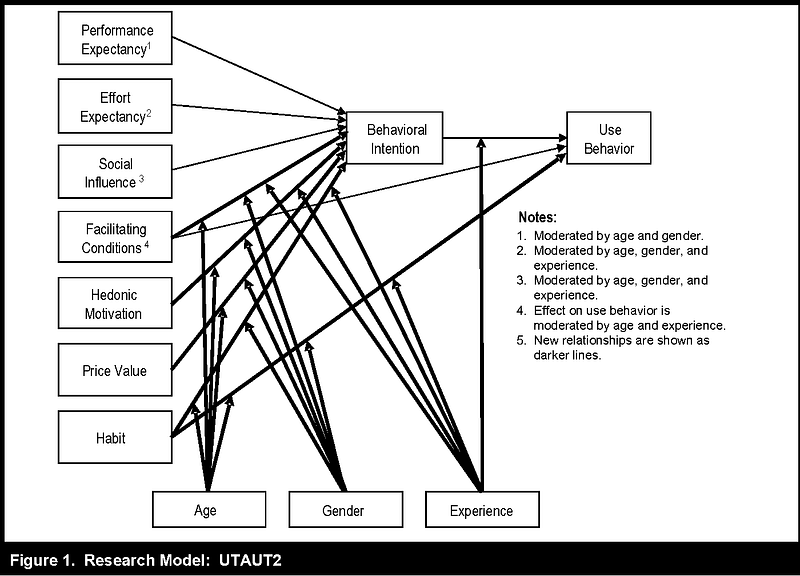
Finally, in the podcast, we briefly touch on a paper that is not about VR adoption but worth mentioning for more context to where the above papers are coming from. Venkatesh, Thong, and Xu in 2013 argue for ”Extending the unified theory of acceptance and use of technology” and introduce more nuanced constructs, including hedonic motivation and social conditions:
https://www.semanticscholar.org/paper/Consumer-Acceptance-and-Use-of-Information-the-of-Venkatesh-Thong/512dd3c7e1b55786e6f918bd0411ff744bb4cf62/figure/0

Nevertheless, we feel that none of the models discussed here quite find a balance between adoption, the notion of ”usefulness”, and a user-centred approach sensitive to a broad spectrum of intentions and motivations. Manis and Choi echo this in their conclusions:

While VR hardware can be improved for functionality, the VR industry must also simultaneously refine and develop more relative content to increase the usefulness of VR in general and VR hardware in particular.

However, they use the word ”content” to imply that VR is just another platform to channel content, rather than the next computing platform - one that would not need a ”killer app” because the medium in itself is the killer app.

Perhaps it is when a technology implies such a paradigm-shifting promise, its potential is especially difficult to capture into a set of predictive constructs, to a satisfying result.

Takeaway: Take off the headset, step back, and reflect

Whether the spike in VR gaming is triggered by the increase in perceived usefulness, decreased cost, network efforts via social media, or a single game announcement, it still seems likely to be a blip within a homogenous niche of gamers and early adopters in the west.

See also https://twitter.com/skarredghost/status/1216461345601851394?s=21

It is because of this we suggest a general takeaway: technology acceptance studies, while not perfect, do provide a lens through which VR enthusiasts and practitioners can take a step back and reflect on why other consumers are not ”getting it”, and what the timeframe for any major shift in their intentions and attitudes might be.

If you enjoyed the post, please give a clap or even a few!

LIsten the podcast on Soundcloud, Spotify, or Apple Podcasts.

Follow us on Twitter

Technology
Virtual Reality
Steam
VR
Technology Trends
Recommended from ReadMedium