
The Grandmaster’s View of The World
About Lee Kuan Yew (1923–2015)
A little boy heard on the radio a man’s voice urging Singaporeans to join Malaya “or else, we will not survive” or words to that effect. I didn’t know who he was; that he was our then Prime Minister Lee Kuan Yew. There were many reasons, he argued, from history to economic markets, to resource abundance, to independence from Britain, and social stability.
I knew little then of what most of these meant. But, his “language of survival” in a calm, authoritative voice exuding the confidence of leadership was sufficient to elicit trust and faith, and I also somehow embrace the need for that defining moment. I was then too young to vote, but in 1962, more than 70% of Singaporeans voted for Merger with Malaya. And I became a “Malaysian” in the newly formed country, Malaysia, on 30 August 1963. The Merger victory ended two years later on 9 August 1965, when Singapore was booted out of Malaysia at the stroke of midnight like a pariah and bastard child.
BOOK REVIEW
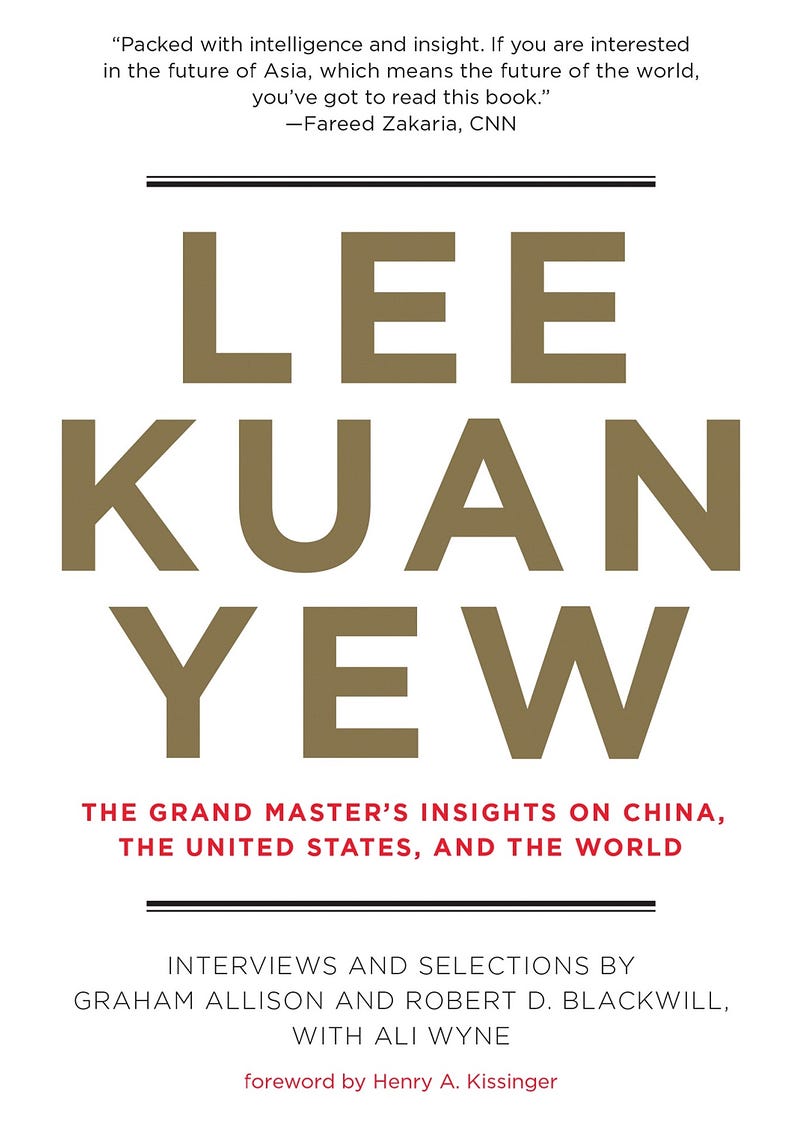
He was hailed as a “Wise Man for The World” by Karen Elliott House, a Wall Street Journal publisher as well as Pulitzer Prize-winning reporter and editor, in her review of the book “Lee Kuan Yew: The Grand Master’s Insights on China, the United States, and the World” by Graham Allison and Robert Blackwill (MIT Press, 2013).
This article is inspired by the book and adapted from her review.
The book gathers key insights from interviews, speeches, and Lee’s voluminous published writings and presents them in an engaging question-and-answer format. He developed his insightful wisdom during more than fifty years on the world stage. The book was based on interviews with Lee Kuan Yew by the authors — Graham Allison, a professor of government at Harvard’s Kennedy School, and Robert Blackwill, a former US diplomat — who also added a distillation of Lee’s speeches, writings, and interviews with others over many years.
For decades, world leaders, corporate CEOs, scholars, and journalists have made the pilgrimage to Singapore to seek his views. US presidents from Richard Nixon to Barack Obama have welcomed him to the White House; British prime ministers from Margaret Thatcher to Tony Blair have recognized his wisdom; and business leaders from Rupert Murdoch to Rex Tillerson, CEO of Exxon Mobil, have praised his accomplishments.
The grand strategist and founder of modern Singapore offers key insights and controversial opinions on globalization, geopolitics, economic growth, and democracy. he offers a unique perspective on the geopolitics of East and West.
Lee does not pull his punches as he offers unvarnished opinions on multiculturalism, the welfare state, education, and the free market. He affirms the United States’ position as the world’s sole superpower but expresses dismay at the vagaries of its political system. He offers strategic advice for dealing with China and goes on to discuss India’s future, Islamic terrorism, economic growth, geopolitics and globalization, and democracy. In his assessment of China’s future, he asserts that “China will want to share this century as co-equals with the United States”
China already dominates Asia and intends to become the world’s leading power. The United States is not yet a “second rate power”, but the inability of its political leaders to make unpopular decisions bodes poorly. Russia, Japan, Western Europe, and India are, for the most part, tired bureaucracies. If Iran gets the bomb, a nuclear war in the Middle East is almost inevitable.
The book focuses forward on Lee’s prognostications, not backward on his accomplishments. Authors Allison and Blackwill refrain from commentary on the man and his ideas, letting readers interpret for themselves. The downside of such restraint is that the book does not truly convey Lee’s combative candor or the exceptional subtlety of mind that Reviewer Karen was privileged to experience in her own interviews with Lee over two decades. It was his combination of penetrating brilliance about the wider world and prickly pettiness in his own Singaporean laboratory (eg. banning two Dow Jones publications for the sin of free expression) that made him so fascinating.
Beyond Singapore, China has always been Lee Kuan Yew’s primary focus. China, he says, is determined to be “the greatest power in the world,” and it expects to be accepted on its own terms, “not as an honorary member of the West.” Yet despite China’s progress over the past 30 years, Lee says, it has multiple “handicaps” to overcome, chief among them an absence of the rule of law and the presence of widespread corruption.
The biggest fear of China’s leaders, he says, is popular revulsion at the corrosive effects of graft. The Chinese language itself — which “is exceedingly difficult for foreigners to learn sufficiently to embrace China and be embraced by its society” — is another obstacle to China’s great-power aspirations. So is a culture that does not “permit a free exchange and contest of ideas.”
While competition between the United States and China is inevitable, Lee argues, confrontation need not be. The US should not expect a democratic China: “China is not going to become a liberal democracy; if it did, it would collapse.” In China’s 5,000 years of recorded history, he notes, the emperor has ruled by right, and if the people disagree, “you chop off heads, not count heads.”
Despite America’s political gridlock and excessive debt, Lee remains optimistic about the future of the United States and its role in the world. In his view, America’s “creativity, resilience, and innovative spirit will allow it to confront its core problems, overcome them and regain its competitiveness.” Americans believe that they can “make things happen,” and thus they usually do.
Still, Lee worries about the breakdown of civil society in America — individual rights (not paired with individual responsibility) run amok — and about a growing culture of entitlements. Sociologists, he says, have convinced Americans that failure isn’t their fault but the fault of the economic system. Once charity became an entitlement, he observes, the stigma of living on charity disappeared. As a result, entitlement costs outpace government resources, resulting in huge debts for future generations. In the meantime, America’s political leaders kick the can down the road to win elections. As so often is the case, Lee Kuan Yew says starkly what others think.
Lee bluntly blames Saudi Arabia for encouraging the growth of Islamist extremism by financing mosques, religious schools, and preachers worldwide to spread its “austere version of Wahhabis’ Islam.” What the West can do, he says, is to give Muslim moderates the confidence to confront extremists for control of the Islamic soul. But, he warns, if moderates continue to be intimidated by extremists, they will find themselves living in repressive theocracies like Iran. And if Iran gets the bomb, other Islamic states like Saudi Arabia and Egypt will do so as well, unleashing the specter of regional nuclear war.
Lee Kuan Yew’s three political heroes are France’s Charles de Gaulle, Winston Churchill of the United Kingdom, and China’s Deng Xiaoping, the Chinese leader who launched economic reform in the 1980s. The reason for Lee’s admiration: each held a weak hand at a critical moment in history and, through guts and determination, managed to win. Lee is a firm believer that leaders are born, though managers can be made, and that leaders should be judged by their accomplishments. “The acid test is in performance, not promises.” As with his three heroes, Lee began with a weak hand in Singapore but, by playing it to maximum effect, made himself a wise man for the world.
The book is a tribute to Singapore’s Lee Kuan Yew, the exceptional global statesman. In accordance to his wishes and will, there is no monument or statue of Lee Kuan Yew in Singapore. Modern Singapore is his accomplishment and lasting testimony — with a high per capita income, social stability and a clean and efficient government. The book is inspiring, thought-provoking, and a worthwhile read for everyone, including Singaporeans, whether or not you agree with him and his methods.
Watch the Authors’ Comments on Youtube -
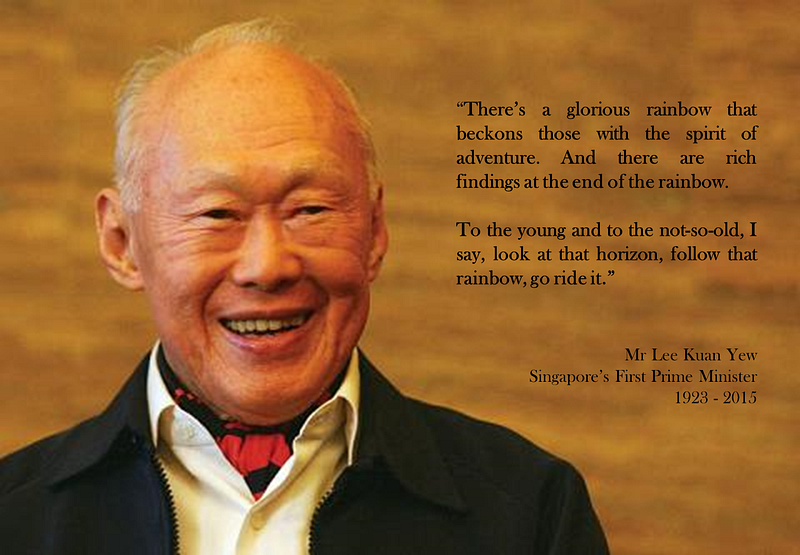
For nearly 60 years, Lee Kuan Yew influenced, shaped, and molded my life through the social, political, and economic transformation of a Third World Singapore into the “First World” nation par none; characterized by economic prosperity, law and order, national security, housing for all, world-class education and full employment with social justice. He was my Prime Minister from 1959 to 1990, and stayed in the government as Minister Mentor till 2011, and was thereafter appointed Senior Advisor to the Government of Singapore Investment Corporation. He died on 23 March 2015 at 91 years old.
Please enjoy my recent Articles.
You can also subscribe to my stories and social media posts via your email. Enjoy more interesting Articles by signing up to Medium here: https://thefuturistoracle.medium.com/membership


