
The Grand Bedtime Protocol: A Single Mom’s Battle Against Sleep Resistance
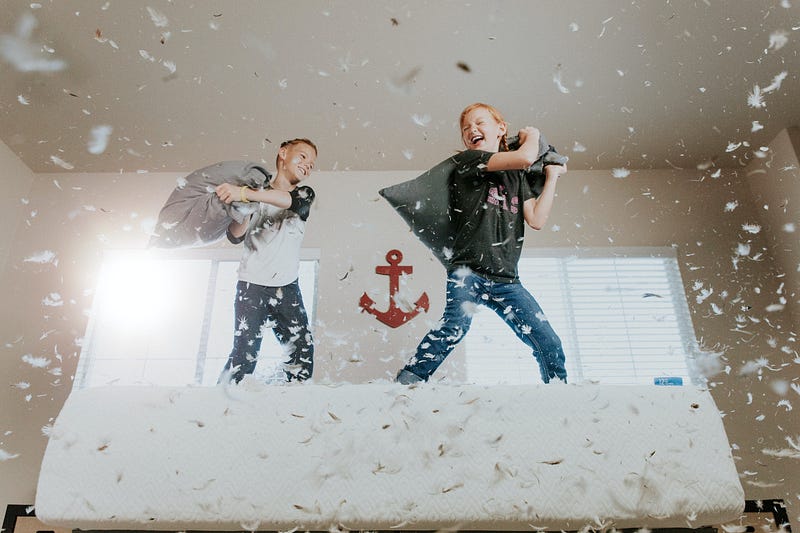
You’d think, as a software engineer, I’d be prepared for anything. I tackle bugs that could bewilder the brains of the brightest tech wizards, I navigate endless lines of code as easily as a tourist strolling through their hometown, and I even speak fluent Java. I thought I was invincible. Then, I encountered my true test: my children’s bedtime.
Now, don’t misunderstand. I love my kids. With all the energy of a thousand suns and all the passion of a thousand committed developers. But bedtime, oh bedtime, is my arch-nemesis. It’s like the final boss in a game that keeps respawning no matter how many times you defeat it. A seemingly unending battle against two tiny, adorable, and staunchly sleep-resistant humans that, without fail, pushes me to question the very fabric of my reality.
The protocol begins, as most bedtimes do, with phase one: the ‘5 More Minutes’ plea. The siren song of these three innocent words has the power to shatter the resolve of even the most dedicated parent. It’s something in their eyes, their voice, the way they pronounce ‘minutes’ — as if they were offering you the secret of the universe — that makes me waver. “Yes, darling, take 5 more hours if you need. Who needs bedtime anyway?” But no, I steel my heart, grit my teeth, and like a firewall holding firm against an onslaught of hacking attempts, I say, ‘No.’
Phase two, a direct counter-attack: the barrage of questions. Like a program full of loops that won’t terminate, these inquiries come fast and furious, and almost always entirely out of left field. Where do dreams come from? Why can’t we see air? What does the number zero taste like? Each query is launched with the intensity of a DDoS attack, meant to overwhelm and cripple my defences. At this point, I yearn for a direct line to Google or perhaps even Einstein’s ghost. But alas, no such luck. Instead, I conjure up stories of dream-weaving fairies, invisible air sprites, and describe zero as tasting like the first spoonful of ice cream on a hot summer day.
This sets the stage for phase three: the water and bathroom break saga. My children, it appears, have the bladder capacity of a gerbil and the thirst of a camel crossing the Sahara. They need water. But not just any water. They require the water in the blue cup, from the second shelf, chilled to precisely 5 degrees Celsius, as if they possess a built-in thermometer. And once they drink it, well, it’s time to navigate the route to the restroom for the umpteenth time.
By this juncture, my logical, analytical, and methodical engineer brain has left the building. Instead, I find myself morphing into an eclectic blend of a whimsical storyteller, a hydration expert, and a master negotiator. These are skills, mind you, that were not covered in the most intensive coding bootcamps.
Next, there’s phase four: the bedtime story. This is not your standard reading of “Goodnight Moon.” No, it’s a full-blown theatrical production complete with distinct voices for every character, improvised plot twists, and an Oscar-worthy performance of suspense, action, and drama. It’s here I discover yet another role I’ve unwittingly adopted: an accomplished voice actor.
Even after the last echoes of my dramatic storytelling performance fade away, the mission is far from accomplished. There is still the great shadow puppet performance, the under-the-bed monster inspection, and the routine wardrobe check to ensure no lurking boogeymen. Yes, my duties are as versatile as they are unpredictable, often toeing the line between a parental figure and a full-time monster huntress.
Once the coast is clear, my miniature humans finally seem ready to submit to slumber. But not before each requires an individually tailored, perfectly executed goodnight kiss and hug routine. Too tight, too loose, too ticklish — the feedback comes in real-time, and the debugging and recoding process starts all over again.
Just when I think the protocol has terminated successfully, there’s a whisper from the top bunk, “I love you, Mommy.” And despite the hour-long, intensive struggle, my heart inexplicably melts. This unexpected but wonderful return statement makes all the loops and recursive functions worth it.
As they drift off into dreamland, my mind hums like a server farm on Cyber Monday, a whirlwind of thoughts, questions, and lingering fragments of fairy tales. I stand in the dim light, watching them, their small chests rising and falling rhythmically. I realise, in the peace of this moment, I wouldn’t trade it for anything. Not even for a perfectly running code or a system that never crashes.
Creeping out of their room, ready to face a few hours of coding and a short sleep before the dawn breaks and the morning school rush begins, I am left in awe of this complex and convoluted protocol. With each passing night, the bedtime routine reveals more to me, not just about my children and their imaginative minds, but also about the delicate, unexpected intersections between my professional life and my parenting journey.
As I settle down at my computer, basking in the soft glow of the screen, I’m left pondering on a simple truth. Bedtime, like coding, is a process. It’s not about the end product of a sleeping child or a flawless software, but the journey — the challenges faced, the triumphs savoured, and the wisdom gathered. It’s the laughter, the frustrations, the joys, and the dilemmas.
The bedtime protocol, though intense, is as necessary and nuanced as any system you run at work. And yes, the debugging process is relentless, but the rewards are immeasurable. After all, how many can say they’ve negotiated with pint-sized dictators, spun tales of dreams and air sprites, provided hydration at precise temperatures, and managed to write lines of code, all in a single day?
Here’s to the journey, the joy, the laughter, the tears. Here’s to the sleepless nights and the bright days. Here’s to the battles won, the tales told, the bugs fixed. Here’s to the great bedtime protocol.


