
The GPT Store is Here! How to Leverage it for Your Business
The GPT Store has arrived, offering a new opportunity for online entrepreneurs. Learn how you can make money with the GPT Store or use it as a lead magnet.
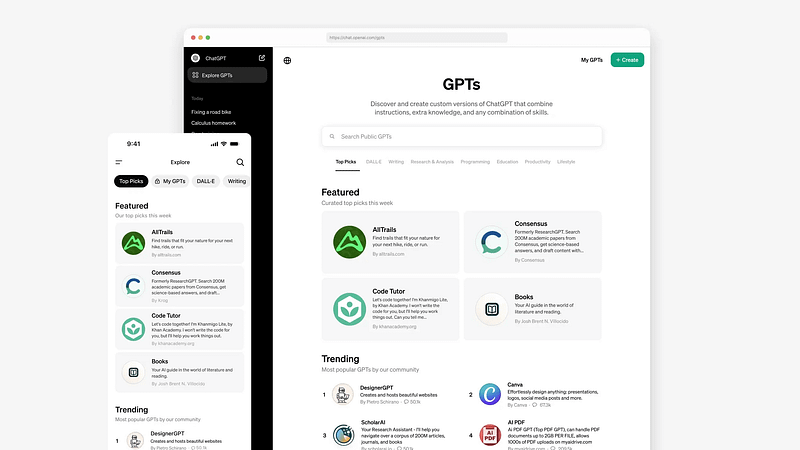
The GPT Store is shaking up the world of Artificial Intelligence (AI) once again. The big question is: a goldmine or a gimmick?
In this article, I explore the new possibilities of the GPT Stores for online businesses.
What is the GPT Store?
The GPT Store is the culmination of OpenAI’s recent developments:
- In November 2022, the beta version of ChatGPT was released.
- In February 2023, the Plus version followed for 20 USD/month.
- In November 2023, CustomGPT and the Assistant API were introduced, allowing anyone to create their own GPTs.
- And now, in January 2024, comes the launch of the Custom GPT Store, where users can find and offer GPTs.
In this new marketplace, we will be able to search and find customized ChatGPTs for various use cases. From SEO helpers, life mentors, to recipe creators — there should be something for everyone.
According to OpenAI, more than 3 million Custom GPTs have been created within two months of the launch of Custom GPTs!
How You Can Use the GPT Store
The GPT Store is currently available for users of the paid ChatGPT Plus, Enterprise, or Team accounts and will gradually become accessible to everyone at chat.openai.com/gpts.
GPTs can be searched and easily found and used via a search interface. The only requirement is that the CustomGPT has been made public by the creator.
Guidelines and Review Process
Before you can share your own GPT in the store, it is important to understand OpenAI’s guidelines. Each GPT must comply with the latest usage and branding guidelines. This ensures that all content in the GPT Store is safe and trustworthy. The review process includes both human and automated checks to ensure compliance with these standards.
If a violation is suspected, users can also report GPTs, triggering a re-examination. This process ensures that the GPT Store remains a place where quality and trust are paramount.
Can You Make Money with GPTs?
According to current statements by OpenAI, this should be possible, but not yet and first in the USA.
In Q1 we will launch a GPT builder revenue program. As a first step, US builders will be paid based on user engagement with their GPTs. We’ll provide details on the criteria for payments as we get closer.
Active use of the GPTs will be important for potential revenues. Perhaps it will work similarly to the Medium Partner Program.
More readers = more earnings.
Whether this will end up being pennies or significant revenues is still open.
Unfortunately, there is currently no sign of being able to call a fixed monthly flat rate for use. Those who plan this should rather build an application detached from the GPT Store. Exactly for this purpose, the Assistants API was developed. It allows direct API control of the Custom GPT functions and integration into your own applications and workflows.
Problem: Costs for External Functions
Building a GPT initially costs nothing (except the 20 USD/month for a Plus account). With this, you could already feed your GPT with prompts and even knowledge (via file upload) and use the functions of ChatGPT (like Dall-E, Bing, or the Code Interpreter). You can already do quite a lot with this.
However, the really exciting use cases are those in which so-called Functions are executed in the GPT. These are API calls that control functions in third-party applications.
Examples include:
- Querying keywords from an SEO tool
- Creating an invoice or a quote in accounting software
- Placing an order in a shop
- Sending a Linkedin contact request
- Ordering pizza from a delivery service
- Sending a WhatsApp or SMS message, or a postcard
- Ordering a taxi
- etc.
All of this is possible if the desired service behind it offers an API interface.
The challenge, however, is that such API usage generally costs money. And without an actual return in the form of a predictable revenue, this can not only be an unattractive business, but even one in which money is burned.
However, there could still be an exciting way to use the GPT Store as a marketing tool.
GPT Store SEO & Lead Magnets
If the GPT Store becomes THE go-to place for seekers, it might still be interesting to publish your own GPT there, just to be found.
Maybe “GPT Store SEO” will someday be a thing to bring people into your own GPT.
If someone manages to bring users into their “own” Custom GPT, they could potentially use the tool as a lead magnet.
For example, I could imagine a GPT spitting out information based on knowledge and then asking the user if they want to provide their email address to receive more information.
A coaching GPT, for example, could offer to send more useful tips and updates via newsletter.
At this point, an API call (via Function) to an email marketing tool could be meaningfully integrated.
Example: Recipes GPT
GPT: Hi, what would you like to cook today?
User: I still have 2 eggplants and potatoes in the kitchen
GPT: Great, I recommend a casserole. Follow these steps…
User: Thanks, it was delicious!
GPT: You’re welcome. If you want regular healthy and easy recipe ideas, then sign up for the Cooking-with-Chris newsletter. Should I register you?
User: Sure. My email is [email protected]
System: (Enters email address in the email tool)
GPT: Great, I’ve registered your email address in our newsletter. Please confirm the subscription in your mailbox. By the way, there are daily updates and short inspirations on our Instagram channel XYZ.
This is how a GPT could be used to build a lead magnet. I have not found any indication in the OpenAI policies that would exclude this type of use.
My Conclusion on the GPT Store
The GPT Store from OpenAI is more than just a collection of tools — it could be a gateway to a new world of marketing or monetization.
The big question is whether the store will become so popular that it functions as an acquisition channel, and what audience will use it.
Those who have to bring users into the GPT themselves will only do so if direct monetization by OpenAI based on usage is possible. This is still open and remains to be seen.
As a lead magnet, it will be exciting if sufficient traffic is possible.