

The Golden Ratio — Hidden in Plain Sight! 🕵️♂️
(within a regular pentagon)
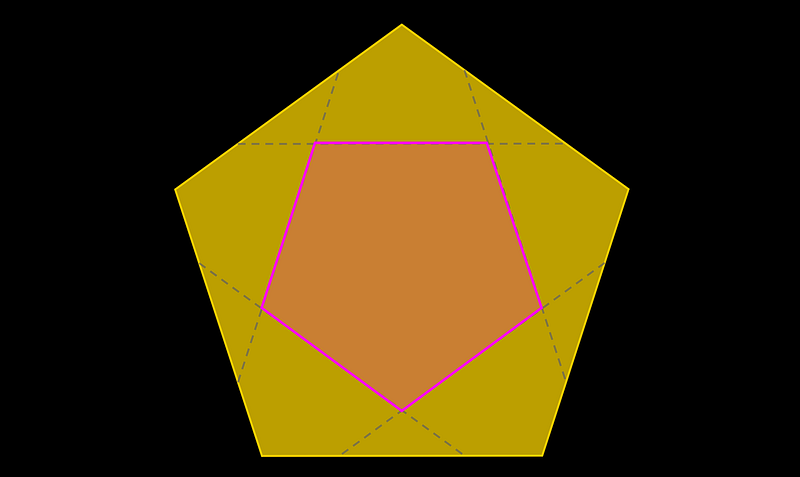
This article was inspired by a beautiful problem from the 2023 American Mathematics Competition about folding a paper pentagon.
A regular pentagon with area 1 + sqrt(5) is printed on paper and cut out. The five vertices of the pentagon are folded into the center of the pentagon, creating a smaller pentagon. What is the area of the new pentagon?

Feel free to have a go at the problem yourself before reading on. You’ll need a pen and paper!
There are many ways to do it, most involving trigonometry with angles of size 36°, 54° or 72°.
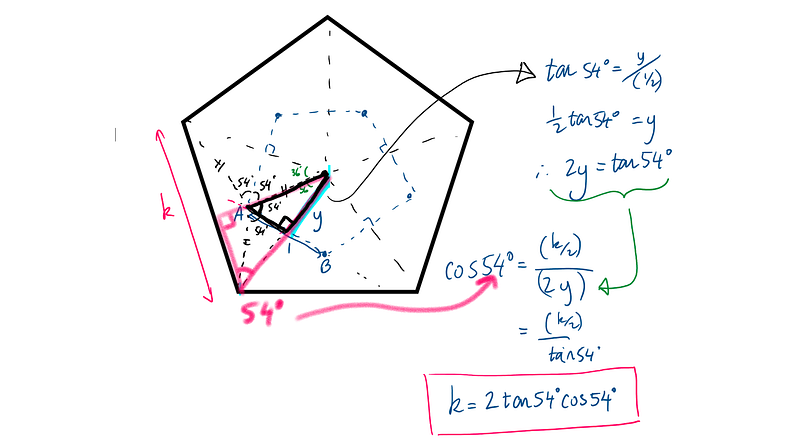
One such method is shown below, where I finally fumbled my way to work out an expression for the ratio between the two pentagons’ side lengths: 2tan(54°)cos(54°).
The working shown below is not particularly clear, but don’t worry about the details — it’s not the focus of this article!
What surprised me about the result is that 2tan(54°)cos(54°) turns out to be …
… drumroll 🥁🥁🥁 …
… the golden ratio!
When I realised that fact (with the help of a calculator) I was determined to find a more elegant solution to explain the presence of the golden ratio. 🕵️♂️
But before I get to that, let’s take a few steps back.
The Golden Rectangle
The golden ratio φ is often introduced through the golden rectangle.
It’s a rectangle with sides in the ratio φ, and it’s special because if you cut out a square from one side, you are left with another smaller rectangle which is similar (i.e. has the same side length ratio) as the original rectangle.
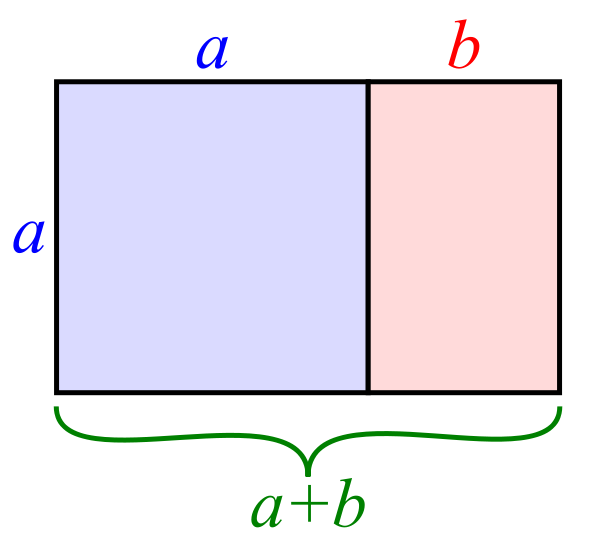
In the rectangles shown above, the ratios a/b and (a+b)/a are both equal to φ.
The value of φ is given by the positive solution to the quadratic equation
φ² = φ + 1,
which comes from rearranging the ratios a little as shown below.
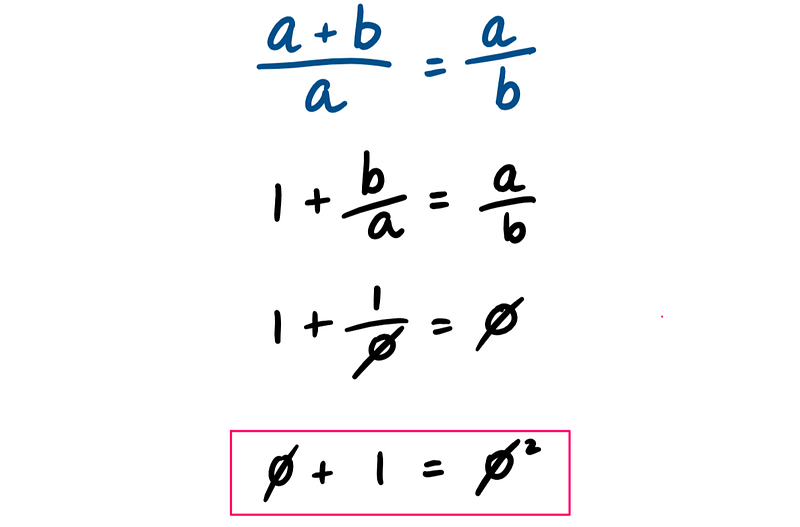
Then the quadratic formula can be be used to show that φ = (1+sqrt(5))/2.
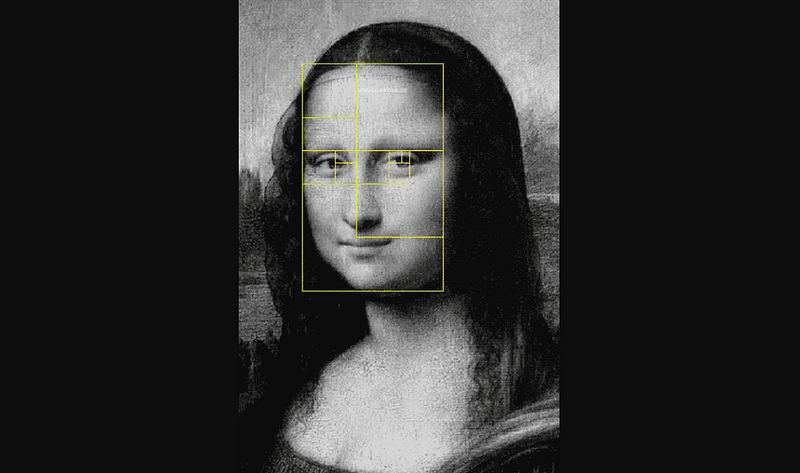
The golden rectangle has famously been used by artists such as Leonardo da Vinci and Michelangelo, as it is believed to possess a natural aesthetic appeal.

The Golden Triangle
The golden triangle is less well known that the golden rectangle. It is an isosceles triangle with the two equal sides being a factor of φ larger than the third side.
It turns out to have two angles of 72° and one angle of 36°, and is closely related to the regular pentagon, as was known to Euclid.
One of the most beautiful results in all of Euclid’s Elements is the construction of a regular pentagon inscribed in a circle (IV.11). The proof of this construction makes use of all the geometry he has developed so far so that on could say that to understand fully this single result is tantamount to understanding all of the first four book of Euclid’s geometry. — Kathryn Mann
The golden triangle appears in the regular pentagon as shown below, where the 5 vertices have been joined to create a regular 5-pointed star (the pentagram).
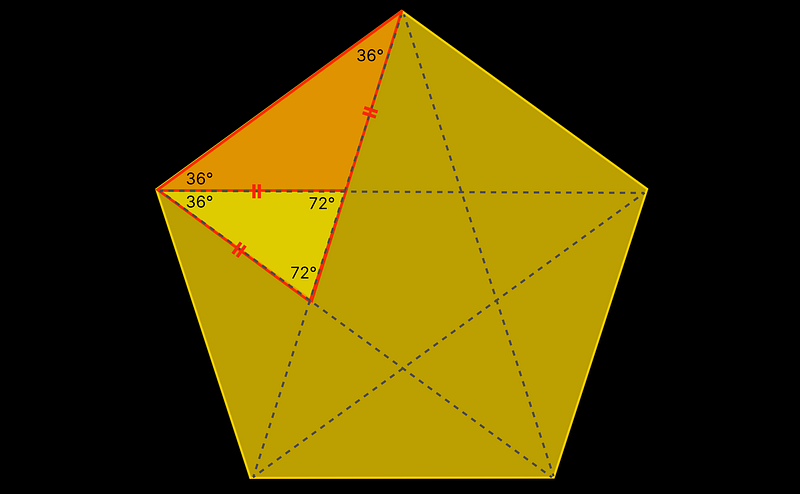
Analogous to the golden rectangle, the golden triangle contains a similar triangle within as shown below. We could say that this similarity occurs because 72° happens to be double 36°. Or we could deduce the similarity from the equal side lengths of the pentagram, as shown below.
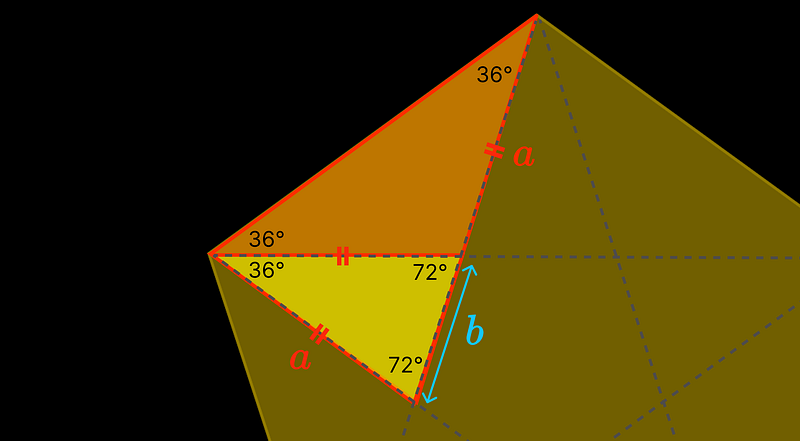
Just like with the golden rectangle, the ratios between a and b in the similar triangles give rise to the quadratic equation φ² = φ + 1, which has the solution φ = (1+sqrt(5))/2.
Where is the Golden Triangle Hiding?
So with a trigonometry “bash”, I realised that the length ratio between the folded smaller pentagon and the larger pentagon is actually φ.
But where is the golden triangle hiding?!?
I spent a long time searching for it, and I won’t go in to all the rabbit holes I went down along the way!
Here is the easiest way to see it.
When a vertex is folded to the centre, it creates an isosceles triangle with two angles of 36° and one angle of 108°.
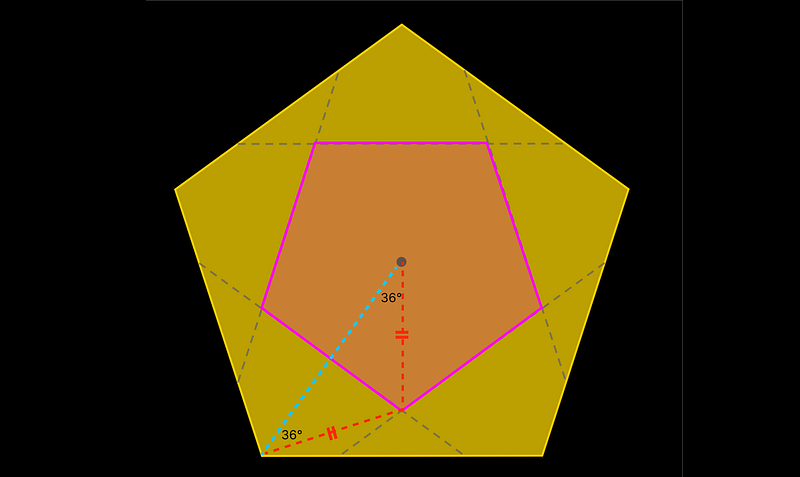
This is part of our golden triangle!
To make it clearer, let’s construct the smaller golden triangle at the bottom to complete the picture.
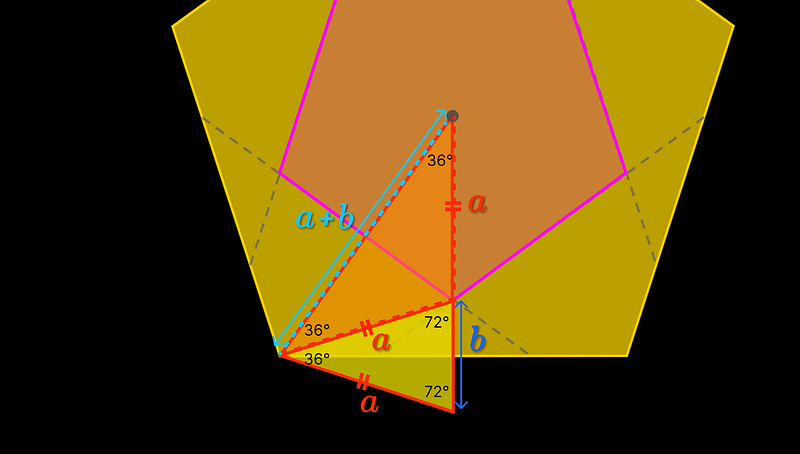
The distance from the center to the vertex of the small pink pentagon is a. The distance from the center to the vertex of the large pentagon is a + b. As this is a golden triangle, this ratio (a + b)/a is equal to φ = (1+sqrt(5))/2.
Seems so obvious now. But it took me a long time to find it hiding there, so it was quite rewarding when it finally dawned on me! 😅