
The Golden Gate of Kyiv
How it survived over one thousand years of turbulent history
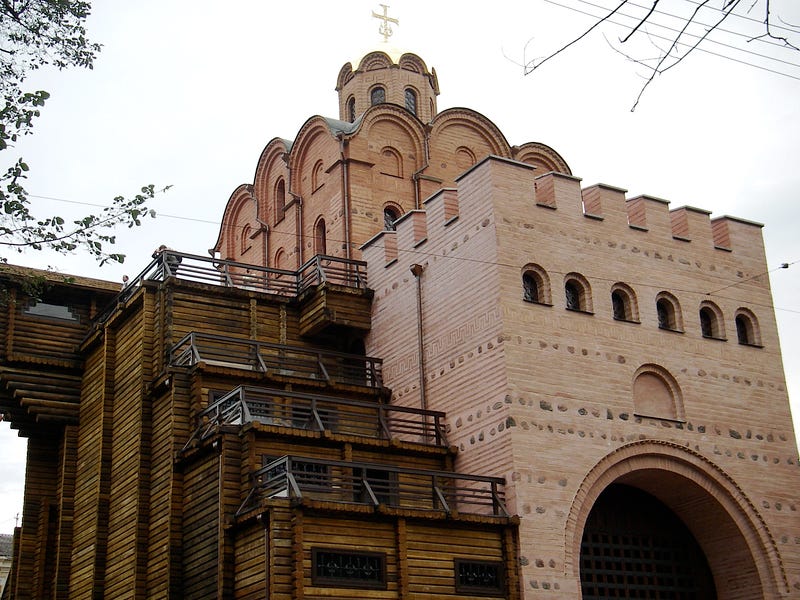
Nearly one thousand years ago the city of Kyiv was surrounded by a strong wall, protecting its great cathedral of St Sophia and its buildings of state. The home of Grand Prince Yaroslav the Wise, it sat at the top of a hill — a natural rampart, which was further strengthened by its imposing wall. Visitors could enter through one of three gates, the most magnificent of which was the Golden Gate — the other gates, the Polish and the Jewish Gates, were merely tradesmen’s entrances.
Yaroslav the Wise was the son of Volodymyr, who had brought Orthodox Christianity to Kyiv, after carefully weighing up the various alternative religions of Islam, Judaism, and Catholicism. Yaroslav married his daughters into major European dynasties — in Norway to King Harold Hardrada, to King Henry of France, and to King Andrew of Hungary. He was connected to the courts of England and Poland through his sisters. He himself was married to Anne, the sister of the powerful Byzantine Emperor Basil II.
When the Golden Gate was built in 1037, Kyiv was at the height of its power and influence within the medieval world, as the capital of Kyivan Rus’. Medieval Kyiv was a thriving trading centre. It straddled the important silk routes from east to west, as well as the north-south route from the Black Sea up to the Baltic. It would have been full of people from all over the world — traders, artisans, philosophers and diplomats.
The Golden Gate must have been an impressive sight for travellers and migrants. They would have seen the city from quite a distance, as they travelled through what was then rough countryside. The Golden Gate loomed large, with its huge, eight-metre high stone walls, topped with the dome of its church. It was the triumphal arch used for ceremonial purposes, as well as a vital daily lifeline for commerce. It would have been guarded by soldiers in their royal livery, with powers to refuse entry, probably to confiscate goods and imprison people too. The soldiers could have seen people coming from afar, long before they got close. If necessary, they had plenty of time to prepare, then to fire arrows at potential invaders through the slots in the walls, pour boiling oil on them, and to close the enormous gates, made of thick wood.
Kyiv’s age of prosperity and influence did not last, though. This beautiful, culturally and politically influential city became a target for attacks by a series of invaders, starting with rival prince Andrey Bogulyubsky in 1169. Bogulyubsky destroyed the old town of Kyiv and the court moved the capital of Kievan Rus’ to the city of Vladimir. Further invasions by Rus princes followed until the more decisive Mongol invasion took place in 1240. The city was completely destroyed, the Golden Gate and the great cathedral of St Sofia razed to the ground.
Just six years after the Mongol invasion, Giovanni de Plano Carpini, the pope’s envoy to the Mongol Great Khan, visited Kyiv and wrote:
“They (the Mongols) attacked Rus’, where they made great havoc, destroying cities and fortresses and slaughtering men; and they laid siege to Kiev, the capital of Rus’; after they had besieged the city for a long time, they took it and put the inhabitants to death. When we were journeying through that land we came across countless skulls and bones of dead men lying about on the ground. Kiev had been a very large and thickly populated town, but now it has been reduced almost to nothing, for there are at the present time scarce two hundred houses there and the inhabitants are kept in complete slavery.”
It was the beginning of a period of invasions and wars that lasted until the eighteenth century. Kyiv was later part of the Grand Duchy of Lithuania, then the Commonwealth of Poland-Lithuania, before eventually becoming part of the Russian Empire.
The Dutch artist Abraham van Westerfeld made a series of drawings and paintings of Kyiv in 1651, showing how far it had sunk from its former glory. Although partially destroyed, the Golden Gate remained in use as an entrance portal to the city. The Cossack hetman Bohdan Khmelnytsky had triumphally entered Kyiv through the Gate in the Cossack Uprising of 1648, then just three years later the city was regained by the Polish-Lithuanian army. Abraham van Westerfeld was on the staff of the victorious general, Prince Radzivill, a Polish hetman. He may have been a kind of ‘war artist’, obviously working on the side of the victor rather than of the benighted townspeople, but nonetheless is regarded as a reliable source. His beautiful drawings still exist, showing scenes of broken Kyiv, including the remains of the Golden Gate.
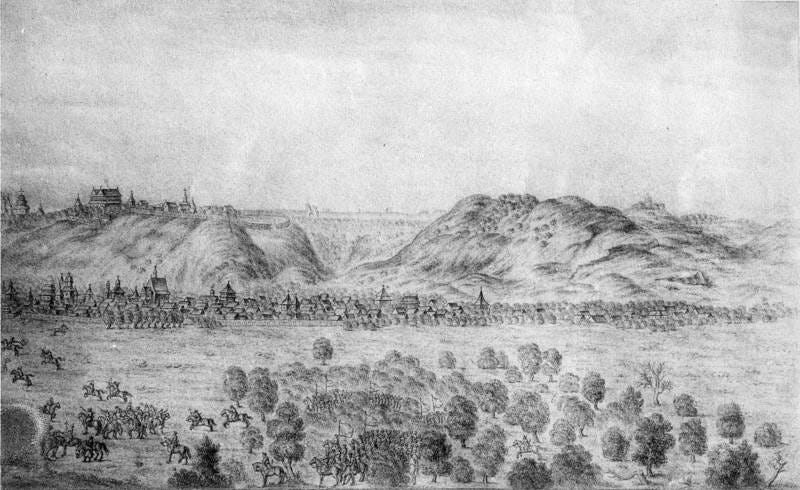
Kyiv was gradually re-established, albeit as a provincial city rather than an independent capital, under cultural subjection to the ruling empire, first Lithuanian-Polish and later Russian. In 1832, the remains of the Golden Gate were finally excavated, at the behest of Kyiv’s senior cleric, Metropolitan Yevgeny Bolkhovitinov. The two main walls of the structure were found, showing the impressive extent the former gate. Further work was then undertaken through the nineteenth century, investigating, strengthening and protecting the excavations. Finally, the importance of this great historic relic started to be recognised.
It was an inspiration to several artists.
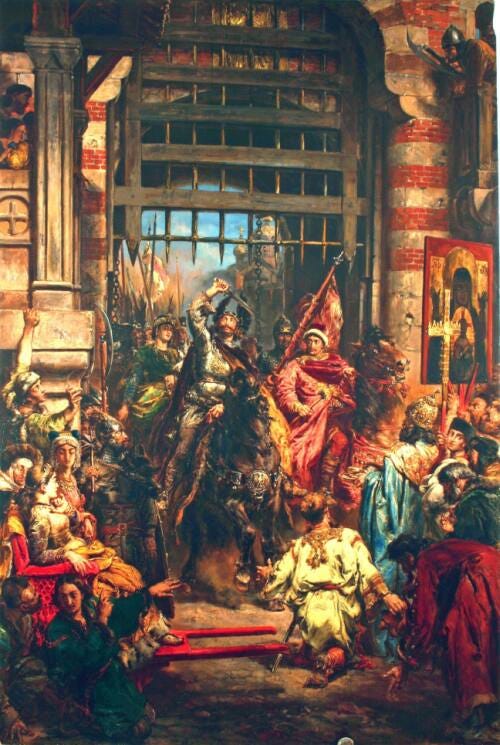
The Polish painter, Jan Matelko, in 1883, painted a wonderfully melodramatic scene of a battle at the Golden Gate. In it the Polish King Boleslaw is shown defeating the Kievan Rus’ Prince Sviatopolk Vladimirovich, using the Polish ceremonial sword used for coronations, as part of the Kievan succession crisis of 1041. Fanciful and not representative of the Kievan perspective, it nonetheless shows an image of the Gate that is drawn from archaeological evidence and close to the present-day reconstructed version.
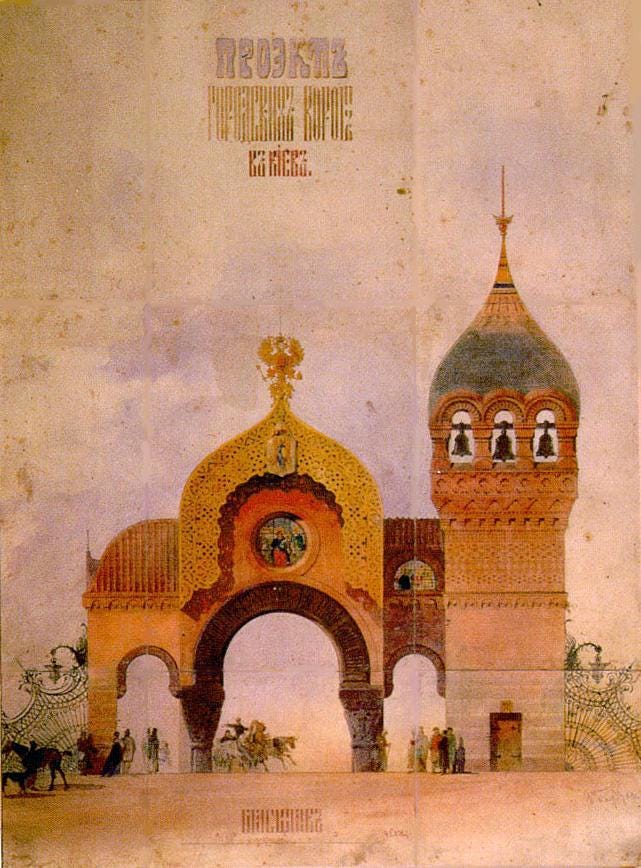
My favourite artistic depiction is, without doubt, that of the Russian composer Modest Mussorgsky’s Pictures at an Exhibition, orchestrated by Maurice Ravel (1922). The movement entitled The Great Gate of Kiev was in my head when I first visited the Golden Gate — and I must say jarred rather with what I actually saw. Rather than being a faithful representation of the original wood and stone, medieval construction, Mussorgsky’s vision is much grander and tinged with a nineteenth-century pretension. Mussorgsky’s work was inspired by the work of artist Viktor Hartmann, his close friend who had recently died suddenly. Hartmann had worked as an architect and travelled widely, producing a huge output of paintings, some of which featured his own design ideas. His Plan for a City Gate in Kiev (1869) is one such painting, offering his vision for a Russified, ornate reconstruction of the more utilitarian, medieval stronghold. Mussorgsky was inspired to select ten of Hartmann’s paintings, including this one, and to write a set of pieces for piano. Ravel later rewrote them for orchestra, in a version which gives the final majestic theme to the brass and woodwind, in its breath-taking finale.
At last, in the twenty-first century, in finally independent Ukraine, the Golden Gate has been reconstructed — and probably with more faithfulness to its original design than it would have been if Hartmann’s proposal had been accepted. It is a wonderful achievement after so many centuries, now providing a tourist attraction with an interpretive museum inside.
However, set now in a modern square, towered over by buildings from later periods and with traffic all around, it takes some imagination to see it in the context of the original medieval city, dominating the skyline and commanding respect from visitors.


.jpg#/media/File:Matejko-chrobry_at_Kiev_(Kijow).jpg)
