avatarDianna Lesage

Free AI web copilot to create summaries, insights and extended knowledge, download it at here

3356

Abstract

m venture builder as a corporate innovation business where the goal is to build startups from concepts and ideas mostly coming from inside the company. This is called intrapreneurship. He also notes that the idea<i> can</i> come from outside the company, but the point is that the term “venture builder” refers to <i>corporate </i>innovation and shouldn’t be used interchangeably with the term “startup studio”.</p><h1 id="8475">The Goal of a Startup Studio</h1><p id="8f69">At the end of Alberto’s article, there’s an excellent infographic comparing Venture Builders against Corporate Accelerators and Startup Studios.</p><figure id="6965"><img src="https://cdn-images-1.readmedium.com/v2/resize:fit:800/0*wI186gandzucueIQ.png"><figcaption><a href="https://sifted.eu/articles/venture-builder-characteristics/">https://sifted.eu/articles/venture-builder-characteristics/</a></figcaption></figure><p id="8dbf">While nothing is set in stone and definitions are based on opinion and perspective<i> (in every industry but especially the innovation industry)</i> the graphic does provide a comprehensive outline of what a studio is and what it isn’t. I was particularly drawn to the information in the last two rows.</p><h2 id="6c32">The Expected Outcome: Many Startups Launched</h2><p id="cc59">The expected outcome of a startup studio is the “spin out” of new startup ventures. Plain and simple. A startup studio is a company that builds startups and thus the creation and launch of new startups is the expected outcome.</p><p id="bc29">Refer back to the first graphic in this article, from Revelry. Once a startup idea is validated, the next step is getting it out into the world to function as a true startup in the market. This is what the studio industry calls a “spin-out”.</p><p id="8128">Startup ideas are validated and ventures are built by the core team within the studio using proven processes, shared resources, and internal funding. When these ventures are “ready to fly”, they’re pushed out of the nest to “test their wings”.</p><figure id="3078"><img src="https://cdn-images-1.readmedium.com/v2/resize:fit:800/0*qfj3Ger_m_VIO6JJ.jpg"><figcaption></figcaption></figure><p id="7246" type="7">The expected outcome from a startup studio is the validation and “spin out” of many new startup ventures.</p><p id="cefa">Each studio is unique in its timeframe and outcome metrics- meaning that some studios spin out a dozen early-stage startups in a 9-month time frame and other studios spin out only 2 or 3 further-along startups in the same time frame. A variety of factors influence this, including team size and industry.</p><h2 id="da69">The Main Goal: Unicorn Exits</h2><p id="dac5">The goal is different from the outcome in that the outcome is the “what” and the goal is the “why”.</p><p id="e620">Startup studios don’t create new ventures for fun (although it is fun!)- the reason studios exist and have had such success is because studio-born startups return higher multiples in a shorter period of time than startups typically do.</p><p id="4c5e" type="7">A startup studio is like an innovation firm with a venture investment business model.</p><p id="d2d4">When a studio works on a new startup idea, the team evaluates it from a venture-scale and success probability perspective. The top-of-mind question is always, “how can we efficiently bui

Options

ld this startup and quickly position it for the best chance of success, scale, and exit?”</p><figure id="53e4"><img src="https://cdn-images-1.readmedium.com/v2/resize:fit:800/0*RHAm3RxnA-lw6dNc.png"><figcaption><a href="https://www.studioupstart.com/post/from-idea-to-traction-to-exit-how-startup-studios-run">https://www.studioupstart.com/post/from-idea-to-traction-to-exit-how-startup-studios-run</a></figcaption></figure><p id="9f41">Studios are motivated by their large equity stake in the ventures they work with because, when an exit happens, the studio wins big (as do the entrepreneurs on the founding team and the investors in the studio- everyone wins big when there’s an exit from a studio).</p><p id="b42b">According to <a href="https://www.gan.co/blog/startup-studios-look-like-2020/">research published by the Global Startup Studio Network (GSSN)</a>, <i>“the average studio injects an initial 232,458 in capital to each startup they create, giving them a strong cash position from day one. In return for all of this support, the startup founders give an average of 36% equity to the startup studio.”</i></p><p id="b650">Because the studio has such a high percentage of equity in each of its portfolio companies, the studio has real “skin in the game” which drives the studio to go above and beyond in efforts to ensure success for portfolio startups.</p><p id="581b" type="7">The accelerating force behind it all is the Unicorn exit.</p><p id="e867">A studio doesn’t make any money unless the startup has an exit event (sale, acquisition, merger, or IPO…) Studios don’t have the same time frame as typical venture firms <i>(invest early, wait 10 years, realize 5–10X return on a few investments)</i> they create and co-build many startups in a relatively short period of time (2–5 years) and move these ventures through to the exit phase fairly quickly with the goal of consistently returning capital back to the fund.</p><h2 id="f5b8">How Does 10,000X your Investment Sound?</h2><p id="f259">For example, Dollar Shave Club was a startup launched by a startup studio called Science Inc. As the story goes (<a href="https://www.science-inc.com/dollar-shave-club.html">told by Michael Jones of Science Inc.</a>) <i>“Back in 2012, we invested 100,000 into Dollar Shave Club and the brand saw 65 million in sales a mere two years later, in 2014. Now, in the five years since its inception, the brand's appeal has the European consumer goods company making one of the largest deals that we've ever seen in Los Angeles.”</i></p><figure id="5bff"><img src="https://cdn-images-1.readmedium.com/v2/resize:fit:800/0*P8qq0h7lm0QQrPWi"><figcaption></figcaption></figure><p id="2c00">Science Inc. invested 100,000 to launch Dollar Shave Club in 2012, there were 2 years of amazing growth, and sold to Unilever for $1 Billion in 2016.</p><p id="27c4">Because of the startup studio’s pre-built resources, ready-made connections, and startup scale expertise- they returned 10,000X their investment in just 4 years.</p><p id="0987"><b>That is the power of a startup studio my friends.</b></p><p id="fd33"></p><figure id="4737"><img src="https://cdn-images-1.readmedium.com/v2/resize:fit:800/1*Vp3gAIPV6dWWblVBErtHgA.png"><figcaption><a href="https://studiostack.substack.com/">https://studiostack.substack.com/</a></figcaption></figure></article></body>

The Goal of a Startup Studio

Spoiler Alert: it’s exits
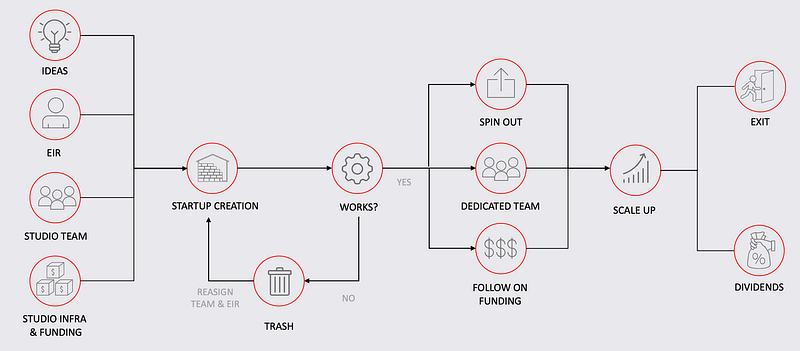
Graphic curtesy of Fiera Studio

First, let’s define what a startup studio is so we’re all on the same page.

A startup studio is a company that builds startups in rapid succession.

Studios often have many ideas in the works at the same time because, at the end of the “incubation period”, only a handful will survive. For example, a Studio might consider 50 different ideas, choose 40 to test, end up with 20 validated, create 10 of those- of which 5 will get traction- and 2 will “spinout”.

Studios are expert executioners and have pre-defined criteria (called stage-gates) that influence “kill or keep” decisions. When a stage-gate is reached, the fledgling venture is evaluated against the relevant benchmarks and, if it doesn’t pass the test, it’s out.

This is just one of the reasons studios are so successful at building winning startups- there’s no innovator bias. No one falls in love with the venture and keeps it on life support for a decade. Success is defined ahead of time and the team works enthusiastically to exceed expectations but, if it doesn’t take off, that’s just part of the process. Failing is fun in a startup studio.

The graphic below, from Revelry- a studio operating in New Orleans- provides a great overview and timeline of the process from “idea” to “scale”.
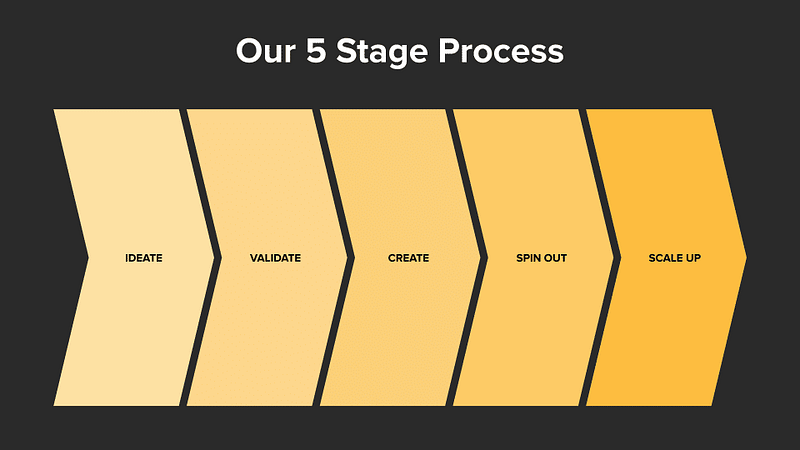
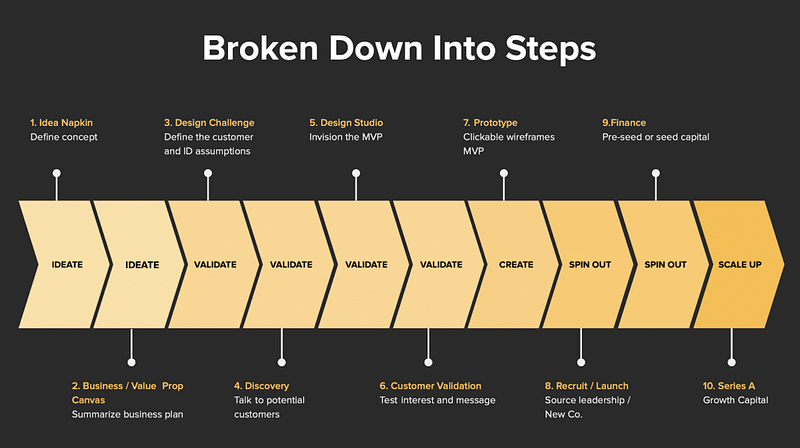
https://revelry.co/startup-studio/

If you’ve never heard of a startup studio, you’re not alone. While these entities have been around since the 90’s, they are just now reaching the mainstream inflection point. You likely know some of the startups that have come out of studios including Dollar Shave Club, GIPHY, and we can’t forget Medium!
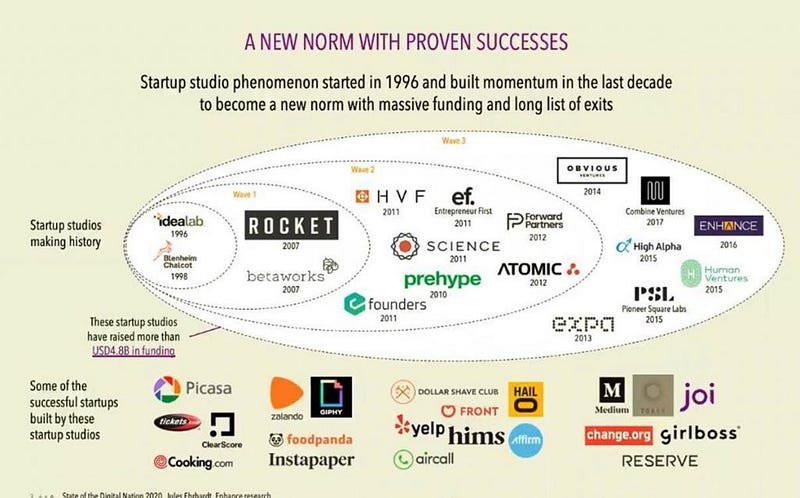
The term “startup studio” is often used interchangeably with the following labels: venture studio/ startup foundry/ company builder. Because of the constant switch in vernacular, it’s hard for one term to take “become a household name” (like the term “accelerator” did).

You’ll also hear a startup studio called a “venture builder”- but I recently learned about some debate on that particular label. Alberto Onetti, a longtime studio expert and fellow enthusiast, wrote a great article on this topic called “Sorry, not everything is a venture builder”.

Within the article, he defines the term venture builder as a corporate innovation business where the goal is to build startups from concepts and ideas mostly coming from inside the company. This is called intrapreneurship. He also notes that the idea can come from outside the company, but the point is that the term “venture builder” refers to corporate innovation and shouldn’t be used interchangeably with the term “startup studio”.

The Goal of a Startup Studio

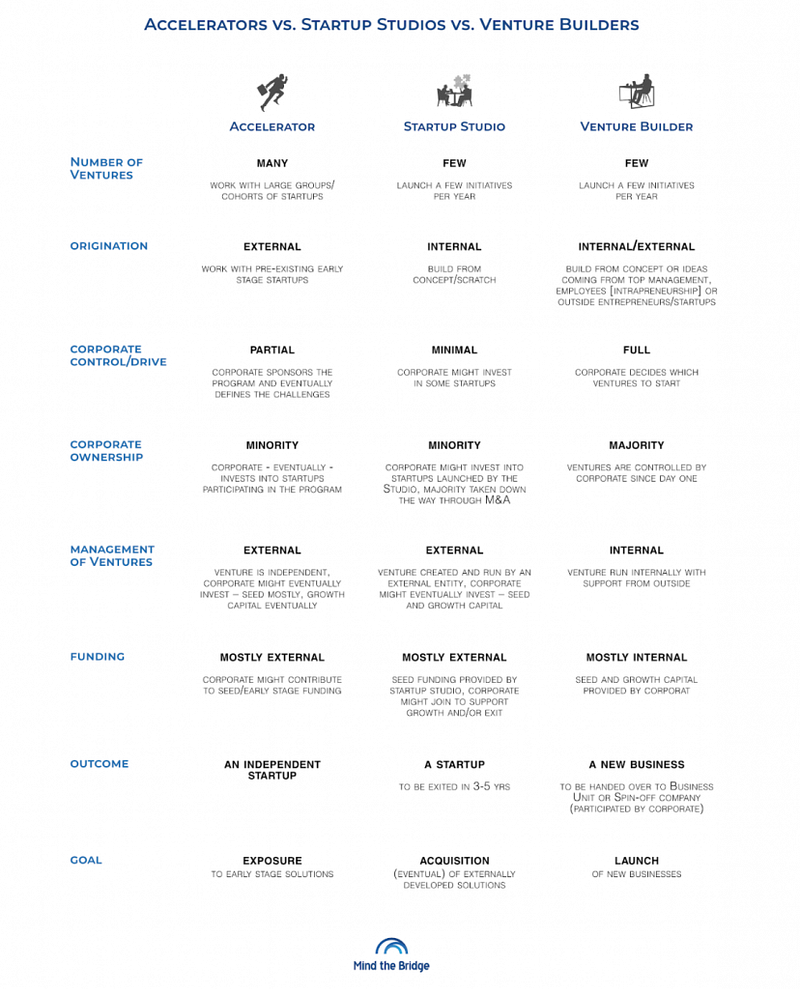
At the end of Alberto’s article, there’s an excellent infographic comparing Venture Builders against Corporate Accelerators and Startup Studios.
https://sifted.eu/articles/venture-builder-characteristics/

While nothing is set in stone and definitions are based on opinion and perspective (in every industry but especially the innovation industry) the graphic does provide a comprehensive outline of what a studio is and what it isn’t. I was particularly drawn to the information in the last two rows.

The Expected Outcome: Many Startups Launched

The expected outcome of a startup studio is the “spin out” of new startup ventures. Plain and simple. A startup studio is a company that builds startups and thus the creation and launch of new startups is the expected outcome.

Refer back to the first graphic in this article, from Revelry. Once a startup idea is validated, the next step is getting it out into the world to function as a true startup in the market. This is what the studio industry calls a “spin-out”.

Startup ideas are validated and ventures are built by the core team within the studio using proven processes, shared resources, and internal funding. When these ventures are “ready to fly”, they’re pushed out of the nest to “test their wings”.

The expected outcome from a startup studio is the validation and “spin out” of many new startup ventures.

Each studio is unique in its timeframe and outcome metrics- meaning that some studios spin out a dozen early-stage startups in a 9-month time frame and other studios spin out only 2 or 3 further-along startups in the same time frame. A variety of factors influence this, including team size and industry.

The Main Goal: Unicorn Exits

The goal is different from the outcome in that the outcome is the “what” and the goal is the “why”.

Startup studios don’t create new ventures for fun (although it is fun!)- the reason studios exist and have had such success is because studio-born startups return higher multiples in a shorter period of time than startups typically do.

A startup studio is like an innovation firm with a venture investment business model.

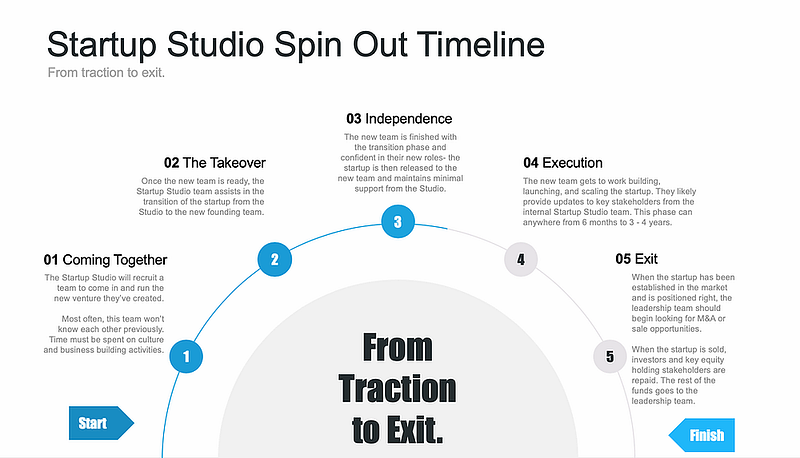
When a studio works on a new startup idea, the team evaluates it from a venture-scale and success probability perspective. The top-of-mind question is always, “how can we efficiently build this startup and quickly position it for the best chance of success, scale, and exit?”
https://www.studioupstart.com/post/from-idea-to-traction-to-exit-how-startup-studios-run

Studios are motivated by their large equity stake in the ventures they work with because, when an exit happens, the studio wins big (as do the entrepreneurs on the founding team and the investors in the studio- everyone wins big when there’s an exit from a studio).

According to research published by the Global Startup Studio Network (GSSN), “the average studio injects an initial $232,458 in capital to each startup they create, giving them a strong cash position from day one. In return for all of this support, the startup founders give an average of 36% equity to the startup studio.”

Because the studio has such a high percentage of equity in each of its portfolio companies, the studio has real “skin in the game” which drives the studio to go above and beyond in efforts to ensure success for portfolio startups.

The accelerating force behind it all is the Unicorn exit.

A studio doesn’t make any money unless the startup has an exit event (sale, acquisition, merger, or IPO…) Studios don’t have the same time frame as typical venture firms (invest early, wait 10 years, realize 5–10X return on a few investments) they create and co-build many startups in a relatively short period of time (2–5 years) and move these ventures through to the exit phase fairly quickly with the goal of consistently returning capital back to the fund.

How Does 10,000X your Investment Sound?

For example, Dollar Shave Club was a startup launched by a startup studio called Science Inc. As the story goes (told by Michael Jones of Science Inc.) “Back in 2012, we invested $100,000 into Dollar Shave Club and the brand saw $65 million in sales a mere two years later, in 2014. Now, in the five years since its inception, the brand's appeal has the European consumer goods company making one of the largest deals that we've ever seen in Los Angeles.”

Science Inc. invested $100,000 to launch Dollar Shave Club in 2012, there were 2 years of amazing growth, and sold to Unilever for $1 Billion in 2016.

Because of the startup studio’s pre-built resources, ready-made connections, and startup scale expertise- they returned 10,000X their investment in just 4 years.

That is the power of a startup studio my friends.

https://studiostack.substack.com/
Startup Studio
Startup
Venture Capital
Investing
Entrepreneurship
Recommended from ReadMedium