
The Glamorization of White Criminality
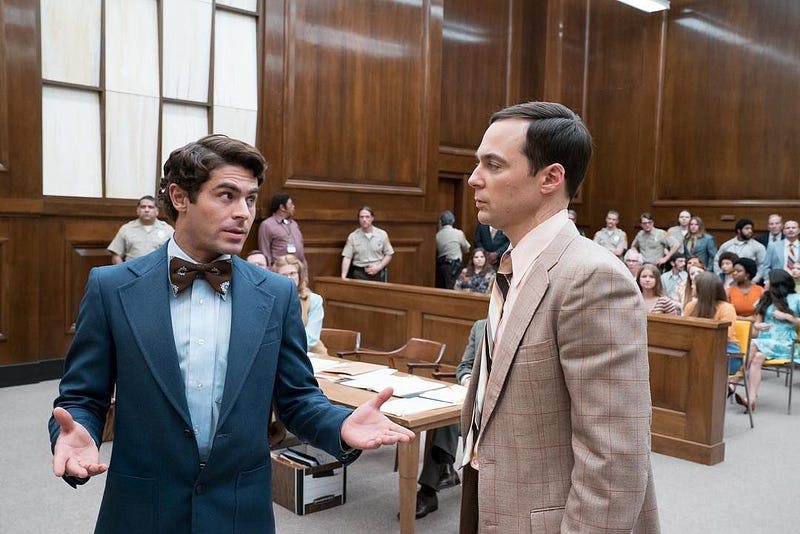
The recent trailer, debuting the biopic of Serial Killer, Ted Bundy, titled, EXTREMELY WICKED, SHOCKINGLY EVIL AND VILE showcases the unfurling of the career of a criminal mind.
Problematic about this trailer however, is it is not apparent that this is about a Serial Killer. On the contrary, there appears to be an idolization of the infamous murderer.
This is not new, of course. Hollywood and Western society in particular, have always been infatuated with its White criminals. In fact, the term, ‘criminal masterminds’ encapsulates just that. Reminiscent of this infatuation is notable mention of other titles, such as the popularly known, The Godfather, Catch Me if You Can, The Departed, Legend, Bonnie and Clyde. There is more, but I think these would do. These mentioned titles of course, are all nonfiction. Then you have other mentions, such as the Ocean’s Trilogy, American Pyscho, and The Man from U.N.C.L.E. All of these movies have one thing in common — one is almost made to root for the bad guys.
The movie itself, appears to be low-key praising the violent criminal who terrorized his society during his era. The first time I ever heard of Bundy, was in a Forensics Psychology class during my second year, on the topic of Psychopathy. In fact, he was a poster-boy for it, due to his apathy, and absence of respect for other human lives.
His serial killings are re-oriented as conquests and exploits, and his lack of remorse, and manipulative tendencies are lauded in the form of a James Dean rhetoric. Zac Efron, popularized from his High School Musical (and more recent movies) days, is selected to play this role, thereby enhancing the “good boy turned bad” imagery of the Criminal. And, as I have even seen some commenters mention, the trailer evokes a sense of a charismatic figure. A man, who killed without hesitation, and left a trail of dead bodies behind him, has at least, two-hours dedicated to him on the top-most movie streaming service in the world. He is the centralized figure in the whole drama that unfolds.
Why does it appear, again and again, as though White criminals are praised for their delinquent behaviour? We hear news daily of Black individuals, as well as other minorities, such as Hispanics in the US, victims of incarceration and Police violence. Many of whom end up being false positives. Yet their lives are permanently taken from them, or the trajectory of their futures destroyed (see my previous article for more about this) once their innocence is discovered. Blacks in particular, regardless of age, are seen as less innocent and generally regarded as suspicious. This explains the unwarranted phone calls and predominant police violence towards innocent Blacks. The disparity in perception and treatment of real and perceived criminals, on the basis of race, cannot be overemphasized.
Could it be that Western society is more accepting and even deems violent and criminal behaviour praiseworthy, when conducted by White individuals? Or, on the flipside, where, when the conduct of the White criminal is outlandishly vile, there is a minimization of the offense, or the victimizing of the individual? They are immediately narrated as people who suffer from “mental illness” or who had a sudden “nervous-breakdown”. Ultimately, the underlying point is that they were neither “at fault” nor are they at all “bad”.
A criminal whose “fame” really should belong in Criminal studies and documentaries, where obscurity would threaten his relevance, should not be so elevated, to the point of celebrity-status, in mainstream media.
Some people might argue, well, what about O.J. Simpson? Great question. It is not to be missed that Simpson, firstly, in an era where segregation and racism was still front and center (and still is) and was put on trial for the murder of his White wife, was given such clout for that sole reason. His White wife. That put him under special scrutiny. It was not because of the murder per se, but to whom it was believed to be enacted upon. It is also noteworthy to mention that he was already in the spotlight, due to his athletic career.
Bundy, as well as the other criminals, on the other hand, were just that — criminals. Their fame was as a result of their criminality. And of course, their Whiteness.


