
The Gingerbread Woman
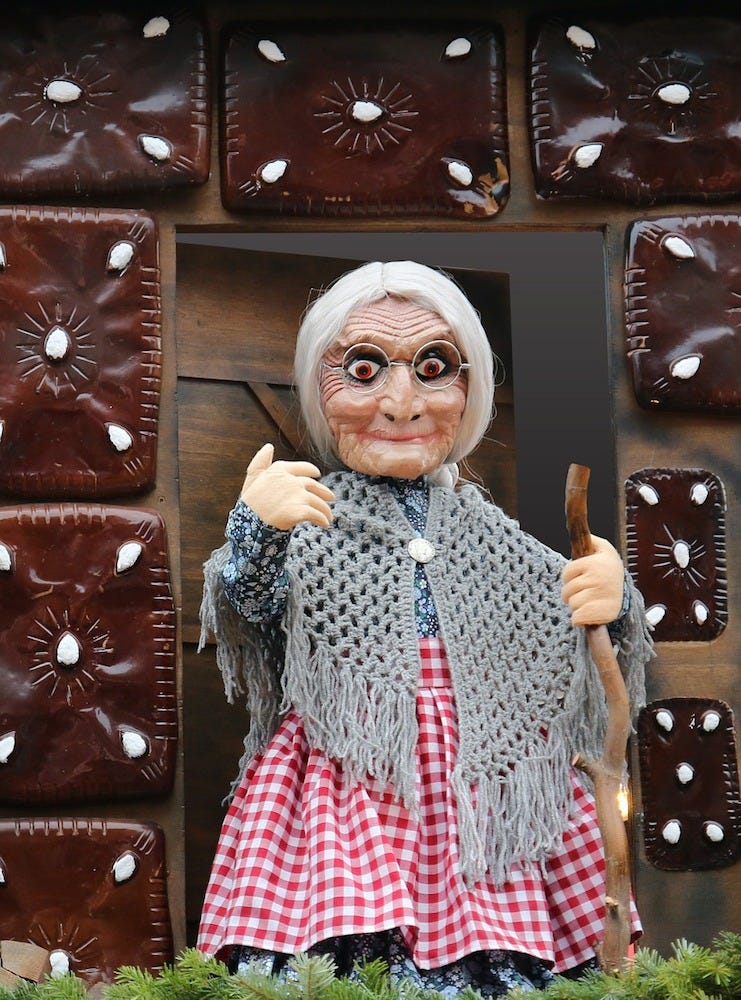
My sister was always eccentric. She was precisely the sort of old woman who’d go out into the woods and build a house made of gingerbread and candy.
And then she left the damn thing to me when she died.
I had no idea what happened to her; I learned via a message from the mayor that there had been a terrible accident, that she had been cremated, and that her absurd house was now mine.
Who would want such an impractical thing? If ants and mice didn’t nibble it to pieces, surely one good rain would reduce the entire construction to a pile of sugary sludge. My sister was a witch, and quite a good one, but she could hardly hold back all of nature. I had long ago ceased practicing the craft, myself; I had no intention of picking it back up just to keep a house of cookies and frosting standing.
The house was quite lovely in its own way; I’ll give her that much. The gingerbread gave off an intoxicating spicy smell. She’d decorated the outer walls with an array of candies in all hues of the rainbow.
But as I’d feared, the house was slowly being destroyed by the creatures in the woods. Pieces of candy were gone from the sides of the house. The mice that nibbled holes in the gingerbread were getting so fat that they could barely run when I chased them off.
In the bedroom I found an unsent letter addressed to “My Dear Sister Marlene.” As I read it, my blood chilled. I finally understood that before her death, my sister had taken leave of whatever senses she once possessed.
She explained that despite what I’d said to her, her house was very practical, thank you, because children who got lost in the woods would find the house and begin eating away at it, and before long they’d be nice and fat — and a good-sized child would provide meat for months if prepared properly and stored in the house’s cellar.
The thought of it nauseated me. What on earth had come over my sister, to even suggest such a thing? The arts we had practiced were never so dark.
After reading that, I sealed the doorway to the cellar shut, as I had no desire to see what might be down there. Now I felt as if I were living in a sugary mausoleum. I needed a new place to live, but times were very hard and I had little money.
I had no options until the day the children showed up.
One afternoon I was dozing on the sofa, which was plain old wood and cloth. My sister’s eccentricities hadn’t extended to sleeping on a bed of, say, gumdrops and marshmallows. The sounds of something picking my house apart startled me awake. I hauled myself off the sofa, grabbed a broom, and opened the door, ready to swing at whatever animal was out there.
A boy and a girl, their mouths overflowing with gingerbread and smeared with chocolate, looked at me with terror-stricken eyes. These children were so thin that even with their bellies bloated from candy, there’d barely be enough meat on them to feed the wolves that roamed the woods. The girl’s red hair was snarled, and the blond boy was deathly pale.
The boy stammered as he spoke to me.
“We’re so sorry, ma’am. It’s just that we’ve been lost in the woods for days, and we’re so hungry.”
I had never been especially fond of children, but these two looked pitiable.
“Well, come in then, and get some proper food.” There wasn’t much proper food to offer but I had bean stew and bread, which the children fell upon quite enthusiastically.
“What are your names?” I asked them.
“He’s Leo and I’m Katrina.”
“And how came you to be lost in the woods?”
The children looked at each other and burst into tears.
“Stop the sniveling. I might be able to help you get home if I know what happened,” I snapped.
Katrina finally composed herself enough to speak.
“Our family was going very hungry, and our parents took us to the woods and then abandoned us.”
I spat out a mouthful of tea at the girl’s words. “Have your parents no backbones? No heart?”
“They believed someone would take us in, ma’am.” Leo stared down at his hands, looking as if he were the one who’d done something wrong.
I didn’t know what to say to that. I could barely take care of myself these days, and dreaded the idea of looking after two children in a gingerbread house that was deteriorating by the day. But then something occurred to me.
“You may stay with me if you help me tomorrow.”
“Help with what?” Katrina asked.
“I cannot stay in this house much longer,” I said. “Winter is coming, and this place will not withstand the elements. Help me to build a new house, and we will all live there together.”
Leo frowned. “Why would you build a giant gingerbread house, if you didn’t want to live in it?”
“I didn’t. It was my sister’s.”
“Why did she build a giant gingerbread house?” said Katrina.
I scowled. “Because she was weird. Enough questions.”
The next day, we split logs and sawed and hammered, and did so every day until I had a proper house made of wood. It took a while; the children weren’t terribly strong and I was old and slow. At night we shared what little food I had left and huddled together in my sister’s bed for warmth. The new house was finished just in time for winter.
When we all stood inside the finished cottage for the first time, Katrina looked up at me.
“Granny?”
“I am not your grandmother,” I said.
“But you’re as close as we have to it,” Leo said.
I sighed. “Fine. What is it?”
“May we eat the rest of the old house?”
I thought about it for a moment.
“I don’t see why not. Might as well save whatever’s still edible. But stay out of the cellar.”
“Why?”
“Because I worry about what my sister might have been doing down there. Best to leave it be.”
And the next day we had a wonderful time taking the huge gingerbread house apart. I began to feel lighter and freer as I sawed the walls apart, and the children pulled the candies off, laughing.
When the old house had been torn down to its gingerbread floor, the three of us shoveled dirt over it until it was completely covered. And then, out of the children’s sight, I whispered an incantation I remembered from my days of witchcraft, words to comfort the dead and help them rest in peace.
And then Katrina let out a shriek.
“Granny! Look!”
Leo and I hurried over. Katrina pointed to the contents of an enormous chocolate egg she had pulled from a wall and cracked open. Gold coins, more than I had ever seen in my life, spilled out onto the ground, along with precious gems.
I fainted dead away.
I assumed that the children would become bored with a strange old woman and leave me to find their parents, but they did not. Although I could have bought a much finer place with the treasure my sister had concealed, I elected to stay in the cottage we had built, and Leo and Katrina remained with me. In spite of myself I had grown fond of them, and so made no effort to get them to leave.
Several years after they first came to the gingerbread house, Katrina arrived home from town one day carrying several packages. It was almost Christmas, and although she was practically a young woman now, she had yet to lose her childlike excitement about the season.
“I’ve got an activity for us!” she cried.
The boxes contained slabs of gingerbread that could be glued together with frosting and decorated with candies and icing to make miniature houses.
“The baker was selling them,” she said. “They remind me of your old house, Granny.”
And so I poured us wine as we gathered around the kitchen table and assembled the houses. The gingerbread filled the room with a spicy cinnamon scent that made me think of my sister’s house. Our hands grew sticky with frosting and candy, and the house Katrina made looked unsettlingly like the one I had once lived in.
Leo had been rather quiet all day. Perhaps it was the wine that finally made him speak up.
“I heard the strangest story in the tavern yesterday, Granny.”
“Oh?”
He cleared his throat. “Fellow by the name of Hansel started talking to the innkeeper. Said that his father abandoned him and his sister in these woods many years back, and they came across a giant house made of gingerbread and candy. A witch trapped them inside to fatten them up and then eat them. His sister Gretel managed to shove the old witch into her own oven and roast her to death.”
“Leo!” Katrina dropped a peppermint and glared at him. “What a ghastly story.”
“Do you know anything about that, Granny?” Leo didn’t sound as if he was accusing me of anything. Not exactly.
I turned around and stared at my oven, which I had taken from my sister’s house.
“I know that tomorrow, I am getting a new oven. My god. All the food I’ve cooked in that thing, and someone died in it?” I shuddered.
“Granny?” Now Katrina eyed me a bit nervously.
“That woman was my sister. As I told you before, the house passed to me after her death. I had nothing to do with whatever she got up to when she lived there, and I never knew how she died. Until now.”
We sat and sipped our wine for a moment.
“I suppose we’re fortunate that we weren’t abandoned in the woods while she still lived,” Katrina said finally.
At that, I had to ask something that had puzzled me for quite a while.
“Did you never want to go back to your parents?”
They looked at each other. “We talked about it,” Katrina said, sounding slightly guilty.
“But we were afraid to,” Leo said. “If things went bad again, we feared they’d do the same thing to us. Or worse.”
“You shared what little you had with us,” Katrina said. “We trusted that you would never abandon us should times grow hard.”
We finished constructing our gingerbread houses in a pleasant silence, and when we were satisfied with them, Katrina arranged them carefully in the center of the table.
As we stood together admiring our creations, I mused that my sister had done one thing right at the end. She’d died and left me her house, and that monstrosity had brought me and the children something we had never known we needed: Each other.
“Merry Christmas, children,” I said, squeezing their sticky hands.